
Apr 27, 2010
MRT network driving up land value
By Dickson Li
THE opening of new MRT stations has pushed up property prices across the island and made it hard for developers to find land at viable prices.
Wing Tai Asia property director Chng Chee Beow told a discussion yesterday: 'The transportation networking makes things much closer and that brings up property prices.
'The biggest headache facing developers now is this: How can you find land with a reasonable price, so that the final cost of the product is reasonable?'
The panel discussion was held as part of the graduation ceremony for students in the Singapore Management University (SMU)-Building and Construction Authority advanced management programme.
The three-month course is for professionals in the building industry.
Analysts at the event, which was held at SMU, believe that property prices still have some room to move.
'With 700 sq km of land, and five million people, (prices) can only go one way - up,' said CIMB-GK Research economist Song Seng Woon.
'Opportunities are opening up in Singapore - when we see residential properties popping up, we see businesses setting up shop too. For instance, we are now seeing stronger pick-up in office rental so, all in all, this will support the residential market as well.'
Keppel Land, for instance, still has most of its assets in Singapore because the value of its assets here is 'very high', even though it wants overseas earnings to hit 50 per cent of the total, said chief executive Kevin Wong yesterday.
'We have been investing in office buildings... Marina Bay Financial Centre is a good example,' he added.
'Other than China, we're quite big in Vietnam and we're looking very carefully at Indonesia, where we have quite a significant exposure.'
Mr Song also points to the larger growth story in the region to explain his optimism about property values.
The price rises are a 'combination of not just local buying, but also because we've seen growth around the region and we get more buyers coming in from Hong Kong and mainland China', he said.
Low interest rates have fuelled the boom in property markets across the region, and 'property is one asset that you can leverage up on', he says.
The threat of central banks starting to roll back on monetary stimulus by raising interest rates does not worry Mr Song.
'Even if rates go up, it's going to be in environment where there's growth opportunity and momentum. So any tightening at this point will be accompanied by strong growth,' he said.

Tuesday, April 27, 2010
ST : Govt proposes changes to en bloc sale rules
Apr 27, 2010
parliament
Govt proposes changes to en bloc sale rules
By Joyce Teo
COLLECTIVE property sales will be streamlined under proposed changes unveiled in Parliament yesterday, in the wake of a number of highly contentious drawn-out legal disputes.
At the same time, new checks and balances will be added into the legislation to ensure that the process is fair, and that unwilling sellers are not unduly harassed.
The Government proposes that if one attempt at an en bloc sale fails, then a two-year restricted period will apply, during which it will be far tougher to try again.
This is meant to discourage repeated attempts to sell when there is insufficient support among owners.
The proposals also aim to strip out some of the potentially time-wasting legal hurdles that may impede a sale.
Some recent attempted en bloc sales, such as Horizon Towers and Gillman Heights, have become bogged down in acrimonious disputes that have dragged on for some two years or more.
To speed up the process, the Strata Titles Board (STB) will be stripped of its role of making rulings in disputed cases.
The STB will continue its mediation role, but this will be limited to 60 days, again to expedite the resolution of disputes over contentious sales.
In other words, warring parties can head to the High Court earlier in the process to have their disputes resolved.
This will help reduce costs and time taken in resolving the more contentious cases, said the Law Ministry.
Government data shows that from 2006 to now, about 10 per cent of the 124 en bloc sale applications that went to the STB ended up in the High Court.
All these proposed changes were introduced in a Bill in Parliament yesterday, following feedback the Ministry of Law received on the Land Titles (Strata) Act.
The latest major overhaul of collective sale rules, aimed at achieving greater transparency, took effect in 2007.
Some of the recent en bloc sale disputes have centred on the role and motives of sales committee members.
The Government proposes that committee members be subject to stricter disclosure requirements. They will have to declare the extent to which they, their immediate family members and related firms have interests in the strata development and the date of purchase of the units.
This, said the Law Ministry, will allow owners to make a more informed choice on who they want to elect.
The proposals also aim to streamline the en bloc sale process at the stage of holding extraordinary general meetings (EGMs) of owners.
The Government proposes doing away with some EGM requirements, which industry experts applaud as a practical move. For instance, EGMs will not have to be called to update owners on consent levels, sales proposals, bid amounts received, or the terms and conditions of the sale and purchase agreement (when the developer buys the site).
This information can be supplied at regular meetings, which are easier to call as no decision-making is required from owners on these matters.
EGMs would still be required to appoint lawyers, consultants, approve the apportionment method, and the terms and conditions of the collective sale agreement (when owners agree to sell).
The two-year restricted period addresses complaints of owners who say a small number of keen sellers can cause trouble by repeatedly trying to sell, thereby wasting management funds.
During these two years, the first retry to convene an EGM to reappoint a sales committee will require the agreement of 50 per cent of the owners, up from the usual level of 20 per cent by share value or 25 per cent by the total number of owners.
Any subsequent attempts to convene EGMs within this period will need 80 per cent. If there is another failed attempt, the stricter rules will apply for another two years.
One critic of this proposal is Credo Real Estate managing director Karamjit Singh, who said this is 'a hindrance to majority owners seeking to reinitiate a sale in a booming market, as they may miss the sale opportunity'.
Said law firm Rodyk & Davidson partner Norman Ho: 'The changes tidy up the whole process. Frivolous cases where people try and try can be avoided, and EGMs can be cut down from at least four currently to two, making the process easier to handle.'
These proposed changes are expected to take effect in June this year.
parliament
Govt proposes changes to en bloc sale rules
By Joyce Teo
COLLECTIVE property sales will be streamlined under proposed changes unveiled in Parliament yesterday, in the wake of a number of highly contentious drawn-out legal disputes.
At the same time, new checks and balances will be added into the legislation to ensure that the process is fair, and that unwilling sellers are not unduly harassed.
The Government proposes that if one attempt at an en bloc sale fails, then a two-year restricted period will apply, during which it will be far tougher to try again.
This is meant to discourage repeated attempts to sell when there is insufficient support among owners.
The proposals also aim to strip out some of the potentially time-wasting legal hurdles that may impede a sale.
Some recent attempted en bloc sales, such as Horizon Towers and Gillman Heights, have become bogged down in acrimonious disputes that have dragged on for some two years or more.
To speed up the process, the Strata Titles Board (STB) will be stripped of its role of making rulings in disputed cases.
The STB will continue its mediation role, but this will be limited to 60 days, again to expedite the resolution of disputes over contentious sales.
In other words, warring parties can head to the High Court earlier in the process to have their disputes resolved.
This will help reduce costs and time taken in resolving the more contentious cases, said the Law Ministry.
Government data shows that from 2006 to now, about 10 per cent of the 124 en bloc sale applications that went to the STB ended up in the High Court.
All these proposed changes were introduced in a Bill in Parliament yesterday, following feedback the Ministry of Law received on the Land Titles (Strata) Act.
The latest major overhaul of collective sale rules, aimed at achieving greater transparency, took effect in 2007.
Some of the recent en bloc sale disputes have centred on the role and motives of sales committee members.
The Government proposes that committee members be subject to stricter disclosure requirements. They will have to declare the extent to which they, their immediate family members and related firms have interests in the strata development and the date of purchase of the units.
This, said the Law Ministry, will allow owners to make a more informed choice on who they want to elect.
The proposals also aim to streamline the en bloc sale process at the stage of holding extraordinary general meetings (EGMs) of owners.
The Government proposes doing away with some EGM requirements, which industry experts applaud as a practical move. For instance, EGMs will not have to be called to update owners on consent levels, sales proposals, bid amounts received, or the terms and conditions of the sale and purchase agreement (when the developer buys the site).
This information can be supplied at regular meetings, which are easier to call as no decision-making is required from owners on these matters.
EGMs would still be required to appoint lawyers, consultants, approve the apportionment method, and the terms and conditions of the collective sale agreement (when owners agree to sell).
The two-year restricted period addresses complaints of owners who say a small number of keen sellers can cause trouble by repeatedly trying to sell, thereby wasting management funds.
During these two years, the first retry to convene an EGM to reappoint a sales committee will require the agreement of 50 per cent of the owners, up from the usual level of 20 per cent by share value or 25 per cent by the total number of owners.
Any subsequent attempts to convene EGMs within this period will need 80 per cent. If there is another failed attempt, the stricter rules will apply for another two years.
One critic of this proposal is Credo Real Estate managing director Karamjit Singh, who said this is 'a hindrance to majority owners seeking to reinitiate a sale in a booming market, as they may miss the sale opportunity'.
Said law firm Rodyk & Davidson partner Norman Ho: 'The changes tidy up the whole process. Frivolous cases where people try and try can be avoided, and EGMs can be cut down from at least four currently to two, making the process easier to handle.'
These proposed changes are expected to take effect in June this year.
ST : Up to market to set prices of resale flats
Apr 27, 2010
parliament
Up to market to set prices of resale flats
By Esther Teo
NATIONAL Development Minister Mah Bow Tan said the Government has no intention of trying to fine-tune HDB policy for first-time buyers, preferring to leave it to the market.
His comments to Parliament yesterday also included the release of sales figures for the past two years that give a snapshot of how the markets for new and resale flats are faring.
He told MPs that about 8,000 first-time buyers bought resale HDB flats in each of the past two calendar years. This is out of about an average of 18,000 flats sold in each of those years.
Of the resale buyers, at least 6,800 had a monthly household income of less than $8,000, meaning they qualified for the CPF housing grant.
The new/resale ratio has fluctuated over the years. When resale prices were lower, such flats comprised as much as 70 per cent of total sales, but the proportion is coming down now as resale prices head north, he said.
Mr Mah was responding to a question from MP Lim Wee Kiak (Sembawang GRC), who asked if the Government will take steps to encourage more first-time resale buyers to allow for 'the renewing of estates'.
Dr Lim also asked if the Government would consider increasing the CPF housing grant or introducing another form of financing for the cash-over-valuation (COV) as a way of increasing the incentive for buying a resale flat.
Mr Mah reiterated that as the Government did not have a particular view on the new/resale ratio, there was no need to introduce incentives.
'The most important point is whether we have enough flats overall for first-timers to purchase, whether new or resale... I don't think we want to skew the decision either way; we will let the market take care of it.'
While build-to-order flats were priced lower due to subsidies, they required a longer waiting time and were mostly in non-mature estates, which might not suit some buyers, he said.
The minister also addressed MP Ho Geok Choo's (West Coast GRC) suggestion that the valuation process be reviewed to address high COVs.
Mr Mah said: 'The resale flat prices must be set by the market and the COV is part and parcel of the resale flat price.'
He added that there was nothing unusual about having a COV in the HDB resale market. 'Just last year, we had COVs which were either zero or negative, which reflected the market situation at that time. I dare say that as the market cools down and as supply catches up with demand, the COV prices will start to moderate as well.'
parliament
Up to market to set prices of resale flats
By Esther Teo
NATIONAL Development Minister Mah Bow Tan said the Government has no intention of trying to fine-tune HDB policy for first-time buyers, preferring to leave it to the market.
His comments to Parliament yesterday also included the release of sales figures for the past two years that give a snapshot of how the markets for new and resale flats are faring.
He told MPs that about 8,000 first-time buyers bought resale HDB flats in each of the past two calendar years. This is out of about an average of 18,000 flats sold in each of those years.
Of the resale buyers, at least 6,800 had a monthly household income of less than $8,000, meaning they qualified for the CPF housing grant.
The new/resale ratio has fluctuated over the years. When resale prices were lower, such flats comprised as much as 70 per cent of total sales, but the proportion is coming down now as resale prices head north, he said.
Mr Mah was responding to a question from MP Lim Wee Kiak (Sembawang GRC), who asked if the Government will take steps to encourage more first-time resale buyers to allow for 'the renewing of estates'.
Dr Lim also asked if the Government would consider increasing the CPF housing grant or introducing another form of financing for the cash-over-valuation (COV) as a way of increasing the incentive for buying a resale flat.
Mr Mah reiterated that as the Government did not have a particular view on the new/resale ratio, there was no need to introduce incentives.
'The most important point is whether we have enough flats overall for first-timers to purchase, whether new or resale... I don't think we want to skew the decision either way; we will let the market take care of it.'
While build-to-order flats were priced lower due to subsidies, they required a longer waiting time and were mostly in non-mature estates, which might not suit some buyers, he said.
The minister also addressed MP Ho Geok Choo's (West Coast GRC) suggestion that the valuation process be reviewed to address high COVs.
Mr Mah said: 'The resale flat prices must be set by the market and the COV is part and parcel of the resale flat price.'
He added that there was nothing unusual about having a COV in the HDB resale market. 'Just last year, we had COVs which were either zero or negative, which reflected the market situation at that time. I dare say that as the market cools down and as supply catches up with demand, the COV prices will start to moderate as well.'
ST : New HDB flats still affordable: Mah
Apr 27, 2010
parliament
New HDB flats still affordable: Mah
Prices within the means of the various income groups
By Sue-Ann Chia
THE hot issue of high property prices received another airing in Parliament yesterday, with the Government releasing fresh figures to show new flats are affordable to all first-time buyers.
In giving the numbers, National Development Minister Mah Bow Tan also addressed the issue of how findings can change when different base years are used to look at the HDB resale price index and household incomes.
He was replying to Mr Lim Biow Chuan (Marine Parade GRC) who had asked for housing affordability data based on how the median household income has risen in comparison to the HDB resale price index. Mr Lim also wanted to know if resale prices had risen faster than the growth of median household income in the last decade when different base years are used.
The issue of the relative pace of price and income increases first came under scrutiny early this month when Mr Mah released the two sets of figures in a Straits Times interview.
They showed that HDB home prices are not beyond reach. This is because the resale price index has risen by an average of 3.2 per cent annually from 1999 to last year, lower than the 3.9 per cent increase in median household income.
But opposition Reform Party member Hazel Poa later wrote in a blog post that the results would be different if the base year is changed from 1999, to say 2001 or 2006.
Mr Mah did not refer to Ms Poa, but said in his reply to Mr Lim: 'It is possible that prices of resale flats have risen faster than incomes when indexed against different years.'
Using more recent years like 2004 to index the growth, he said the an-nual growth in the resale price index exceeded income growth, owing to strong demand and the quick economic recovery (see chart).
But he also pointed out that if 1995 was used as the base year, it would yield a different result as resale flat prices rose by 2.8 per cent, lower than income growth of 3.2 per cent.
'Ultimately, what matters is whether at all times, first-time home buyers are able to afford HDB flats,' he said.
To that, the answer is 'yes', he said, as the Government has done two things to ensure new flats are not priced out of reach. One, new flats of different sizes and in different locations for different income groups are always available. Two, setting these flat prices so that they are well within the means of buyers in various income ceiling groups.
Elaborating on how new flats are affordable, he referred to a formula called the debt service ratio (DSR). It compares the monthly mortgage instalment to the monthly household income. The average DSR for new flats launched in the last six months when property prices surged ranged from 17 per cent to 25 per cent (see table). This applies to new flats in non-mature estates. For those in more central locations and mature estates, the DSR is around 30 per cent.
These figures are within the international benchmark for housing affordability, which ranges from 30 per cent to 35 per cent, he said.
But Nominated MP Paulin Straughan pointed out that the majority of flat owners seem to be using most of their Central Provident Fund (CPF) savings to pay for their home loans, with those living in three- and four-room flats having to top them up with cash. Will this lead to insufficient retirement savings, she asked.
Mr Mah said: 'I have to emphasise that buying an HDB flat is not an expenditure, it is an investment...because when you buy an HDB flat, at the end of the tenure of the flat or towards your retirement, that HDB flat is a very significant store of value.'
Citing a Department of Statistics survey, he said on average a Singaporean family has more than $100,000 in asset value in their flat. If that asset is monetised, they need not fear using up their CPF savings to pay for it.
'This is another vindication of our home ownership policy because if we were to use that same amount of money - 25 per cent of income - to rent rather than to buy a place, then at the end of 20 or 30 years, you will not be having this asset which you can use for retirement income,' said Mr Mah.
On whether the $8,000 household income ceiling for new flat buyers will be raised, he said the answer is still 'no'.
'We've a finite housing budget... and at the household income ceiling of $8,000 today, we're actually subsidising about 80 per cent of the population,' he said.
sueann@sph.com.sg
parliament
New HDB flats still affordable: Mah
Prices within the means of the various income groups
By Sue-Ann Chia
THE hot issue of high property prices received another airing in Parliament yesterday, with the Government releasing fresh figures to show new flats are affordable to all first-time buyers.
In giving the numbers, National Development Minister Mah Bow Tan also addressed the issue of how findings can change when different base years are used to look at the HDB resale price index and household incomes.
He was replying to Mr Lim Biow Chuan (Marine Parade GRC) who had asked for housing affordability data based on how the median household income has risen in comparison to the HDB resale price index. Mr Lim also wanted to know if resale prices had risen faster than the growth of median household income in the last decade when different base years are used.
The issue of the relative pace of price and income increases first came under scrutiny early this month when Mr Mah released the two sets of figures in a Straits Times interview.
They showed that HDB home prices are not beyond reach. This is because the resale price index has risen by an average of 3.2 per cent annually from 1999 to last year, lower than the 3.9 per cent increase in median household income.
But opposition Reform Party member Hazel Poa later wrote in a blog post that the results would be different if the base year is changed from 1999, to say 2001 or 2006.
Mr Mah did not refer to Ms Poa, but said in his reply to Mr Lim: 'It is possible that prices of resale flats have risen faster than incomes when indexed against different years.'
Using more recent years like 2004 to index the growth, he said the an-nual growth in the resale price index exceeded income growth, owing to strong demand and the quick economic recovery (see chart).
But he also pointed out that if 1995 was used as the base year, it would yield a different result as resale flat prices rose by 2.8 per cent, lower than income growth of 3.2 per cent.
'Ultimately, what matters is whether at all times, first-time home buyers are able to afford HDB flats,' he said.
To that, the answer is 'yes', he said, as the Government has done two things to ensure new flats are not priced out of reach. One, new flats of different sizes and in different locations for different income groups are always available. Two, setting these flat prices so that they are well within the means of buyers in various income ceiling groups.
Elaborating on how new flats are affordable, he referred to a formula called the debt service ratio (DSR). It compares the monthly mortgage instalment to the monthly household income. The average DSR for new flats launched in the last six months when property prices surged ranged from 17 per cent to 25 per cent (see table). This applies to new flats in non-mature estates. For those in more central locations and mature estates, the DSR is around 30 per cent.
These figures are within the international benchmark for housing affordability, which ranges from 30 per cent to 35 per cent, he said.
But Nominated MP Paulin Straughan pointed out that the majority of flat owners seem to be using most of their Central Provident Fund (CPF) savings to pay for their home loans, with those living in three- and four-room flats having to top them up with cash. Will this lead to insufficient retirement savings, she asked.
Mr Mah said: 'I have to emphasise that buying an HDB flat is not an expenditure, it is an investment...because when you buy an HDB flat, at the end of the tenure of the flat or towards your retirement, that HDB flat is a very significant store of value.'
Citing a Department of Statistics survey, he said on average a Singaporean family has more than $100,000 in asset value in their flat. If that asset is monetised, they need not fear using up their CPF savings to pay for it.
'This is another vindication of our home ownership policy because if we were to use that same amount of money - 25 per cent of income - to rent rather than to buy a place, then at the end of 20 or 30 years, you will not be having this asset which you can use for retirement income,' said Mr Mah.
On whether the $8,000 household income ceiling for new flat buyers will be raised, he said the answer is still 'no'.
'We've a finite housing budget... and at the household income ceiling of $8,000 today, we're actually subsidising about 80 per cent of the population,' he said.
sueann@sph.com.sg
ST : China mulls over tax on residential property
Apr 27, 2010
China mulls over tax on residential property
BEIJING: China is likely to introduce a property tax on residential housing in the first half of the year as part of its attempts to curb spiralling real estate prices, state media reported yesterday.
Such a move would mark a significant escalation of its struggle to cool down a booming property market now widely described as a bubble, the Wall Street Journal said.
The levy would be imposed on a trial basis in Beijing, Shanghai, Chongqing and Shenzhen, the Economic Observer newspaper said, citing sources.
Government agencies including the central bank, the Finance Ministry and the State Administration of Taxation are working out when to implement the tax, it said.
China currently has no such levy on residential property. It does impose a 1.2 per cent tax on 70 per cent to 90 per cent of the value of commercial real estate.
Details of the new tax were not yet finalised, the report said, such as whether it would be levied against all homes or merely on additional residences purchased by an individual home buyer beyond the first property.
The report came after Beijing recently announced a range of new measures to prevent the growth of asset bubbles and soaring property prices.
Official data showed real estate prices in 70 cities jumped 11.7 per cent last month, the fastest year-on-year rise for a single month in five years.
Beijing recently tightened curbs on advance sales of new projects, introduced new restrictions on loans for third-home purchases, and raised minimum down payments for second homes.
State media reports last week said banking regulators had ordered lenders to conduct quarterly stress tests on mortgages as the government tries to clamp down on bad loans and rein in speculation.
How the authorities handle any property tax will have significant implications for China's economy, and will ripple through global markets, the Journal said in its report yesterday.
It added that the construction boom is the main driver of the recovery in China and underpins the country's demand for raw materials, which has helped support global prices for commodities such as copper and iron ore.
Opponents fear new taxes would shatter confidence in the real estate market, leading to a bust that would damage the entire economy, it said.
AGENCE FRANCE-PRESSE
With additional information from the Wall Street Journal
China mulls over tax on residential property
BEIJING: China is likely to introduce a property tax on residential housing in the first half of the year as part of its attempts to curb spiralling real estate prices, state media reported yesterday.
Such a move would mark a significant escalation of its struggle to cool down a booming property market now widely described as a bubble, the Wall Street Journal said.
The levy would be imposed on a trial basis in Beijing, Shanghai, Chongqing and Shenzhen, the Economic Observer newspaper said, citing sources.
Government agencies including the central bank, the Finance Ministry and the State Administration of Taxation are working out when to implement the tax, it said.
China currently has no such levy on residential property. It does impose a 1.2 per cent tax on 70 per cent to 90 per cent of the value of commercial real estate.
Details of the new tax were not yet finalised, the report said, such as whether it would be levied against all homes or merely on additional residences purchased by an individual home buyer beyond the first property.
The report came after Beijing recently announced a range of new measures to prevent the growth of asset bubbles and soaring property prices.
Official data showed real estate prices in 70 cities jumped 11.7 per cent last month, the fastest year-on-year rise for a single month in five years.
Beijing recently tightened curbs on advance sales of new projects, introduced new restrictions on loans for third-home purchases, and raised minimum down payments for second homes.
State media reports last week said banking regulators had ordered lenders to conduct quarterly stress tests on mortgages as the government tries to clamp down on bad loans and rein in speculation.
How the authorities handle any property tax will have significant implications for China's economy, and will ripple through global markets, the Journal said in its report yesterday.
It added that the construction boom is the main driver of the recovery in China and underpins the country's demand for raw materials, which has helped support global prices for commodities such as copper and iron ore.
Opponents fear new taxes would shatter confidence in the real estate market, leading to a bust that would damage the entire economy, it said.
AGENCE FRANCE-PRESSE
With additional information from the Wall Street Journal
BT : Property financing tightened up a notch
Business Times - 27 Apr 2010
Property financing tightened up a notch
(HONG KONG) China has tightened real-estate financing by requiring developers to submit fund-raising plans for review, stepping up efforts to prevent a bubble even as the central bank pledged to maintain an 'easy' monetary policy.
The China Securities Regulatory Commission has sent financing requests from 41 companies to the Ministry of Land and Resources for reviews of land-use compliance, according to a statement posted on a government website on April 24.
Central bank governor Zhou Xiaochuan said in a statement at an International Monetary Fund meeting in Washington the same day that China will keep its 'relatively easy' monetary policy.
The two statements reflect policy makers' aim of both damping a surge in domestic property prices and sustaining an economic rebound amid uncertainty about the strength of a global recovery. The latest move adds to curbs on loans for third-home purchases, increased downpayment requirements and higher mortgage rates announced this month.
'The government only wants to curtail the excessive gains in some areas,' Li Daokui, an adviser to the central bank, said last week. 'Measures to increase home supply will follow.'
Any declines in property prices would add to a slump in equities in hurting returns on savings. China's one-year bank deposit rate has also fallen below the pace of inflation, eroding households' purchasing power.
The real-estate 'crackdown' will spur 'large pools of funds to enter the stock market', analysts led by Yu Jun at Beijing-based Citic Securities Co, China's largest brokerage, said in a report. An estimated 400 billion yuan (S$80.1 billion) may flow out of property into equities, with consumer-related shares with small capitalisations among those benefiting, Citic says.
Property prices in 70 cities went up by 11.7 per cent in March, the most since comparable records began in 2005, and China's economy expanded 11.9 per cent from a year earlier in the first quarter, suggesting tighter policies are needed.
Chinese banks lent a record 9.6 trillion yuan last year, and introduced a four trillion yuan stimulus package, to bolster growth through the global financial crisis. Officials remain unconvinced that the sustainability of the world economic recovery is assured.
'The outlook for the global economy faces many uncertainties,' Mr Zhou said in his statement. 'We will continue to implement a proactive fiscal policy and a relatively easy monetary policy, and will continuously improve the policy package to respond to the international financial crisis to maintain good momentum of the economic recovery.'
China's equities have fallen this year because of concern ending government stimulus along with measures to curb inflation will hurt economic growth.
The Shanghai Composite index is down 9 per cent in 2010, the world's eighth-worst performer. A gauge of property stocks in Shanghai has declined by more than 18 per cent.
Companies planning to invest in real estate through equity financing are subject to the reviews.
Companies with real-estate business that are planning to pay back bank loans or boosting operating capital are also required to submit equity financing plans to the ministry, China's securities regulator said.
The ministry will provide official comment on the companies' financing plans to the stock regulator after reviewing whether land purchases were made legally, according to the statement. It will also review whether there are cases of real estate being left idle and changes in the use of properties.
Developing nations with faster growth rates need to maintain 'good recovery momentum while also preventing the accumulation of asset bubbles, requiring the timely consideration of an exit from stimulus policies', Mr Zhou said.
China will continue with 'stable and relatively rapid' growth this year, while balancing 'inflation expectations', Mr Zhou said. The central government projects gross domestic product growth of about 8 per cent and an inflation rate of 3 per cent this year, the statement said.
People's Bank of China deputy governor Yi Gang said on April 24 that China should take 'early signs of inflation seriously' amid 'robust' economic growth.
China's policy makers raised the bank reserve ratio twice this year to contain inflation and slow loan growth. To cool the housing market, China on April 20 ordered developers not to take deposits for sales of uncompleted flats. -- Bloomberg
Copyright © 2010 Singapore Press Holdings Ltd. All rights reserved.
Property financing tightened up a notch
(HONG KONG) China has tightened real-estate financing by requiring developers to submit fund-raising plans for review, stepping up efforts to prevent a bubble even as the central bank pledged to maintain an 'easy' monetary policy.
The China Securities Regulatory Commission has sent financing requests from 41 companies to the Ministry of Land and Resources for reviews of land-use compliance, according to a statement posted on a government website on April 24.
Central bank governor Zhou Xiaochuan said in a statement at an International Monetary Fund meeting in Washington the same day that China will keep its 'relatively easy' monetary policy.
The two statements reflect policy makers' aim of both damping a surge in domestic property prices and sustaining an economic rebound amid uncertainty about the strength of a global recovery. The latest move adds to curbs on loans for third-home purchases, increased downpayment requirements and higher mortgage rates announced this month.
'The government only wants to curtail the excessive gains in some areas,' Li Daokui, an adviser to the central bank, said last week. 'Measures to increase home supply will follow.'
Any declines in property prices would add to a slump in equities in hurting returns on savings. China's one-year bank deposit rate has also fallen below the pace of inflation, eroding households' purchasing power.
The real-estate 'crackdown' will spur 'large pools of funds to enter the stock market', analysts led by Yu Jun at Beijing-based Citic Securities Co, China's largest brokerage, said in a report. An estimated 400 billion yuan (S$80.1 billion) may flow out of property into equities, with consumer-related shares with small capitalisations among those benefiting, Citic says.
Property prices in 70 cities went up by 11.7 per cent in March, the most since comparable records began in 2005, and China's economy expanded 11.9 per cent from a year earlier in the first quarter, suggesting tighter policies are needed.
Chinese banks lent a record 9.6 trillion yuan last year, and introduced a four trillion yuan stimulus package, to bolster growth through the global financial crisis. Officials remain unconvinced that the sustainability of the world economic recovery is assured.
'The outlook for the global economy faces many uncertainties,' Mr Zhou said in his statement. 'We will continue to implement a proactive fiscal policy and a relatively easy monetary policy, and will continuously improve the policy package to respond to the international financial crisis to maintain good momentum of the economic recovery.'
China's equities have fallen this year because of concern ending government stimulus along with measures to curb inflation will hurt economic growth.
The Shanghai Composite index is down 9 per cent in 2010, the world's eighth-worst performer. A gauge of property stocks in Shanghai has declined by more than 18 per cent.
Companies planning to invest in real estate through equity financing are subject to the reviews.
Companies with real-estate business that are planning to pay back bank loans or boosting operating capital are also required to submit equity financing plans to the ministry, China's securities regulator said.
The ministry will provide official comment on the companies' financing plans to the stock regulator after reviewing whether land purchases were made legally, according to the statement. It will also review whether there are cases of real estate being left idle and changes in the use of properties.
Developing nations with faster growth rates need to maintain 'good recovery momentum while also preventing the accumulation of asset bubbles, requiring the timely consideration of an exit from stimulus policies', Mr Zhou said.
China will continue with 'stable and relatively rapid' growth this year, while balancing 'inflation expectations', Mr Zhou said. The central government projects gross domestic product growth of about 8 per cent and an inflation rate of 3 per cent this year, the statement said.
People's Bank of China deputy governor Yi Gang said on April 24 that China should take 'early signs of inflation seriously' amid 'robust' economic growth.
China's policy makers raised the bank reserve ratio twice this year to contain inflation and slow loan growth. To cool the housing market, China on April 20 ordered developers not to take deposits for sales of uncompleted flats. -- Bloomberg
Copyright © 2010 Singapore Press Holdings Ltd. All rights reserved.
BT : The shoeshine boy's hottest tip: China property
Business Times - 27 Apr 2010
The shoeshine boy's hottest tip: China property
By ANDY XIE
'MY maid just asked for leave,' a friend in Beijing told me recently. 'She's rushing home to buy property. I suggested she borrow 70 per cent, so she could cap the loss.' It wasn't the first time I had heard such a story in China. Friends in Shanghai have told me similar ones. It seems all the housemaids are rushing into the market at the same time.
There are benefits to housekeeping for fund managers. China's housemaids may be Asia's answer to the shoeshine boy whose stock tips prompted Joseph Kennedy to sell his shares before the Wall Street Crash of 1929.
Another friend recently vacationed in the southern island-resort city of Sanya in Hainan province and felt compelled to visit a development sales office. Everyone she knew had bought there already. It's either buy or be unsocial. 'You should buy two,' the sharp sales girl suggested. 'In three years, the price will have doubled. You could sell one and get one free.' How could anyone resist an offer like that? The evidence in official-corruption cases no longer involves cash stashed in refrigerators or starlet mistresses in Versace. The evidence is now apartments. One mid-level official in Shanghai was caught with 24 of them.
First, let me make it perfectly clear that calling China's real-estate market a 'bubble' isn't denying China's development success. As optimism is an essential ingredient in a bubble, economic success is a necessary condition. Nor am I saying that prices will drop tomorrow. A bubble evolves and bursts in its own time. When it is about to burst, I'll let you know.
Expectations of a Chinese currency revaluation are, perhaps, the most important force inflating the bubble. First, it plays to latent human desire for a free lunch. You just need to exchange your money for yuan. According to all the experts on Wall Street, you can only gain. The money has been gushing into China.
Second, the revaluation story has kept Chinese money inside the country. The US dollar has always been the safe-haven asset for Chinese. This is why Chinese banks had a large dollar deposit base. Of course, anybody who was somebody had dollars offshore. Now all that money is back. More importantly, any income, legal or otherwise, now stays in China.
Why would corrupt officials keep apartments rather than cash? Well, according to Wall Street, the yuan is going to appreciate. So holding dollars is out of the question. And why hold Chinese cash when property prices are always going up? The corruption money can be turbocharged in the real-estate market. Only when they are caught do they understand the downside of holding fixed assets.
The massive liquidity waves have prompted Chinese banks to lend as much as possible. One Wall Street tradition adopted quickly in China was bonus recipients signing company cheques to themselves. All you need is to report eye-popping quarterly earnings. It is an easier game than on Wall Street: The Chinese government keeps the lending spread wide by fixing both the deposit and lending rates. You just have to lend. The earnings will follow. Might the loans turn bad in three years?
Well, I'm not going to give back my bonuses, right? For a bubble to last, you need a force to hold it together when it stumbles. Wall Street kept pumping out new natural or synthetic products to turn debt into demand for assets. Local governments play this role in China.
When it comes to interested parties, Chinese governments are knee-deep in the bubble. They get all the money from land sales. Land values have risen to half of the development cost. In hot spots, land costs more than the development - the governments want to collect the future price gain immediately.
When properties are sold, transaction and profit taxes kick in. Developers pay more levies to the governments than they earn. When developers finally book their earnings, they must put it to work, as good Wall Street analysts would recommend, so they buy land.
As land prices are much higher, their measly earnings aren't enough, so they have to borrow. The governments get all their earnings and debt repayments. Can you blame them for boosting the market whenever it slips? Land obsession is another force at work.
China was a rural economy not so long ago. The most important asset was always land. 'Be a government official and become rich' is a millennium-old Chinese saying. It didn't explain where the money went. It always went into agricultural land. In cities, you only see buildings, not paddy fields. But the buildings sit on land.
Now housemaids are in the market. Who else? Never underestimate 1.3 billion people. Welcome to China, the land of getting rich quick. -- Bloomberg
The writer is an independent economist based in Shanghai and was formerly Morgan Stanley's chief economist for the Asia-Pacific region. The opinions expressed are his own
Copyright © 2010 Singapore Press Holdings Ltd. All rights reserved.
The shoeshine boy's hottest tip: China property
By ANDY XIE
'MY maid just asked for leave,' a friend in Beijing told me recently. 'She's rushing home to buy property. I suggested she borrow 70 per cent, so she could cap the loss.' It wasn't the first time I had heard such a story in China. Friends in Shanghai have told me similar ones. It seems all the housemaids are rushing into the market at the same time.
There are benefits to housekeeping for fund managers. China's housemaids may be Asia's answer to the shoeshine boy whose stock tips prompted Joseph Kennedy to sell his shares before the Wall Street Crash of 1929.
Another friend recently vacationed in the southern island-resort city of Sanya in Hainan province and felt compelled to visit a development sales office. Everyone she knew had bought there already. It's either buy or be unsocial. 'You should buy two,' the sharp sales girl suggested. 'In three years, the price will have doubled. You could sell one and get one free.' How could anyone resist an offer like that? The evidence in official-corruption cases no longer involves cash stashed in refrigerators or starlet mistresses in Versace. The evidence is now apartments. One mid-level official in Shanghai was caught with 24 of them.
First, let me make it perfectly clear that calling China's real-estate market a 'bubble' isn't denying China's development success. As optimism is an essential ingredient in a bubble, economic success is a necessary condition. Nor am I saying that prices will drop tomorrow. A bubble evolves and bursts in its own time. When it is about to burst, I'll let you know.
Expectations of a Chinese currency revaluation are, perhaps, the most important force inflating the bubble. First, it plays to latent human desire for a free lunch. You just need to exchange your money for yuan. According to all the experts on Wall Street, you can only gain. The money has been gushing into China.
Second, the revaluation story has kept Chinese money inside the country. The US dollar has always been the safe-haven asset for Chinese. This is why Chinese banks had a large dollar deposit base. Of course, anybody who was somebody had dollars offshore. Now all that money is back. More importantly, any income, legal or otherwise, now stays in China.
Why would corrupt officials keep apartments rather than cash? Well, according to Wall Street, the yuan is going to appreciate. So holding dollars is out of the question. And why hold Chinese cash when property prices are always going up? The corruption money can be turbocharged in the real-estate market. Only when they are caught do they understand the downside of holding fixed assets.
The massive liquidity waves have prompted Chinese banks to lend as much as possible. One Wall Street tradition adopted quickly in China was bonus recipients signing company cheques to themselves. All you need is to report eye-popping quarterly earnings. It is an easier game than on Wall Street: The Chinese government keeps the lending spread wide by fixing both the deposit and lending rates. You just have to lend. The earnings will follow. Might the loans turn bad in three years?
Well, I'm not going to give back my bonuses, right? For a bubble to last, you need a force to hold it together when it stumbles. Wall Street kept pumping out new natural or synthetic products to turn debt into demand for assets. Local governments play this role in China.
When it comes to interested parties, Chinese governments are knee-deep in the bubble. They get all the money from land sales. Land values have risen to half of the development cost. In hot spots, land costs more than the development - the governments want to collect the future price gain immediately.
When properties are sold, transaction and profit taxes kick in. Developers pay more levies to the governments than they earn. When developers finally book their earnings, they must put it to work, as good Wall Street analysts would recommend, so they buy land.
As land prices are much higher, their measly earnings aren't enough, so they have to borrow. The governments get all their earnings and debt repayments. Can you blame them for boosting the market whenever it slips? Land obsession is another force at work.
China was a rural economy not so long ago. The most important asset was always land. 'Be a government official and become rich' is a millennium-old Chinese saying. It didn't explain where the money went. It always went into agricultural land. In cities, you only see buildings, not paddy fields. But the buildings sit on land.
Now housemaids are in the market. Who else? Never underestimate 1.3 billion people. Welcome to China, the land of getting rich quick. -- Bloomberg
The writer is an independent economist based in Shanghai and was formerly Morgan Stanley's chief economist for the Asia-Pacific region. The opinions expressed are his own
Copyright © 2010 Singapore Press Holdings Ltd. All rights reserved.
BT : Marina Bay Sands gets its licence to deal just in time
Business Times - 27 Apr 2010
Marina Bay Sands gets its licence to deal just in time
By ARTHUR SIM
(SINGAPORE) The Marina Bay Sands (MBS) casino has been awarded its licence - just one day before it was scheduled to open. This means that the casino, along with 963 hotel rooms, the Sands Expo and Convention Centre, the event plaza and portions of the shopping mall, will open today as planned.
In a statement released around noon yesterday, Marina Bay Sands said it is 'pleased to announce that it has been awarded the casino licence by the Casino Regulatory Authority (CRA) of Singapore'.
CRA also made an announcement yesterday morning through its website that it had issued a casino licence to Marina Bay Sands on April 26, 2010. 'The casino operator must ensure that it remains suitable to manage and operate a casino in accordance with Section 45 of the Casino Control Act,' added CRA.
Section 45 refers to the suitability of applicants of the casino licence. It sets out the criteria for which suitability is assessed, including having a 'sound and stable financial background' and not having a 'business association with any person, body or association who or which, in the opinion of the Authority, is not of good repute'.
The news of the award of the casino licence comes after some market speculation that MBS's casino opening would be delayed.
This was partly because of the fact that CRA had awarded Resorts World Sentosa its casino licence about a week before the opening date of its casino in February.
There had also been reports earlier this month about alleged links between Las Vegas Sands (LVS) and a junket promoter with triad links in Macau and that the Nevada Gaming Commission (NGC) - which regulates a substantial chunk of LVS's business operations - was carrying out its own investigations.
Earlier this year, the New Jersey Casino Control Commission (NJCCC) declared that it found MGM Mirage's partnership with Pansy Ho, daughter of Stanley Ho 'unsuitable' because of Mr Ho's alleged links with Macau triads.
Dean Macomber, a gaming consultant and president of Macomber International, said that there is some market speculation that the NJCCC resolution could put pressure on NGC to act. But he also added that while all agencies have the same goal of effectively regulating the gaming industry, 'each venue in the US seems to approach this task a little bit differently'.
This seems to be true in Asia too.
Sean Monaghan, managing director at AG Leisure Partners, says: 'The CRA has been acting to keep certain elements away from Singapore. Every jurisdiction operates differently.'
With construction cranes still visible at the MBS site, it is perhaps not too surprising that there has been doubt about the Marina Bay integrated resort (IR) opening on time.
Derek da Cunha, author of Singapore Places Its Bets, adds: 'The fact that the casino licence was given only a day before the scheduled opening indicates that the company had been working round-the- clock to meet its own imposed deadline while allaying any concerns the authorities may have had.
'I also think there may have been competing pressures at work here, not least of which is the fact that the initial MICE event - the Inter-Pacific Bar Association conference - is to be held from May 2-5,' he added.
The Grand Opening of MBS is actually scheduled for June 23, when the rest of the hotel rooms and suites, the Sands SkyPark and additional shops are expected to open.
The museum, theatres and the remainder of the shops will open towards the end of the year.
Copyright © 2010 Singapore Press Holdings Ltd. All rights reserved.

All set: Visitors on a platform of The Helix bridge, which leads to the Marina Bay Sands (right). The casino and a few other parts of the IR start operations today.
Marina Bay Sands gets its licence to deal just in time
By ARTHUR SIM
(SINGAPORE) The Marina Bay Sands (MBS) casino has been awarded its licence - just one day before it was scheduled to open. This means that the casino, along with 963 hotel rooms, the Sands Expo and Convention Centre, the event plaza and portions of the shopping mall, will open today as planned.
In a statement released around noon yesterday, Marina Bay Sands said it is 'pleased to announce that it has been awarded the casino licence by the Casino Regulatory Authority (CRA) of Singapore'.
CRA also made an announcement yesterday morning through its website that it had issued a casino licence to Marina Bay Sands on April 26, 2010. 'The casino operator must ensure that it remains suitable to manage and operate a casino in accordance with Section 45 of the Casino Control Act,' added CRA.
Section 45 refers to the suitability of applicants of the casino licence. It sets out the criteria for which suitability is assessed, including having a 'sound and stable financial background' and not having a 'business association with any person, body or association who or which, in the opinion of the Authority, is not of good repute'.
The news of the award of the casino licence comes after some market speculation that MBS's casino opening would be delayed.
This was partly because of the fact that CRA had awarded Resorts World Sentosa its casino licence about a week before the opening date of its casino in February.
There had also been reports earlier this month about alleged links between Las Vegas Sands (LVS) and a junket promoter with triad links in Macau and that the Nevada Gaming Commission (NGC) - which regulates a substantial chunk of LVS's business operations - was carrying out its own investigations.
Earlier this year, the New Jersey Casino Control Commission (NJCCC) declared that it found MGM Mirage's partnership with Pansy Ho, daughter of Stanley Ho 'unsuitable' because of Mr Ho's alleged links with Macau triads.
Dean Macomber, a gaming consultant and president of Macomber International, said that there is some market speculation that the NJCCC resolution could put pressure on NGC to act. But he also added that while all agencies have the same goal of effectively regulating the gaming industry, 'each venue in the US seems to approach this task a little bit differently'.
This seems to be true in Asia too.
Sean Monaghan, managing director at AG Leisure Partners, says: 'The CRA has been acting to keep certain elements away from Singapore. Every jurisdiction operates differently.'
With construction cranes still visible at the MBS site, it is perhaps not too surprising that there has been doubt about the Marina Bay integrated resort (IR) opening on time.
Derek da Cunha, author of Singapore Places Its Bets, adds: 'The fact that the casino licence was given only a day before the scheduled opening indicates that the company had been working round-the- clock to meet its own imposed deadline while allaying any concerns the authorities may have had.
'I also think there may have been competing pressures at work here, not least of which is the fact that the initial MICE event - the Inter-Pacific Bar Association conference - is to be held from May 2-5,' he added.
The Grand Opening of MBS is actually scheduled for June 23, when the rest of the hotel rooms and suites, the Sands SkyPark and additional shops are expected to open.
The museum, theatres and the remainder of the shops will open towards the end of the year.
Copyright © 2010 Singapore Press Holdings Ltd. All rights reserved.

All set: Visitors on a platform of The Helix bridge, which leads to the Marina Bay Sands (right). The casino and a few other parts of the IR start operations today.
BT : Harder to try and try again for en bloc sales
Business Times - 27 Apr 2010
Harder to try and try again for en bloc sales
Bill seeks to put restrictions in place; other changes may simplify process
By UMA SHANKARI
(SINGAPORE) A new amendment bill introduced in Parliament yesterday will make it harder for property owners to keep re-trying for a collective sale.
But analysts said other changes - such as allowing contested sales to bypass Strata Titles Board (STB) hearings and reducing the number of extraordinary general meetings (EGMs) that must be held - could help to speed up the en bloc sale process.
A key revision that has been tabled will make it harder for motivated owners to re-start an en bloc process once it fails as there will be a two-year restriction period.
Within this restriction period, the first re-try to convene an EGM will need 50 per cent of share value or number of owners. And for the second and subsequent re-tries, 80 per cent will be needed.
Right now, the support of either 20 per cent of owners by share value or 25 per cent of the total number of owners is needed to call an EGM to start the process.
'The objective of this change is to discourage numerous attempts at en bloc sales where there is insufficient level of interest and support from owners,' said the Ministry of Law in a statement. It also added that this move prevents management committee funds from depleting.
The amendment bill to the Land Titles (Strata) Act also looks to streamline the role of the STB and balance the interests of minority and majority owners. The changes are expected to take effect in June.
'In recent years, a number of en bloc sale applications have become highly contentious, with objectors raising questions on points of law ranging from fiduciary to constitutional law,' said the Ministry of Law. 'Many of these cases have ended up in the High Court and even the Court of Appeal. This has resulted in lengthy and costly proceedings.'
In addition, once a sales committee (SC) is formed it will have one year to obtain the first signature for the collective sale agreement (CSA) or it will be automatically dissolved. This is to ensure that the sales process is not dragged out.
Analysts were not too worried about the two-year restriction period.
Credo Real Estate managing director Karamjit Singh said en bloc transaction volumes are driven more by market forces and owners' expected gains.
'But having said that, the two-year restriction period following a failed attempt may be disadvantageous to some projects that may want to capitalise on improved market sentiments, should that happen after the failed attempt,' said Mr Singh.
But Chua Chor Hoon, head of DTZ's South-east Asia research team, said that the two-year restriction period could have a large impact as the definition of a failed attempt covers a whole host of situations - including right at the beginning, when the quorum required for an EGM to discuss a collective sale is not met within an hour and the EGM is dissolved.
The new amendments could also speed up the process 'in theory'.
'It helps to eliminate some of the ambiguities in the current legislation and will help to expedite the process,' said Ho Eng Joo, executive director for investment sales at Colliers International.
The Ministry of Law last amended the Act in 2007, introducing changes to make the en bloc sale process more transparent.
Then, it was decided that SCs will have to be properly formed and elected. It was also decided that CSAs will have to be witnessed by lawyers who can clarify doubts and explain terms and liabilities. And even after they signed, potential sellers were given a five-day 'cooling-off period' during which they can change their minds.
This latest round of changes comes as activity in the collective sales market appears to be picking up after falling off sharply in 2008 and 2009.
According to data from CBRE Research, there were 110 collective sale transactions worth a total of $11.9 billion in 2007. This fell to eight deals worth $381 million in 2008 and just one deal worth $101 million in 2009 as the property market took a downturn.
But since the start of this year, five collective sales worth $275 million in all have gone through - signalling that the en bloc market could be picking up again.
'There has been more interest on the ground from Q3 and Q4 last year,' said Jeremy Lake, executive director of investment properties at CBRE.
Most analysts were also disappointed that two measures, in particular, were not axed.
'I am disappointed that they have not removed the cooling off period of five working days, notwithstanding the requirement that a solicitor must witness the signatures of the owners executing in Singapore,' said law firm Rodyk & Davidson partner Norman Ho. CBRE's Mr Lake likewise pointed out that the requirement for the CSA to be witnessed by lawyers is the 'biggest hindrance' to a collective sale going through.
'The main problem that SCs face at the moment is securing the 80 per cent or 90 per cent agreement needed and that is principally due to the need to have the signing witnessed by lawyers,' he said. Sometimes it was difficult to get a lawyer and owner together at the same time to get the CSA signed, he said.
Copyright © 2010 Singapore Press Holdings Ltd. All rights reserved.

Harder to try and try again for en bloc sales
Bill seeks to put restrictions in place; other changes may simplify process
By UMA SHANKARI
(SINGAPORE) A new amendment bill introduced in Parliament yesterday will make it harder for property owners to keep re-trying for a collective sale.
But analysts said other changes - such as allowing contested sales to bypass Strata Titles Board (STB) hearings and reducing the number of extraordinary general meetings (EGMs) that must be held - could help to speed up the en bloc sale process.
A key revision that has been tabled will make it harder for motivated owners to re-start an en bloc process once it fails as there will be a two-year restriction period.
Within this restriction period, the first re-try to convene an EGM will need 50 per cent of share value or number of owners. And for the second and subsequent re-tries, 80 per cent will be needed.
Right now, the support of either 20 per cent of owners by share value or 25 per cent of the total number of owners is needed to call an EGM to start the process.
'The objective of this change is to discourage numerous attempts at en bloc sales where there is insufficient level of interest and support from owners,' said the Ministry of Law in a statement. It also added that this move prevents management committee funds from depleting.
The amendment bill to the Land Titles (Strata) Act also looks to streamline the role of the STB and balance the interests of minority and majority owners. The changes are expected to take effect in June.
'In recent years, a number of en bloc sale applications have become highly contentious, with objectors raising questions on points of law ranging from fiduciary to constitutional law,' said the Ministry of Law. 'Many of these cases have ended up in the High Court and even the Court of Appeal. This has resulted in lengthy and costly proceedings.'
In addition, once a sales committee (SC) is formed it will have one year to obtain the first signature for the collective sale agreement (CSA) or it will be automatically dissolved. This is to ensure that the sales process is not dragged out.
Analysts were not too worried about the two-year restriction period.
Credo Real Estate managing director Karamjit Singh said en bloc transaction volumes are driven more by market forces and owners' expected gains.
'But having said that, the two-year restriction period following a failed attempt may be disadvantageous to some projects that may want to capitalise on improved market sentiments, should that happen after the failed attempt,' said Mr Singh.
But Chua Chor Hoon, head of DTZ's South-east Asia research team, said that the two-year restriction period could have a large impact as the definition of a failed attempt covers a whole host of situations - including right at the beginning, when the quorum required for an EGM to discuss a collective sale is not met within an hour and the EGM is dissolved.
The new amendments could also speed up the process 'in theory'.
'It helps to eliminate some of the ambiguities in the current legislation and will help to expedite the process,' said Ho Eng Joo, executive director for investment sales at Colliers International.
The Ministry of Law last amended the Act in 2007, introducing changes to make the en bloc sale process more transparent.
Then, it was decided that SCs will have to be properly formed and elected. It was also decided that CSAs will have to be witnessed by lawyers who can clarify doubts and explain terms and liabilities. And even after they signed, potential sellers were given a five-day 'cooling-off period' during which they can change their minds.
This latest round of changes comes as activity in the collective sales market appears to be picking up after falling off sharply in 2008 and 2009.
According to data from CBRE Research, there were 110 collective sale transactions worth a total of $11.9 billion in 2007. This fell to eight deals worth $381 million in 2008 and just one deal worth $101 million in 2009 as the property market took a downturn.
But since the start of this year, five collective sales worth $275 million in all have gone through - signalling that the en bloc market could be picking up again.
'There has been more interest on the ground from Q3 and Q4 last year,' said Jeremy Lake, executive director of investment properties at CBRE.
Most analysts were also disappointed that two measures, in particular, were not axed.
'I am disappointed that they have not removed the cooling off period of five working days, notwithstanding the requirement that a solicitor must witness the signatures of the owners executing in Singapore,' said law firm Rodyk & Davidson partner Norman Ho. CBRE's Mr Lake likewise pointed out that the requirement for the CSA to be witnessed by lawyers is the 'biggest hindrance' to a collective sale going through.
'The main problem that SCs face at the moment is securing the 80 per cent or 90 per cent agreement needed and that is principally due to the need to have the signing witnessed by lawyers,' he said. Sometimes it was difficult to get a lawyer and owner together at the same time to get the CSA signed, he said.
Copyright © 2010 Singapore Press Holdings Ltd. All rights reserved.

BT : More Marina Bay Suites units this week
Business Times - 27 Apr 2010
More Marina Bay Suites units this week
CDL sells 360 Tree House units; 570 units at Waterbank at Dakota taken up
By KALPANA RASHIWALA
(SINGAPORE) The next batch of units at Marina Bay Suites will be released by the the project's developer on Thursday, BT understands.
Prices have yet to be finalised, say sources.
The units to be released are expected to be above the 46th level sky terrace in the 66-storey development. This is unlike the initial batch of 90-odd units released by the developer late last year, which were mostly below the 46th storey; they were sold at between $1,900 per square foot and $2,600 psf.
At the nearby Marina Bay Residences, units have transacted in the sub-sale market at $2,100 psf to $3,050 psf, based on caveats lodged from January to early April this year.
However, at least one unit in the project, which is expected to receive Temporary Occupation Permit soon, was recently transacted at $3,500 psf - a three-bedroom-plus-study unit of 1,970 sq ft on the 46th floor.
Both projects have 99-year leasehold tenure and are being developed by a consortium controlled by Keppel Land, Cheung Kong Holdings and Hongkong Land Holdings.
Joseph Tan, executive director (residential) at CB Richard Ellis, which is one of the marketing agents for Marina Bay Suites, notes that owners of high-floor, prime facing units in the project are currently asking prices ranging from $3,800 to $5,600 psf.
Elsewhere in Singapore, developers continue to chalk up sales.
City Developments Ltd (CDL) has sold 360 units at its Tree House condo at Chestnut Avenue since previewing the project last week. The 99-year leasehold project has an average price of about $820 psf. To date, CDL has released 400 of the project's 429 units.
Over in the Holland Road area, CLSA Capital Partners Real Estate Fund and Lippo sold six units at their Holland Collection project last week. This means that the developers have sold eight units in the 26-unit project since previewing the project last month. Units sold last week include two penthouses (at about $6.3 million each) and a strata bungalow that fetched $6 million.
The buyers in the freehold project are mostly foreigners. The eight units sold to date are priced between $1,850 psf and $2,200 psf. The freehold project is four storeys high and has an attic level.
Meanwhile, UOL Group is understood to have achieved further sales of about 50 units at its Waterbank at Dakota condo last week, taking total sales to 570 units in the 616-unit project. The average price for the 99-year leasehold development is $1,170 psf. It has been on the market for about 21/2 weeks.
However, sales of condos on Sentosa Cove continue to be slow. For instance, CDL has to date sold about 25 units at The Residences at W Sentosa Cove. The 99-year leasehold project, priced at $2,500-3,000 psf, has been on the market for nearly a month now. To date, CDL has released 56 of the project's 228 units.
Ho Bee and IOI, which are developing The Seascape on a more attractive spot on Sentosa Cove, are said to have sold about 33 units to date. The project has an average price of about $2,700 psf, with achieved prices ranging from $2,619 psf to $3,145 psf. The Seascape came to market at about the same time as The Residences at W.
Meanwhile, property giant Far East Organization told BT that it has sold 112 homes so far this month (as at Sunday). This is close to its 128-unit sales for the whole of March.
Looking ahead, the group hopes to launch in mid-May a 104-unit, low-rise freehold development in the East Coast area. Unit sizes at The Sound range from 581 sq ft for a one bedder to 1,873 sq ft for a five-bedroom compact unit with an attic.
A CDL spokeswoman said that the group's planned launches include a condo at Pasir Ris located next to Livia, which will comprise 642 units, as well as a 158-unit condo on the former Concorde Residences site at Thomson Road.
'We are also in the midst of designing the redevelopment of Copthorne Orchid (hotel) into a condominium comprising about 150 units,' she added.
Copyright © 2010 Singapore Press Holdings Ltd. All rights reserved.

The Sound: Far East Organization is looking to launch the 104-unit, low-rise freehold project in the East Coast area in mid-May. In its other projects, the developer has sold a total of 112 units so far this month
More Marina Bay Suites units this week
CDL sells 360 Tree House units; 570 units at Waterbank at Dakota taken up
By KALPANA RASHIWALA
(SINGAPORE) The next batch of units at Marina Bay Suites will be released by the the project's developer on Thursday, BT understands.
Prices have yet to be finalised, say sources.
The units to be released are expected to be above the 46th level sky terrace in the 66-storey development. This is unlike the initial batch of 90-odd units released by the developer late last year, which were mostly below the 46th storey; they were sold at between $1,900 per square foot and $2,600 psf.
At the nearby Marina Bay Residences, units have transacted in the sub-sale market at $2,100 psf to $3,050 psf, based on caveats lodged from January to early April this year.
However, at least one unit in the project, which is expected to receive Temporary Occupation Permit soon, was recently transacted at $3,500 psf - a three-bedroom-plus-study unit of 1,970 sq ft on the 46th floor.
Both projects have 99-year leasehold tenure and are being developed by a consortium controlled by Keppel Land, Cheung Kong Holdings and Hongkong Land Holdings.
Joseph Tan, executive director (residential) at CB Richard Ellis, which is one of the marketing agents for Marina Bay Suites, notes that owners of high-floor, prime facing units in the project are currently asking prices ranging from $3,800 to $5,600 psf.
Elsewhere in Singapore, developers continue to chalk up sales.
City Developments Ltd (CDL) has sold 360 units at its Tree House condo at Chestnut Avenue since previewing the project last week. The 99-year leasehold project has an average price of about $820 psf. To date, CDL has released 400 of the project's 429 units.
Over in the Holland Road area, CLSA Capital Partners Real Estate Fund and Lippo sold six units at their Holland Collection project last week. This means that the developers have sold eight units in the 26-unit project since previewing the project last month. Units sold last week include two penthouses (at about $6.3 million each) and a strata bungalow that fetched $6 million.
The buyers in the freehold project are mostly foreigners. The eight units sold to date are priced between $1,850 psf and $2,200 psf. The freehold project is four storeys high and has an attic level.
Meanwhile, UOL Group is understood to have achieved further sales of about 50 units at its Waterbank at Dakota condo last week, taking total sales to 570 units in the 616-unit project. The average price for the 99-year leasehold development is $1,170 psf. It has been on the market for about 21/2 weeks.
However, sales of condos on Sentosa Cove continue to be slow. For instance, CDL has to date sold about 25 units at The Residences at W Sentosa Cove. The 99-year leasehold project, priced at $2,500-3,000 psf, has been on the market for nearly a month now. To date, CDL has released 56 of the project's 228 units.
Ho Bee and IOI, which are developing The Seascape on a more attractive spot on Sentosa Cove, are said to have sold about 33 units to date. The project has an average price of about $2,700 psf, with achieved prices ranging from $2,619 psf to $3,145 psf. The Seascape came to market at about the same time as The Residences at W.
Meanwhile, property giant Far East Organization told BT that it has sold 112 homes so far this month (as at Sunday). This is close to its 128-unit sales for the whole of March.
Looking ahead, the group hopes to launch in mid-May a 104-unit, low-rise freehold development in the East Coast area. Unit sizes at The Sound range from 581 sq ft for a one bedder to 1,873 sq ft for a five-bedroom compact unit with an attic.
A CDL spokeswoman said that the group's planned launches include a condo at Pasir Ris located next to Livia, which will comprise 642 units, as well as a 158-unit condo on the former Concorde Residences site at Thomson Road.
'We are also in the midst of designing the redevelopment of Copthorne Orchid (hotel) into a condominium comprising about 150 units,' she added.
Copyright © 2010 Singapore Press Holdings Ltd. All rights reserved.

The Sound: Far East Organization is looking to launch the 104-unit, low-rise freehold project in the East Coast area in mid-May. In its other projects, the developer has sold a total of 112 units so far this month
BT : China poised to slap tax on home purchases
Business Times - 27 Apr 2010
China poised to slap tax on home purchases
(BEIJING) China is likely to introduce a property tax on residential housing in the first half of the year as part of its attempts to curb spiralling real estate prices, state media reported yesterday.
The levy would be imposed on a trial basis in Beijing, Shanghai, the south-western municipality of Chongqing and the southern city of Shenzhen, the Economic Observer newspaper said, citing sources familiar with the matter.
Government agencies including the central bank, the finance ministry and the State Administration of Taxation were still working out when to implement the tax, it said.
China currently has no such levy on residential property but it does impose a 1.2 per cent tax on 70 to 90 per cent of the value of commercial real estate.
Details of the new tax were not yet finalised, the report said, such as whether it would be levied against all homes or merely on additional residences purchased by an individual home buyer beyond the first property.
The report came after Beijing recently announced a range of measures to prevent the growth of asset bubbles and soaring property prices. Official data showed real estate prices in 70 cities jumped 11.7 per cent in March, the fastest year-on-year rise for a single month in five years.
The government recently tightened restrictions on advance sales of new property developments, introduced new curbs on loans for third home purchases, and raised minimum down payments for second homes. State media reports last week also said banking regulators had ordered lenders to conduct quarterly stress tests on mortgages as the government tries to clamp down on bad loans and rein in real estate speculation.
The new property tax was also expected to help replenish the coffers of local governments, which have been severely depleted by the government-led investment binge of the past year linked to an economic stimulus programme, the report said. -- AFP
Copyright © 2010 Singapore Press Holdings Ltd. All rights reserved.
China poised to slap tax on home purchases
(BEIJING) China is likely to introduce a property tax on residential housing in the first half of the year as part of its attempts to curb spiralling real estate prices, state media reported yesterday.
The levy would be imposed on a trial basis in Beijing, Shanghai, the south-western municipality of Chongqing and the southern city of Shenzhen, the Economic Observer newspaper said, citing sources familiar with the matter.
Government agencies including the central bank, the finance ministry and the State Administration of Taxation were still working out when to implement the tax, it said.
China currently has no such levy on residential property but it does impose a 1.2 per cent tax on 70 to 90 per cent of the value of commercial real estate.
Details of the new tax were not yet finalised, the report said, such as whether it would be levied against all homes or merely on additional residences purchased by an individual home buyer beyond the first property.
The report came after Beijing recently announced a range of measures to prevent the growth of asset bubbles and soaring property prices. Official data showed real estate prices in 70 cities jumped 11.7 per cent in March, the fastest year-on-year rise for a single month in five years.
The government recently tightened restrictions on advance sales of new property developments, introduced new curbs on loans for third home purchases, and raised minimum down payments for second homes. State media reports last week also said banking regulators had ordered lenders to conduct quarterly stress tests on mortgages as the government tries to clamp down on bad loans and rein in real estate speculation.
The new property tax was also expected to help replenish the coffers of local governments, which have been severely depleted by the government-led investment binge of the past year linked to an economic stimulus programme, the report said. -- AFP
Copyright © 2010 Singapore Press Holdings Ltd. All rights reserved.
BT : S'pore property market may be near peak
Business Times - 27 Apr 2010
S'pore property market may be near peak
Increases in demand are pushing prices up, says economist
By FELDA CHAY
(SINGAPORE) The rising prices seen in the local property market are unlikely to come down anytime soon, even though the market might be near its peak, said CIMB-GK economist Song Seng Wun at a panel discussion on Singapore's building and construction industry.
Speaking at the graduation ceremony of a three-month course for professionals in the building and construction industry at the Singapore Management University (SMU), Mr Song said that the low interest rate environment, combined with the view that property is an asset class that can be leveraged upon, may continue to keep prices up.
'And if you take the view that it doesn't look like (interest) rates are going to go up anytime soon this year - and even if rates go up it is going up in an environment where there is growth opportunity and growth momentum - any tightening at this point will be accompanied by strong growth,' he said.
Also pushing up prices are increases in demand from both local and foreign buyers, added Mr Song.
However, the market might be near its peak, if historical data is anything to go by.
The year-on-year increase at this juncture, said Mr Song, has hit 30 per cent.
'I notice that when we get to a point where property prices year-on-year start to reach the region of 30-40 per cent, it tends to signal the peak of the market over previous cycles, so we are nearly there in terms of year-on-year numbers,' said Mr Song.
The panel discussion - which included panellists such as Keppel Land group chief executive Kevin Wong, WingTai Asia's property director Chng Chee Beow and City Developments Ltd's deputy general manager for design and projects Anthony Chia - also touched on growth in Asia, with all the developers on the panel expressing an interest to expand within the region.
Keppel Land, for one, is looking to have 50 per cent of its earnings coming from overseas markets, said Mr Wong.
Keppel Land's earnings from overseas in FY2009 represented about 31 per cent of its attributable profit.
But venturing overseas is not easy, and to turn into a successful global entity, it is important to know the target market, said Mr Chia.
'There is very little shortcut to that and that's how tough it is in some of these foreign markets . . . it's all about culture, it's all about people and understanding the market.'
Copyright © 2010 Singapore Press Holdings Ltd. All rights reserved.
S'pore property market may be near peak
Increases in demand are pushing prices up, says economist
By FELDA CHAY
(SINGAPORE) The rising prices seen in the local property market are unlikely to come down anytime soon, even though the market might be near its peak, said CIMB-GK economist Song Seng Wun at a panel discussion on Singapore's building and construction industry.
Speaking at the graduation ceremony of a three-month course for professionals in the building and construction industry at the Singapore Management University (SMU), Mr Song said that the low interest rate environment, combined with the view that property is an asset class that can be leveraged upon, may continue to keep prices up.
'And if you take the view that it doesn't look like (interest) rates are going to go up anytime soon this year - and even if rates go up it is going up in an environment where there is growth opportunity and growth momentum - any tightening at this point will be accompanied by strong growth,' he said.
Also pushing up prices are increases in demand from both local and foreign buyers, added Mr Song.
However, the market might be near its peak, if historical data is anything to go by.
The year-on-year increase at this juncture, said Mr Song, has hit 30 per cent.
'I notice that when we get to a point where property prices year-on-year start to reach the region of 30-40 per cent, it tends to signal the peak of the market over previous cycles, so we are nearly there in terms of year-on-year numbers,' said Mr Song.
The panel discussion - which included panellists such as Keppel Land group chief executive Kevin Wong, WingTai Asia's property director Chng Chee Beow and City Developments Ltd's deputy general manager for design and projects Anthony Chia - also touched on growth in Asia, with all the developers on the panel expressing an interest to expand within the region.
Keppel Land, for one, is looking to have 50 per cent of its earnings coming from overseas markets, said Mr Wong.
Keppel Land's earnings from overseas in FY2009 represented about 31 per cent of its attributable profit.
But venturing overseas is not easy, and to turn into a successful global entity, it is important to know the target market, said Mr Chia.
'There is very little shortcut to that and that's how tough it is in some of these foreign markets . . . it's all about culture, it's all about people and understanding the market.'
Copyright © 2010 Singapore Press Holdings Ltd. All rights reserved.
Monday, April 26, 2010
TODAY ONLINE : 'We overreacted'
'We overreacted'
Some Serangoon Gardens residents admit concerns unfounded
05:55 AM Apr 26, 2010
by Ong Dai Lin
SINGAPORE - Yes, we overreacted to the building of a dormitory for foreign workers in our estate, admitted more than half of the Serangoon Gardens residents interviewed by MediaCorp, but the issues raised were relevant and ultimately benefited the estate, they added.
More than 100 days after the Serangoon Gardens foreign workers' dormitory opened - a move that had drawn sharp criticism from residents determined to protect their affluent haven - there has been no friction between residents and the workers.
In fact, residents told MediaCorp reporters, who spent a day in the estate soliciting views, that they generally did not see the workers around the neighbourhood and were pleased that they had not encountered any problems with them.
Residents, such as teacher Jacqueline Loy, told MediaCorp that their concerns proved unfounded, thanks largely to how the entrances to the workers' quarters have been designed. She pointed out that entrance to the dormitory was on the other side of the estate.
This point about workers being out of sight, and so out of mind, was made by several others interviewed. "The dormitory is all fenced up and blocked, so we don't see them around," said Mrs Janet Cheng. "I also don't hear any complaints about the workers from my neighbours."
In 2008, the Government announced plans to convert the former Serangoon Garden Technical School along Burghley Drive into a workers' dormitory. This led to an outcry from residents.
To allay their concerns, the dormitory was fenced up and the exit to Serangoon Gardens estate was sealed. A 400m slip road, which cost $2 million, was also built to allow vehicles direct access to the dormitory from the Central Expressway.
There were, however, those who felt that the entire saga was not a complete overreaction.
"We may have overreacted a bit but if we did not complain, the dormitory entrance may not have changed," said Ms Jenny Chan, 26.
Despite the current arrangements, there was still a handful who were unhappy about the choice of Serangoon Gardens for a workers' dormitory. "There are other housing estates in Singapore, why was the dormitory not set up in other estates?" asked resident Karen Neo.
Member of Parliament for the area, Mrs Lim Hwee Hua, told MediaCorp that one reason there had not been many problems was that residents had worked with volunteers who represented them and voiced their concerns. "If concerns about disamenities like traffic congestion were not surfaced by the residents initially, there might have been post-dorm operation issues," she said.
Mrs Lim is also hoping to organise joint events to promote interaction and understanding between the residents and workers.
Workers living in the dormitory told MediaCorp that they had been told by the dormitory operator not to loiter around the estate.
While residents seem to have been placated - workers complained about the long walk to the dormitory entrance and the living conditions. Said waitress Mu Jing: "The decoration of the dormitory is very bare. The rooms are filled with steel beds."
Ms Xia Yu, who works as a hotel housekeeper, said: "There are eight people living in a room, it can be quite cramped at times."
The dormitory, which houses about 600 workers, has a provision shop, canteen and barber shop. But such no-frills accommodation is the norm, said a manager of another dormitory for foreign workers.
"The most important thing is that the basic necessities of a mini mart and canteen are met."
Copyright 2010 MediaCorp Pte Ltd | All Rights Reserved
Some Serangoon Gardens residents admit concerns unfounded
05:55 AM Apr 26, 2010
by Ong Dai Lin
SINGAPORE - Yes, we overreacted to the building of a dormitory for foreign workers in our estate, admitted more than half of the Serangoon Gardens residents interviewed by MediaCorp, but the issues raised were relevant and ultimately benefited the estate, they added.
More than 100 days after the Serangoon Gardens foreign workers' dormitory opened - a move that had drawn sharp criticism from residents determined to protect their affluent haven - there has been no friction between residents and the workers.
In fact, residents told MediaCorp reporters, who spent a day in the estate soliciting views, that they generally did not see the workers around the neighbourhood and were pleased that they had not encountered any problems with them.
Residents, such as teacher Jacqueline Loy, told MediaCorp that their concerns proved unfounded, thanks largely to how the entrances to the workers' quarters have been designed. She pointed out that entrance to the dormitory was on the other side of the estate.
This point about workers being out of sight, and so out of mind, was made by several others interviewed. "The dormitory is all fenced up and blocked, so we don't see them around," said Mrs Janet Cheng. "I also don't hear any complaints about the workers from my neighbours."
In 2008, the Government announced plans to convert the former Serangoon Garden Technical School along Burghley Drive into a workers' dormitory. This led to an outcry from residents.
To allay their concerns, the dormitory was fenced up and the exit to Serangoon Gardens estate was sealed. A 400m slip road, which cost $2 million, was also built to allow vehicles direct access to the dormitory from the Central Expressway.
There were, however, those who felt that the entire saga was not a complete overreaction.
"We may have overreacted a bit but if we did not complain, the dormitory entrance may not have changed," said Ms Jenny Chan, 26.
Despite the current arrangements, there was still a handful who were unhappy about the choice of Serangoon Gardens for a workers' dormitory. "There are other housing estates in Singapore, why was the dormitory not set up in other estates?" asked resident Karen Neo.
Member of Parliament for the area, Mrs Lim Hwee Hua, told MediaCorp that one reason there had not been many problems was that residents had worked with volunteers who represented them and voiced their concerns. "If concerns about disamenities like traffic congestion were not surfaced by the residents initially, there might have been post-dorm operation issues," she said.
Mrs Lim is also hoping to organise joint events to promote interaction and understanding between the residents and workers.
Workers living in the dormitory told MediaCorp that they had been told by the dormitory operator not to loiter around the estate.
While residents seem to have been placated - workers complained about the long walk to the dormitory entrance and the living conditions. Said waitress Mu Jing: "The decoration of the dormitory is very bare. The rooms are filled with steel beds."
Ms Xia Yu, who works as a hotel housekeeper, said: "There are eight people living in a room, it can be quite cramped at times."
The dormitory, which houses about 600 workers, has a provision shop, canteen and barber shop. But such no-frills accommodation is the norm, said a manager of another dormitory for foreign workers.
"The most important thing is that the basic necessities of a mini mart and canteen are met."
Copyright 2010 MediaCorp Pte Ltd | All Rights Reserved
ST : Homing in on $1 million
Apr 26, 2010
a day with Anthea Yeo
Homing in on $1 million
That is the income Anthea Yeo and her husband, both property agents, are aiming for this year
By john lui
Property agent Anthea Yeo is in a hurry. Not just because she is in a rush to see her client, but because the mother of two has set a target of $1 million this year in income between her and her husband.
At age 34, the PropNex agent is in the prime of her earning years in a market that is hitting historical highs in prices.
She is at the right age, with the right amount of experience. She is talking on her hands-free unit while driving.
'Don't bargain. You get a sea view, no noon sun,' she tells one prospective buyer.
She rattles off other facts about the unit - where the bedroom doors face, the size of the balcony - from memory. At any one time, she remembers detailed information about 15 properties.
'Clients don't want to hear, 'Hold on, I will call you back with the information',' she says. According to her, this instant recall is what sets the pros apart from the wannabes.
Everyone has a relative or friend who is a property or insurance agent. But the majority of them are dabblers - people who wait for deals to come to them. What distinguishes Ms Yeo from your aunt or cousin who holds an agent's licence is that she goes after the deals, with a vengeance.
At night, when most people are watching television, she is making cold calls to owners, asking them to sell or rent through her.
She is designing flyers, placing ads in The Straits Times or on property websites, scanning documents for overseas clients or updating her Facebook page or personal website with the latest units.
The $1-million mark is not impossible. She and her husband have hit it before, though on average they make between $20,000 and $50,000 a month. Achieving it took some doing.
In 2006, when she was starting out, she staked out new condominiums for weeks, buttonholing owners as they left the building, hoping they would appoint her as their sales agent. Or she would make cold calls from lists purchased from property database agencies. Each name cost $3.
Of course, not everyone is pleased to receive a call from her.
'You have to develop bulletproof skin,' she says.
Chasing dreams
Her mother is looking after her children, a 21/2-year-old girl and a boy of eight months, while she and her husband, Mr Jude Teem, 37, a tattoo artist- turned-property agent, chase their dream. She grabs time with them when she can, sometimes taking her daughter on the road with her.
Once Ms Yeo has reached her career goals, which include earning a steady income as a team manager, she will be able to give her children her time as well as the best life they could ask for, she says.
A couple of milestones have been reached: The couple own their dream car, a BMW convertible, in addition to a Honda Stream MPV, and they have just bought a $1.8-million terrace home at the new Luxus Hill development in Ang Mo Kio, which will be completed in three years. By which time, she hopes to spend more time with her children by becoming a sales manager.
So, on top of everything else, she and her husband are recruiting and training agents for their team, now 25 strong. She mentors them, gives them sales leads and gets a small slice of their commissions.
She is near her goal.
'When you are young and girlish, the clients don't trust you. When you get too old, they think you are too slow,' she says.
Her first appointment of the day is 9.30am. Leaving from her three- room HDB flat in Ang Mo Kio, she arrives at the Marbella condo in Mount Sinai Road 10 minutes early.
'You wait for the client, you never make the client wait for you,' she says.
She parks her Honda Stream and, once inside the two-bedroom, 18th-floor apartment, she draws open the curtains and switches on the air-conditioner to freshen up the air.
The potential renters, a German couple, come on time. The foreigners, like many others, are baffled by the bomb shelter and Ms Yeo rattles off the explanation.
'If anything happens, stay in there and wait for help,' she says with the practised ease of a comedian making the same joke for some time.
The couple nod and make a joke about the nuclear bomb-grade shelters in Switzerland.
Clothes-drying is another area ripe with cultural confusion, so the couple's own agent advises the Westerners, who are assumed to have never hung washing on a line before, how to use the drying area.
'Hang your towels out till they are 70 per cent dry, then use the dryer so they get fluffy,' she says.
Ms Yeo, who represents the apartment's owners, likes working with other agents. Though her commission is halved, she makes up for it with volume and speed.
Agent-to-agent conversations cut right to the chase, without the waffling and emotional handholding that owners and buyers often need. Other agents have the units she wants for her buyers and vice-versa.
The downside is the frustration of working with one of the many newbies and dabblers choking up the market now. It makes her blood boil when she has to carry the slack, yet split her commission.
The rent of $4,800 is in a zone where there are more landlords than renters, so the German couple can afford to be picky.
The problem for Ms Yeo is that Singaporean landlords are picky, too. Many of them have 'holding power', she says, in that they are in no hurry to rent or sell their properties. This has led to situations such as the one at the appointment we go to in the afternoon.
This 1,200 sq ft, three-bedroom condo unit in the Novena area is her problem child.
She has shown it to 30 prospects in three months, many times the average for a unit to find a tenant. It is old and the din of construction nearby is ever- present.
We see one potential renter, a man in his 40s, who says he likes the large living room. He takes some pictures and leaves without expressing too much interest.
This unit has eaten up hours of her time because the owner refuses to budge on the $4,900 rent, thanks to almost- daily news reports about the surging property market.
Dealing with tycoons
Ms Yeo, an accountancy graduate from Nanyang Technological University, had tried being a Singapore Airlines stewardess and teaching business at the Institute of Technical Education, but felt frustrated by poor pay, boredom or office politics.
She and her husband wanted to make money for themselves, not earn a salary, but had a natural resistance, as many do, to doing sales. Then they met her husband's nephew, who was earning $10,000 a month as a property agent. So in 2006, she dropped out of a master's programme at the Lee Kuan Yew School of Public Policy in National University of Singapore to pursue the dream.
On the same day as the Novena and Mount Sinai appointments, we meet a client from the Mauritius, in town with his family for a holiday as well as to shop for property as an investment.
We meet at the sales office of The Adria in River Valley Road. The actual development will be located in Derbyshire Road in the Novena area, which is Ms Yeo's speciality.
The 40something man is a property dealer in his home country and walks the lavishly appointed showflat quickly. He stabs at the floor plan with his finger and peppers the Far East Organization sales representative with questions.
'Is the planter box included in the quoted floor area?' he asks. It is. Pros like him and Ms Yeo know how showflats are meant to enhance reality. Doors and some walls are omitted and balconies are treated as part of the living room to make the space look larger.
Sometimes, it is better not to look at the showflat, he says, because it skews cold-hearted business judgment.
'An ugly place might be the one that will make the most money,' he says.
There is location and square footage, of course, but he is also concerned that the Adria units he likes are next to the lift, which could be noisy and a turn-off to potential tenants. He is also worried about the windows, which he thinks give the neighbours too much of the view inside.
Ms Yeo speaks to the millionaire on equal terms. Her advice to the agents in her and her husband's team: Do not be intimidated by clients or you will never be able to give honest advice.
She also asks the client to check with his wife before making a decision.
Spouses are a tricky business for agents. The unconsulted partner can turn vengeful when left out of the decision and cause all kinds of problems. Angry wives have accused her of using her feminine wiles to close deals.
The tycoon has researched the property on the Internet before coming to Singapore, so agents now must know information not on the Web, she says, such as the latest benchmark figures for rent and sales in the area not yet reflected on any website.
There is one more visit, to a $6.5- million penthouse off Orchard Road that the owner, an expatriate, wants to sell.
It is 6pm and it is her last viewing for the day. She works when clients have free time. This means she is busiest on weekends. She takes lunch in her car, either before or after the normal noon-to-2pm slot. She dares to switch off her mobile phone on only one day a year, the first day of Chinese New Year.
She does not have a 10pm viewing tonight as she did the previous evening, but she will be working at home in any case.
The $1-million target is in sight and the clock is ticking.
johnlui@sph.com.sg
--------------------------------------------------------------------------------
'Clients don't want to hear, 'Hold on, I will call you back with the information''
Ms Anthea Yeo, on remembering details of the properties she is marketing
'You have to develop bulletproof skin'
On making cold calls to home owners
'When you are young and girlish, the clients don't trust you. When you get too old, they think you are too slow'
On being at her prime in the industry
'You wait for the client, you never make the client wait for you'
On being early for her appointments

Chasing deals with a vengeance, Ms Yeo has detailed information of about 15 properties at her fingertips and makes cold calls at night. -- ST PHOTOS: JOYCE FANG
a day with Anthea Yeo
Homing in on $1 million
That is the income Anthea Yeo and her husband, both property agents, are aiming for this year
By john lui
Property agent Anthea Yeo is in a hurry. Not just because she is in a rush to see her client, but because the mother of two has set a target of $1 million this year in income between her and her husband.
At age 34, the PropNex agent is in the prime of her earning years in a market that is hitting historical highs in prices.
She is at the right age, with the right amount of experience. She is talking on her hands-free unit while driving.
'Don't bargain. You get a sea view, no noon sun,' she tells one prospective buyer.
She rattles off other facts about the unit - where the bedroom doors face, the size of the balcony - from memory. At any one time, she remembers detailed information about 15 properties.
'Clients don't want to hear, 'Hold on, I will call you back with the information',' she says. According to her, this instant recall is what sets the pros apart from the wannabes.
Everyone has a relative or friend who is a property or insurance agent. But the majority of them are dabblers - people who wait for deals to come to them. What distinguishes Ms Yeo from your aunt or cousin who holds an agent's licence is that she goes after the deals, with a vengeance.
At night, when most people are watching television, she is making cold calls to owners, asking them to sell or rent through her.
She is designing flyers, placing ads in The Straits Times or on property websites, scanning documents for overseas clients or updating her Facebook page or personal website with the latest units.
The $1-million mark is not impossible. She and her husband have hit it before, though on average they make between $20,000 and $50,000 a month. Achieving it took some doing.
In 2006, when she was starting out, she staked out new condominiums for weeks, buttonholing owners as they left the building, hoping they would appoint her as their sales agent. Or she would make cold calls from lists purchased from property database agencies. Each name cost $3.
Of course, not everyone is pleased to receive a call from her.
'You have to develop bulletproof skin,' she says.
Chasing dreams
Her mother is looking after her children, a 21/2-year-old girl and a boy of eight months, while she and her husband, Mr Jude Teem, 37, a tattoo artist- turned-property agent, chase their dream. She grabs time with them when she can, sometimes taking her daughter on the road with her.
Once Ms Yeo has reached her career goals, which include earning a steady income as a team manager, she will be able to give her children her time as well as the best life they could ask for, she says.
A couple of milestones have been reached: The couple own their dream car, a BMW convertible, in addition to a Honda Stream MPV, and they have just bought a $1.8-million terrace home at the new Luxus Hill development in Ang Mo Kio, which will be completed in three years. By which time, she hopes to spend more time with her children by becoming a sales manager.
So, on top of everything else, she and her husband are recruiting and training agents for their team, now 25 strong. She mentors them, gives them sales leads and gets a small slice of their commissions.
She is near her goal.
'When you are young and girlish, the clients don't trust you. When you get too old, they think you are too slow,' she says.
Her first appointment of the day is 9.30am. Leaving from her three- room HDB flat in Ang Mo Kio, she arrives at the Marbella condo in Mount Sinai Road 10 minutes early.
'You wait for the client, you never make the client wait for you,' she says.
She parks her Honda Stream and, once inside the two-bedroom, 18th-floor apartment, she draws open the curtains and switches on the air-conditioner to freshen up the air.
The potential renters, a German couple, come on time. The foreigners, like many others, are baffled by the bomb shelter and Ms Yeo rattles off the explanation.
'If anything happens, stay in there and wait for help,' she says with the practised ease of a comedian making the same joke for some time.
The couple nod and make a joke about the nuclear bomb-grade shelters in Switzerland.
Clothes-drying is another area ripe with cultural confusion, so the couple's own agent advises the Westerners, who are assumed to have never hung washing on a line before, how to use the drying area.
'Hang your towels out till they are 70 per cent dry, then use the dryer so they get fluffy,' she says.
Ms Yeo, who represents the apartment's owners, likes working with other agents. Though her commission is halved, she makes up for it with volume and speed.
Agent-to-agent conversations cut right to the chase, without the waffling and emotional handholding that owners and buyers often need. Other agents have the units she wants for her buyers and vice-versa.
The downside is the frustration of working with one of the many newbies and dabblers choking up the market now. It makes her blood boil when she has to carry the slack, yet split her commission.
The rent of $4,800 is in a zone where there are more landlords than renters, so the German couple can afford to be picky.
The problem for Ms Yeo is that Singaporean landlords are picky, too. Many of them have 'holding power', she says, in that they are in no hurry to rent or sell their properties. This has led to situations such as the one at the appointment we go to in the afternoon.
This 1,200 sq ft, three-bedroom condo unit in the Novena area is her problem child.
She has shown it to 30 prospects in three months, many times the average for a unit to find a tenant. It is old and the din of construction nearby is ever- present.
We see one potential renter, a man in his 40s, who says he likes the large living room. He takes some pictures and leaves without expressing too much interest.
This unit has eaten up hours of her time because the owner refuses to budge on the $4,900 rent, thanks to almost- daily news reports about the surging property market.
Dealing with tycoons
Ms Yeo, an accountancy graduate from Nanyang Technological University, had tried being a Singapore Airlines stewardess and teaching business at the Institute of Technical Education, but felt frustrated by poor pay, boredom or office politics.
She and her husband wanted to make money for themselves, not earn a salary, but had a natural resistance, as many do, to doing sales. Then they met her husband's nephew, who was earning $10,000 a month as a property agent. So in 2006, she dropped out of a master's programme at the Lee Kuan Yew School of Public Policy in National University of Singapore to pursue the dream.
On the same day as the Novena and Mount Sinai appointments, we meet a client from the Mauritius, in town with his family for a holiday as well as to shop for property as an investment.
We meet at the sales office of The Adria in River Valley Road. The actual development will be located in Derbyshire Road in the Novena area, which is Ms Yeo's speciality.
The 40something man is a property dealer in his home country and walks the lavishly appointed showflat quickly. He stabs at the floor plan with his finger and peppers the Far East Organization sales representative with questions.
'Is the planter box included in the quoted floor area?' he asks. It is. Pros like him and Ms Yeo know how showflats are meant to enhance reality. Doors and some walls are omitted and balconies are treated as part of the living room to make the space look larger.
Sometimes, it is better not to look at the showflat, he says, because it skews cold-hearted business judgment.
'An ugly place might be the one that will make the most money,' he says.
There is location and square footage, of course, but he is also concerned that the Adria units he likes are next to the lift, which could be noisy and a turn-off to potential tenants. He is also worried about the windows, which he thinks give the neighbours too much of the view inside.
Ms Yeo speaks to the millionaire on equal terms. Her advice to the agents in her and her husband's team: Do not be intimidated by clients or you will never be able to give honest advice.
She also asks the client to check with his wife before making a decision.
Spouses are a tricky business for agents. The unconsulted partner can turn vengeful when left out of the decision and cause all kinds of problems. Angry wives have accused her of using her feminine wiles to close deals.
The tycoon has researched the property on the Internet before coming to Singapore, so agents now must know information not on the Web, she says, such as the latest benchmark figures for rent and sales in the area not yet reflected on any website.
There is one more visit, to a $6.5- million penthouse off Orchard Road that the owner, an expatriate, wants to sell.
It is 6pm and it is her last viewing for the day. She works when clients have free time. This means she is busiest on weekends. She takes lunch in her car, either before or after the normal noon-to-2pm slot. She dares to switch off her mobile phone on only one day a year, the first day of Chinese New Year.
She does not have a 10pm viewing tonight as she did the previous evening, but she will be working at home in any case.
The $1-million target is in sight and the clock is ticking.
johnlui@sph.com.sg
--------------------------------------------------------------------------------
'Clients don't want to hear, 'Hold on, I will call you back with the information''
Ms Anthea Yeo, on remembering details of the properties she is marketing
'You have to develop bulletproof skin'
On making cold calls to home owners
'When you are young and girlish, the clients don't trust you. When you get too old, they think you are too slow'
On being at her prime in the industry
'You wait for the client, you never make the client wait for you'
On being early for her appointments

Chasing deals with a vengeance, Ms Yeo has detailed information of about 15 properties at her fingertips and makes cold calls at night. -- ST PHOTOS: JOYCE FANG
ST : Rise in ads seeking development sites
Apr 26, 2010
Rise in ads seeking development sites
By Esther Teo
PROPERTY developers, keen to ride the buoyant market, seem to be getting more aggressive in replenishing their depleting land banks.
Some, such as Far East Organization, have taken out advertisements in publications such as The Straits Times to seek development sites of various sizes in the city area and suburbs.
They want to develop homes, office buildings and shopping complexes.
Experts say that while this is not uncommon, developers are usually more discreet. However, their depleting land banks might be prompting these developers to look beyond acquiring land through the government land sales (GLS) programme.
Singapore Press Holdings' Cats Classifieds said advertisements placed by developers seeking to acquire sites had doubled over the past year.
Research compiled by property consultancy DTZ this month showed that out of 16 major developers in Singapore, half had fewer than 1,000 residential units left in their land banks as of Feb 28. Another five developers had between 1,000 and 2,000 units.
Many developers ran down their land banks in the recession and were suprised by the rapid rebound.
The numbers do not factor in strong March home sales - which means that many developers' land banks would have shrunk further by the end of last month.
Some experts are thus predicting more collective sales in the second half of this year.
Chesterton Suntec International's research and consultancy director, Mr Colin Tan, said placing ads could be a more aggressive method adopted by developers to replenish their land bank rather than passively waiting on the Government to release new sites.
'They might be looking beyond just industry people and businesses to target the layman as well in the hope of triggering collective sales... It might not just be vacant land that they're looking for,' he said.
Mr Tan added that in such cases, developers might get better price deals as they have a better understanding of how the market is moving - for example, if government sites have recently been tendered at record prices - compared to the sellers, who may be less savvy.
However, Ngee Ann Polytechnic real estate lecturer Nicholas Mak said the party with the upper hand is mostly determined on a case-by-case basis, depending on who is the savvier of the two.
Knight Frank manager of consultancy and research Ong Kah Seng noted that such advertisements could be a means of acquiring prime freehold development sites since the GLS programme offers only land with 99-year leases.
'For developers looking at high-end residential developments, collective sales and private treaties are still the main avenues to acquire prime freehold sites.'
Mr Ong, however, added that acquiring land through the GLS scheme has its advantages such as not needing to go through lengthy negotiations and the ability to start making development plans soon after the site is awarded.
CB Richard Ellis residential executive director Joseph Tan added that developers will still participate in the GLS programme as there are many choices available and the sites do not attract development charges. If prices are reasonable, however, they may also look at private treaties and collective sales, he said.
Rise in ads seeking development sites
By Esther Teo
PROPERTY developers, keen to ride the buoyant market, seem to be getting more aggressive in replenishing their depleting land banks.
Some, such as Far East Organization, have taken out advertisements in publications such as The Straits Times to seek development sites of various sizes in the city area and suburbs.
They want to develop homes, office buildings and shopping complexes.
Experts say that while this is not uncommon, developers are usually more discreet. However, their depleting land banks might be prompting these developers to look beyond acquiring land through the government land sales (GLS) programme.
Singapore Press Holdings' Cats Classifieds said advertisements placed by developers seeking to acquire sites had doubled over the past year.
Research compiled by property consultancy DTZ this month showed that out of 16 major developers in Singapore, half had fewer than 1,000 residential units left in their land banks as of Feb 28. Another five developers had between 1,000 and 2,000 units.
Many developers ran down their land banks in the recession and were suprised by the rapid rebound.
The numbers do not factor in strong March home sales - which means that many developers' land banks would have shrunk further by the end of last month.
Some experts are thus predicting more collective sales in the second half of this year.
Chesterton Suntec International's research and consultancy director, Mr Colin Tan, said placing ads could be a more aggressive method adopted by developers to replenish their land bank rather than passively waiting on the Government to release new sites.
'They might be looking beyond just industry people and businesses to target the layman as well in the hope of triggering collective sales... It might not just be vacant land that they're looking for,' he said.
Mr Tan added that in such cases, developers might get better price deals as they have a better understanding of how the market is moving - for example, if government sites have recently been tendered at record prices - compared to the sellers, who may be less savvy.
However, Ngee Ann Polytechnic real estate lecturer Nicholas Mak said the party with the upper hand is mostly determined on a case-by-case basis, depending on who is the savvier of the two.
Knight Frank manager of consultancy and research Ong Kah Seng noted that such advertisements could be a means of acquiring prime freehold development sites since the GLS programme offers only land with 99-year leases.
'For developers looking at high-end residential developments, collective sales and private treaties are still the main avenues to acquire prime freehold sites.'
Mr Ong, however, added that acquiring land through the GLS scheme has its advantages such as not needing to go through lengthy negotiations and the ability to start making development plans soon after the site is awarded.
CB Richard Ellis residential executive director Joseph Tan added that developers will still participate in the GLS programme as there are many choices available and the sites do not attract development charges. If prices are reasonable, however, they may also look at private treaties and collective sales, he said.
ST : Redas chief: Media misconstrued speech
Apr 24, 2010
Redas chief: Media misconstrued speech
IN HER commentary on Tuesday, ('Property: Do something drastic or do nothing?'), Ms Chua Mui Hoong had categorised me under the school of thought that 'wants the Government to 'do nothing' about rising property prices' on the basis that 'private property served just 16.5 per cent of the population and should be left free of government intervention'. That was not what I said.
At the launch of the NUS Singapore Residential Price Index on March 24, I had highlighted in my speech that Singapore's residential market is unique in having a very dominant and successful public housing sector which provides a roof over 83.5 per cent of the population.
The strong public housing resale market has helped to realise wealth for many Singaporeans and helped the ongoing upgrading process.
The private housing segment of the market serves only 16.5 per cent of the demography. In this regard, and given the academic forum, I had merely raised an academic question whether the state should be so concerned with intervention in the private residential market.
Nowhere in the speech did I state the view that 'the state should keep its hands off, and developers should be able to price condo units as high as the market can accept'.
Having a free market does not mean having an unregulated market, which many in the media have incorrectly ascribed to my comments. I had in fact observed that the Government is the custodian of state land and it has a range of measures it can use to rein in the market.
Simon Cheong
President
Real Estate Developers' Association of Singapore (Redas)
Redas chief: Media misconstrued speech
IN HER commentary on Tuesday, ('Property: Do something drastic or do nothing?'), Ms Chua Mui Hoong had categorised me under the school of thought that 'wants the Government to 'do nothing' about rising property prices' on the basis that 'private property served just 16.5 per cent of the population and should be left free of government intervention'. That was not what I said.
At the launch of the NUS Singapore Residential Price Index on March 24, I had highlighted in my speech that Singapore's residential market is unique in having a very dominant and successful public housing sector which provides a roof over 83.5 per cent of the population.
The strong public housing resale market has helped to realise wealth for many Singaporeans and helped the ongoing upgrading process.
The private housing segment of the market serves only 16.5 per cent of the demography. In this regard, and given the academic forum, I had merely raised an academic question whether the state should be so concerned with intervention in the private residential market.
Nowhere in the speech did I state the view that 'the state should keep its hands off, and developers should be able to price condo units as high as the market can accept'.
Having a free market does not mean having an unregulated market, which many in the media have incorrectly ascribed to my comments. I had in fact observed that the Government is the custodian of state land and it has a range of measures it can use to rein in the market.
Simon Cheong
President
Real Estate Developers' Association of Singapore (Redas)
ST ; Live life on high
Apr 24, 2010
Live life on high
Tall ceilings and windows and the unique lifestyle are reasons Singaporeans choose loft apartments
By tay suan chiang
When married couple Lawrence Mui and Jeanne Lim were looking for an apartment in 2007, they immediately fell in love with their loft unit when they were taken to see it.
'I had previously seen pictures of loft apartments in magazines and on the Internet,' says Mr Mui, 34, a sales manager. 'It provides a kind of lifestyle that is very different from living in a regular apartment.'
Their dream home is a two-bedroom loft apartment at the Icon in Tanjong Pagar. They paid $1.8 million for the 1,044 sq ft unit, which was developed by Far East Organization.
In cities such as New York, lofts are expansive apartments with no partitions. But in Singapore, the lofts can be as small as 579 sq ft but with double-volume space and a mezzanine level.
The Muis' bedroom is on the mezzanine level while the second bedroom on the first level is now a walk-in wardrobe.
'The apartment fits the requirement of young couples like us looking for city living,' says Ms Lim, 33, who is in wealth management.
Upmarket property developer SC Global is believed to be the first to introduce loft living in Singapore.
In 2000, it launched The Lincoln Modern near Newton, a 30-storey tower with 56 split-level loft apartments, and every unit boasted double-volume 6m-high ceilings and windows.
The uniqueness of its design was recognised by the Royal Institute of British Architects which conferred on the condo its Worldwide Award for 2005, making it the first residential development in Asia to receive such an accolade.
An SC Global spokesman says: 'The Lincoln Modern was ahead of its time with the introduction of a new concept of space in Singapore that remains unique even today.'
Since then, more developers have introduced loft living in their residential projects. But still not every condo has them.
An industry expert, who declined to be named, says by building lofts, fewer units can be built within a block. He adds: 'And it suits only buyers of a certain kind.'
Indeed, trader C.S. Toh, who bought an Icon loft, says such small lofts are 'most ideal for singles or childless couples. This was one of the reasons we were drawn to the development'.
The 41-year-old lives there with his wife, who declined to be named. They do not plan to have children.
For Mr Mui, it was the apartment's high ceiling that also attracted him.
'We can hang a chandelier from the high ceiling, and the 6m-high window gives us a breathtaking panoramic view of the city.'
Over at The Rochester at Buona Vista, future loft home owners will be able to look out onto lush greenery.
'Our loft apartments overlook the expanse of greenery of Rochester Park. Imagine waking up at the eye level of tree canopies - it will truly be a stunning window view,' says a spokesman for United Engineers, developer of The Rochester.
When ready next year, the 366-unit condo will have 60 loft apartments.
The spokesman says buyers are singles, childless couples and 'creative home-office types' who are working out of the artisan village in the Portsdown area. All its loft units are sold out.
Over at upcoming condo Soleil@ Sinaran near Novena, developed by Frasers Centrepoint Homes, nine of its 32 two-bedroom loft units are still available. Prices start from $1,296 per square foot for a 1,432 sq ft unit.
Its spokesman says such units 'especially appeal to the well-heeled trendy professionals and young couples as they offer more creative design options'.
He adds that the pricing for these units is similar to other bedroom types, and it depends on the apartment's size, level and the direction it faces.
While loft units tend to be just one- or two-bedroom units, one developer has gone a step further by introducing a five-bedroom loft unit.
Wing Tai Holding's Ascentia Sky by Tanglin has two mega 3,025 sq ft lofts.
There are three bedrooms on the first storey and two more on the mezzanine level, which also has a family lounge area.
The mega lofts are not yet launched but there have already been inquiries from potential buyers. The lofts are expected to sell for $4.3 million.
Great views but cleaning is a pain
On why such apartments were introduced, Ms Len Siew Lian, Wing Tai's general manager for property, says: 'We have interest from residents at the Tanglin bungalow enclave, as well as those with an extended family, who seek rare, large-sized five-bedroom apartments that can provide them with much needed space to suit their lifestyle needs.'
She adds: 'These mega loft units offer them a landed feel up in the sky, providing premium views of the city and surrounding greenery, and the residents can enjoy full condominium facilities in a premier quality development.'
Wing Tai is also offering potential buyers a choice in customising their apartment, since the lofts are yet to be built. Ms Len says they can configure the upper level into a private master suite or have it designed as separate spaces for children.
Even public housing has caught onto loft living. To date, the Housing Board is offering 281 loft units in three projects - at Treelodge@Punggol, Punggol Sapphire and SkyTerrace@Dawson.
The Punggol lofts will be ready next year while the Dawson units will be ready in 2015. The HDB loft units range from 1,044 sq ft to 1,603 sq ft.
While double-volume space and high windows are attractive, they do present some maintenance problems.
Icon loft resident Daniel Gan has found it a bit of a challenge to clean his 6m-high windows. 'I use a very tall ladder and improvise with a pole as a duster to clean them and other areas of the unit,' says the 34-year-old, who is a commercial pilot.
Still, that has not stopped bank administrative officer Tan Hwee Siam from buying a loft unit at Soleil@Sinaran. Her apartment will be ready next year. The 41-year-old says: 'I will worry about the window- cleaning later. I want to enjoy the spaciousness of the loft first.'
taysc@sph.com.sg

Mr Lawrence Mui and Ms Jeanne Lim's $1.8-million two-bedroom loft apartment at the Icon offers views of the Tanjong Pagar area. -- ST PHOTO: RAJ NADARAJAN
What is a loft?
Mention the word 'lofts' and images of a spacious apartment with an open- plan concept come to mind.

Launched in 2000, The Lincoln Modern condo (above) is believed to be Singapore's pioneer in loft living. -- PHOTO: SC GLOBAL
The loft concept was believed to have started in New York in the 1950s, when artists and bohemians searched for spaces that they could work and live in.
Former warehouses and other industrial facilities were converted into living spaces that were very wide and open, with exposed beams and plumbing.
Lofts have now morphed into living spaces that come with a larger lower level and a smaller one upstairs.
Interior designer Peter Tay, who has done loft showflats for local developers, describe such apartments as those that have 'double volume space with a mezzanine level'.
The kitchen, dining and living areas are on the first floor, with a bedroom on the mezzanine.
The first loft apartments to be introduced in Singapore in 2000 were at The Lincoln Modern, near Newton.
Live life on high
Tall ceilings and windows and the unique lifestyle are reasons Singaporeans choose loft apartments
By tay suan chiang
When married couple Lawrence Mui and Jeanne Lim were looking for an apartment in 2007, they immediately fell in love with their loft unit when they were taken to see it.
'I had previously seen pictures of loft apartments in magazines and on the Internet,' says Mr Mui, 34, a sales manager. 'It provides a kind of lifestyle that is very different from living in a regular apartment.'
Their dream home is a two-bedroom loft apartment at the Icon in Tanjong Pagar. They paid $1.8 million for the 1,044 sq ft unit, which was developed by Far East Organization.
In cities such as New York, lofts are expansive apartments with no partitions. But in Singapore, the lofts can be as small as 579 sq ft but with double-volume space and a mezzanine level.
The Muis' bedroom is on the mezzanine level while the second bedroom on the first level is now a walk-in wardrobe.
'The apartment fits the requirement of young couples like us looking for city living,' says Ms Lim, 33, who is in wealth management.
Upmarket property developer SC Global is believed to be the first to introduce loft living in Singapore.
In 2000, it launched The Lincoln Modern near Newton, a 30-storey tower with 56 split-level loft apartments, and every unit boasted double-volume 6m-high ceilings and windows.
The uniqueness of its design was recognised by the Royal Institute of British Architects which conferred on the condo its Worldwide Award for 2005, making it the first residential development in Asia to receive such an accolade.
An SC Global spokesman says: 'The Lincoln Modern was ahead of its time with the introduction of a new concept of space in Singapore that remains unique even today.'
Since then, more developers have introduced loft living in their residential projects. But still not every condo has them.
An industry expert, who declined to be named, says by building lofts, fewer units can be built within a block. He adds: 'And it suits only buyers of a certain kind.'
Indeed, trader C.S. Toh, who bought an Icon loft, says such small lofts are 'most ideal for singles or childless couples. This was one of the reasons we were drawn to the development'.
The 41-year-old lives there with his wife, who declined to be named. They do not plan to have children.
For Mr Mui, it was the apartment's high ceiling that also attracted him.
'We can hang a chandelier from the high ceiling, and the 6m-high window gives us a breathtaking panoramic view of the city.'
Over at The Rochester at Buona Vista, future loft home owners will be able to look out onto lush greenery.
'Our loft apartments overlook the expanse of greenery of Rochester Park. Imagine waking up at the eye level of tree canopies - it will truly be a stunning window view,' says a spokesman for United Engineers, developer of The Rochester.
When ready next year, the 366-unit condo will have 60 loft apartments.
The spokesman says buyers are singles, childless couples and 'creative home-office types' who are working out of the artisan village in the Portsdown area. All its loft units are sold out.
Over at upcoming condo Soleil@ Sinaran near Novena, developed by Frasers Centrepoint Homes, nine of its 32 two-bedroom loft units are still available. Prices start from $1,296 per square foot for a 1,432 sq ft unit.
Its spokesman says such units 'especially appeal to the well-heeled trendy professionals and young couples as they offer more creative design options'.
He adds that the pricing for these units is similar to other bedroom types, and it depends on the apartment's size, level and the direction it faces.
While loft units tend to be just one- or two-bedroom units, one developer has gone a step further by introducing a five-bedroom loft unit.
Wing Tai Holding's Ascentia Sky by Tanglin has two mega 3,025 sq ft lofts.
There are three bedrooms on the first storey and two more on the mezzanine level, which also has a family lounge area.
The mega lofts are not yet launched but there have already been inquiries from potential buyers. The lofts are expected to sell for $4.3 million.
Great views but cleaning is a pain
On why such apartments were introduced, Ms Len Siew Lian, Wing Tai's general manager for property, says: 'We have interest from residents at the Tanglin bungalow enclave, as well as those with an extended family, who seek rare, large-sized five-bedroom apartments that can provide them with much needed space to suit their lifestyle needs.'
She adds: 'These mega loft units offer them a landed feel up in the sky, providing premium views of the city and surrounding greenery, and the residents can enjoy full condominium facilities in a premier quality development.'
Wing Tai is also offering potential buyers a choice in customising their apartment, since the lofts are yet to be built. Ms Len says they can configure the upper level into a private master suite or have it designed as separate spaces for children.
Even public housing has caught onto loft living. To date, the Housing Board is offering 281 loft units in three projects - at Treelodge@Punggol, Punggol Sapphire and SkyTerrace@Dawson.
The Punggol lofts will be ready next year while the Dawson units will be ready in 2015. The HDB loft units range from 1,044 sq ft to 1,603 sq ft.
While double-volume space and high windows are attractive, they do present some maintenance problems.
Icon loft resident Daniel Gan has found it a bit of a challenge to clean his 6m-high windows. 'I use a very tall ladder and improvise with a pole as a duster to clean them and other areas of the unit,' says the 34-year-old, who is a commercial pilot.
Still, that has not stopped bank administrative officer Tan Hwee Siam from buying a loft unit at Soleil@Sinaran. Her apartment will be ready next year. The 41-year-old says: 'I will worry about the window- cleaning later. I want to enjoy the spaciousness of the loft first.'
taysc@sph.com.sg

Mr Lawrence Mui and Ms Jeanne Lim's $1.8-million two-bedroom loft apartment at the Icon offers views of the Tanjong Pagar area. -- ST PHOTO: RAJ NADARAJAN
What is a loft?
Mention the word 'lofts' and images of a spacious apartment with an open- plan concept come to mind.

Launched in 2000, The Lincoln Modern condo (above) is believed to be Singapore's pioneer in loft living. -- PHOTO: SC GLOBAL
The loft concept was believed to have started in New York in the 1950s, when artists and bohemians searched for spaces that they could work and live in.
Former warehouses and other industrial facilities were converted into living spaces that were very wide and open, with exposed beams and plumbing.
Lofts have now morphed into living spaces that come with a larger lower level and a smaller one upstairs.
Interior designer Peter Tay, who has done loft showflats for local developers, describe such apartments as those that have 'double volume space with a mezzanine level'.
The kitchen, dining and living areas are on the first floor, with a bedroom on the mezzanine.
The first loft apartments to be introduced in Singapore in 2000 were at The Lincoln Modern, near Newton.
ST LETTER : Ban hourly rated hotels from residential areas
Apr 25, 2010
YOUR LETTERS
Ban hourly rated hotels from residential areas
I refer to last Sunday's article, 'Budget hotels move in... then sex workers follow'.
Budget hotels have no place in a residential area, especially a hotel that offers hourly rates.
The hourly rates are used mainly by sex workers and not by normal tourists or workers. And with the presence of budget hotels offering such rates, sex workers will definitely follow.
The response from the Urban Redevelopment Authority (URA) - that the Hotel 81 and Fragrance Hotel sites in Upper Serangoon Road are zoned as commercial and residential land - is a weak one.
Citizens depend on agencies like the URA and the Hotels Licensing Board (HLB) to plan the development of land. Thus, they have the responsibility to consider the impact of proposed businesses on a particular area.
It was reported that 'in January last year, the HLB banned all hotels in heritage-rich Joo Chiat from offering hourly rates, to curb vice activities' and that 'if a hotel is found to be involved in such activities, the board can revoke its licence'.
Surely a couple renting a room for two hours do not do so just to watch television or sleep?
Alvin Yip
YOUR LETTERS
Ban hourly rated hotels from residential areas
I refer to last Sunday's article, 'Budget hotels move in... then sex workers follow'.
Budget hotels have no place in a residential area, especially a hotel that offers hourly rates.
The hourly rates are used mainly by sex workers and not by normal tourists or workers. And with the presence of budget hotels offering such rates, sex workers will definitely follow.
The response from the Urban Redevelopment Authority (URA) - that the Hotel 81 and Fragrance Hotel sites in Upper Serangoon Road are zoned as commercial and residential land - is a weak one.
Citizens depend on agencies like the URA and the Hotels Licensing Board (HLB) to plan the development of land. Thus, they have the responsibility to consider the impact of proposed businesses on a particular area.
It was reported that 'in January last year, the HLB banned all hotels in heritage-rich Joo Chiat from offering hourly rates, to curb vice activities' and that 'if a hotel is found to be involved in such activities, the board can revoke its licence'.
Surely a couple renting a room for two hours do not do so just to watch television or sleep?
Alvin Yip
ST : What to invest in? Try new HDB flats
Apr 25, 2010
small change
What to invest in? Try new HDB flats
For those who are eligible, there are many tangible benefits to be reaped
By Dennis Chan
As I am a financial journalist, one question that is regularly asked of me at gatherings among relatives and friends is: What to invest in?
An equally popular follow-up is: Where are prices headed?
Heck, even my hairdresser asks me that whenever I pop by the salon, about once a month, for a haircut. 'Hard to tell,' is my usual response, accompanied by a sagely nod.
When it comes to stocks and shares, can anyone tell the future accurately and consistently?
That is not to say I do not have some bright ideas about investing. Getting a new HDB flat is a perennial favourite of mine when asked for advice by people who do not already own one.
'Is that it? Aren't you preaching to the converted?' some of you may rightly ask, given that more than 80 per cent of Singaporeans live in HDB flats.
To a certain extent, I am stating the obvious. But this 'wisdom' may not be apparent to all, especially to those who have certain notions about public housing.
And even among those who do not mind public housing, there are some who simply cannot countenance living in the outlying areas like Sengkang and Punggol where most of the new flats are being built.
For them, nothing less than a flat in a mature town will do. I do not doubt many of them have legitimate reasons for sticking to their stand.
As the mainstay of the HDB building programme is in the suburbs, those who insist on a home in a mature estate must realistically turn to the resale flat market.
But from an investment point of view, getting resale flats during a property boom often translates to paying frothy prices. It is not a smart thing to do, especially when one is starting out on a marriage.
Consider the expenses a courting couple usually face once they decide to get married.
Walking down the aisle is just a first step, not the fairy-tale ending that romance novelists like to write about.
A successful wedding proposal is like a city winning the rights to host the Olympics.
First, there is the euphoria: The man may dance a little jig of delight while his bride-to-be swoons over her quail egg-sized diamond ring. But then comes the hard planning and budgeting.
Get it right and the couple may bask in everlasting warmth and glory like the 1984 Los Angeles Olympics, often cited as the most financially successful Games.
Mess it up and they can expect to carry a lasting millstone like Montreal 1976 (It took the Canadian city 30 years to pay off its Olympic Games debts).
Similarly, money woes can make or break a marriage.
A couple tying the knot will typically need to set aside money for four major cash-flow draining events: the wedding, honeymoon, home purchase and renovation.
This is not an issue if they have wealthy parents who are willing to underwrite all or part of the expenses. But for those who have to finance their own way, prioritising and allocating resources judiciously are critical. Invariably, cash will be tight.
Under such circumstances, the right thing to do is to choose an affordable flat and to pay as little cash as possible.
The idea is to save as much of your salary as possible. The accumulated savings can then be channelled to other investments.
In other words, you do not want to be putting all your eggs into one investment - a house that also doubles as your home. You should also avoid getting mired in debt by buying an expensive home, as this could put stress on the marriage.
One way to acquire an inexpensive home is to choose a resale flat that is unpopular. A flat on a low floor or in an unpopular estate is more likely to be sold at a price that is close to its valuation. As HDB loans are pegged to valuation, a flat that is sold at close to its valuation price or lower may allow the buyer to borrow up to 90 per cent from the HDB.
A big advantage of buying from the resale market is the immediate occupation it affords: The buyer can choose to move into the flat the moment the sale is completed.
But if one can wait, a better alternative is to buy a flat directly from the HDB. Unlike resale flats, there is no haggling over price with the seller. This can be a source of comfort to a buyer who is unfamiliar with the property market and who is not confident he can negotiate a good deal in the open market.
The chances of getting a new flat are pretty good as the HDB has continually ramped up its building programme as well as reserving the bulk of its flats for first-time buyers.
So what if the new flats are mostly found in Sengkang and Punggol? They are fast growing into thriving townships, much like what Tampines, Jurong West and Woodlands have become.
New flats are affordable and priced significantly below the market. Take, for example, the price of a four-room flat at Punggol Emerald and Punggol Waves, which the HDB launched for sale last week.
They are being sold at between $243,000 and $323,000. In comparison, prices of resale flats nearby ranged from $355,000 to $385,000.
To help reduce out-of-pocket expenses on renovations, the HDB is also giving the buyer the option of having the flooring of his flat done up at an additional selling price. For a four-room flat, that amounts to $3,250.
As added icing on the cake, a new HDB flat generally comes with a 99-year lease at the time the HDB hands over the keys to the buyer.
In comparison, the clock on a leasehold property sold by the Government to a private developer starts running down from the date of full payment of land price by the successful tenderer, which is typically within 90 days from the date of award of tender of the land parcel.
Factoring in the time for construction and other delays, the buyer of a 99-year leasehold condominium is usually left with 94 to 95 years by the time he gets the keys to his flat.
It is worse for land that was sold at peak prices in 2007.
Take, for example, the South Beach mixed development at Beach Road. The 99-year leasehold site was won by a City Developments-led consortium in a government tender in 2007, but construction has been delayed as a result of the financial crisis. There are plans to start construction by next year.
Any further delays could shave the initial lease by up to a decade by the time the development is ready for occupation. The consortium has up to 2016 to complete the project.
Some people see such delays as insignificant as there are many other factors that determine the value of a property. But at the end of the day, tenure does matter as it is what differentiates a leasehold property from a freehold one.
To recap, some of the benefits of buying a new HDB flat are that it:
· Is more affordable;
· Requires less cash upfront;
· Is sold at a fixed price. No bargaining is needed;
· Affords buyers a fresh 99-year lease;
· Cannot be seized by creditors to pay off debts in the event of bankruptcy provided the purchase was not financed by a bank loan. This protection also applies to resale flats; and
· Is much cheaper than comparative homes in the market. This means there is a built-in protection against falling prices in a market downturn.
In conclusion, I would advise those who are eligible for public housing to buy a new HDB flat as a first step to investing in their future, even if they aspire to live in private homes eventually.
This is because the HDB home ownership programme provides tangible benefits that are available only to Singaporeans. Citizenship has its privilege.
dennis@sph.com.sg

New flats are good buys, being priced significantly below the market level. Four-room flats at Punggol Emerald, for example, cost between $262,000 and $323,000, compared to $355,000 and $385,000 for resale flats in nearby areas. -- PHOTO: HDB
small change
What to invest in? Try new HDB flats
For those who are eligible, there are many tangible benefits to be reaped
By Dennis Chan
As I am a financial journalist, one question that is regularly asked of me at gatherings among relatives and friends is: What to invest in?
An equally popular follow-up is: Where are prices headed?
Heck, even my hairdresser asks me that whenever I pop by the salon, about once a month, for a haircut. 'Hard to tell,' is my usual response, accompanied by a sagely nod.
When it comes to stocks and shares, can anyone tell the future accurately and consistently?
That is not to say I do not have some bright ideas about investing. Getting a new HDB flat is a perennial favourite of mine when asked for advice by people who do not already own one.
'Is that it? Aren't you preaching to the converted?' some of you may rightly ask, given that more than 80 per cent of Singaporeans live in HDB flats.
To a certain extent, I am stating the obvious. But this 'wisdom' may not be apparent to all, especially to those who have certain notions about public housing.
And even among those who do not mind public housing, there are some who simply cannot countenance living in the outlying areas like Sengkang and Punggol where most of the new flats are being built.
For them, nothing less than a flat in a mature town will do. I do not doubt many of them have legitimate reasons for sticking to their stand.
As the mainstay of the HDB building programme is in the suburbs, those who insist on a home in a mature estate must realistically turn to the resale flat market.
But from an investment point of view, getting resale flats during a property boom often translates to paying frothy prices. It is not a smart thing to do, especially when one is starting out on a marriage.
Consider the expenses a courting couple usually face once they decide to get married.
Walking down the aisle is just a first step, not the fairy-tale ending that romance novelists like to write about.
A successful wedding proposal is like a city winning the rights to host the Olympics.
First, there is the euphoria: The man may dance a little jig of delight while his bride-to-be swoons over her quail egg-sized diamond ring. But then comes the hard planning and budgeting.
Get it right and the couple may bask in everlasting warmth and glory like the 1984 Los Angeles Olympics, often cited as the most financially successful Games.
Mess it up and they can expect to carry a lasting millstone like Montreal 1976 (It took the Canadian city 30 years to pay off its Olympic Games debts).
Similarly, money woes can make or break a marriage.
A couple tying the knot will typically need to set aside money for four major cash-flow draining events: the wedding, honeymoon, home purchase and renovation.
This is not an issue if they have wealthy parents who are willing to underwrite all or part of the expenses. But for those who have to finance their own way, prioritising and allocating resources judiciously are critical. Invariably, cash will be tight.
Under such circumstances, the right thing to do is to choose an affordable flat and to pay as little cash as possible.
The idea is to save as much of your salary as possible. The accumulated savings can then be channelled to other investments.
In other words, you do not want to be putting all your eggs into one investment - a house that also doubles as your home. You should also avoid getting mired in debt by buying an expensive home, as this could put stress on the marriage.
One way to acquire an inexpensive home is to choose a resale flat that is unpopular. A flat on a low floor or in an unpopular estate is more likely to be sold at a price that is close to its valuation. As HDB loans are pegged to valuation, a flat that is sold at close to its valuation price or lower may allow the buyer to borrow up to 90 per cent from the HDB.
A big advantage of buying from the resale market is the immediate occupation it affords: The buyer can choose to move into the flat the moment the sale is completed.
But if one can wait, a better alternative is to buy a flat directly from the HDB. Unlike resale flats, there is no haggling over price with the seller. This can be a source of comfort to a buyer who is unfamiliar with the property market and who is not confident he can negotiate a good deal in the open market.
The chances of getting a new flat are pretty good as the HDB has continually ramped up its building programme as well as reserving the bulk of its flats for first-time buyers.
So what if the new flats are mostly found in Sengkang and Punggol? They are fast growing into thriving townships, much like what Tampines, Jurong West and Woodlands have become.
New flats are affordable and priced significantly below the market. Take, for example, the price of a four-room flat at Punggol Emerald and Punggol Waves, which the HDB launched for sale last week.
They are being sold at between $243,000 and $323,000. In comparison, prices of resale flats nearby ranged from $355,000 to $385,000.
To help reduce out-of-pocket expenses on renovations, the HDB is also giving the buyer the option of having the flooring of his flat done up at an additional selling price. For a four-room flat, that amounts to $3,250.
As added icing on the cake, a new HDB flat generally comes with a 99-year lease at the time the HDB hands over the keys to the buyer.
In comparison, the clock on a leasehold property sold by the Government to a private developer starts running down from the date of full payment of land price by the successful tenderer, which is typically within 90 days from the date of award of tender of the land parcel.
Factoring in the time for construction and other delays, the buyer of a 99-year leasehold condominium is usually left with 94 to 95 years by the time he gets the keys to his flat.
It is worse for land that was sold at peak prices in 2007.
Take, for example, the South Beach mixed development at Beach Road. The 99-year leasehold site was won by a City Developments-led consortium in a government tender in 2007, but construction has been delayed as a result of the financial crisis. There are plans to start construction by next year.
Any further delays could shave the initial lease by up to a decade by the time the development is ready for occupation. The consortium has up to 2016 to complete the project.
Some people see such delays as insignificant as there are many other factors that determine the value of a property. But at the end of the day, tenure does matter as it is what differentiates a leasehold property from a freehold one.
To recap, some of the benefits of buying a new HDB flat are that it:
· Is more affordable;
· Requires less cash upfront;
· Is sold at a fixed price. No bargaining is needed;
· Affords buyers a fresh 99-year lease;
· Cannot be seized by creditors to pay off debts in the event of bankruptcy provided the purchase was not financed by a bank loan. This protection also applies to resale flats; and
· Is much cheaper than comparative homes in the market. This means there is a built-in protection against falling prices in a market downturn.
In conclusion, I would advise those who are eligible for public housing to buy a new HDB flat as a first step to investing in their future, even if they aspire to live in private homes eventually.
This is because the HDB home ownership programme provides tangible benefits that are available only to Singaporeans. Citizenship has its privilege.
dennis@sph.com.sg
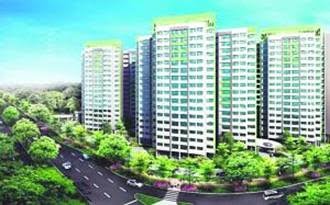
New flats are good buys, being priced significantly below the market level. Four-room flats at Punggol Emerald, for example, cost between $262,000 and $323,000, compared to $355,000 and $385,000 for resale flats in nearby areas. -- PHOTO: HDB
ST : What if you can't afford to retire?
Apr 25, 2010
What if you can't afford to retire?
Options for low-income elderly folk
By Lorna Tan
The reality of just how much it costs to retire is sinking in for many people.
As a result, more expect not to be able to retire completely - they will need to turn to part-time jobs in their golden years.
This was a key finding in a recent survey by Russell Investments and The Nielsen Company on how Singaporeans are planning for their retirement.
The findings indicated that about 70 per cent of the more than 500 respondents believe they will need some part-time work to supplement their retirement income.
Singapore's rapidly ageing population is a cause for concern, with the number of people aged 65 and older expected to treble to 900,000 in 20 years, from about 300,000.
Adding to the bleak picture: The survey indicated that only half of Singaporeans who have not reached retirement age have made financial plans for their nest eggs.
It is no wonder that experts constantly emphasise that when you fail to plan, you plan to fail. But for those who do not have time on their side and have yet to start mapping out their plans, not all hope is lost.
The Sunday Times looks at the income options available to low-income elderly people, particularly those with no financial plans. Some of these options look at the flat as an asset, as well as a source of rental and retirement income.
· Lease Buyback Scheme (LBS)
Launched on March 1 last year, the scheme allows low-income elderly Singaporeans living in three-room and smaller flats to monetise their flats to supplement their retirement needs.
It is believed that these households need more financial help, as they are unlikely to be able to take advantage of other options such as downsizing to a small flat or subletting a room.
Under the scheme, the HDB will buy back the tail end of a flat's 100-year lease at market valuation, leaving a 30-year lease for the owner. For example, if a flat has 70 years left, the HDB buys 40 years of the lease from the owner. It pays the market rate for the 40-year lease and this money goes to the CPF Life national annuity scheme in the flat owner's name. He will then receive a monthly income stream for life.
According to a study last year on unlocking housing equity for retirement by Dr Ngee-Choon Chia and Dr Albert Tsui, a three-room flat which is now worth $236,000 has an estimated housing value, unlocked from a 40-year lease, of about $109,000 at present.
The monthly annuity payouts from CPF Life through the buyback of the three-room flat is $694 to $724 for a man and $620 to $650 for a woman. Monthly payouts for women are lower than for men because of the longer life expectancy of women, on average.
Both the study's authors are from the economics department at the National University of Singapore (NUS).
To be eligible for LBS, the homeowner must be aged at least 62, have enjoyed only one housing subsidy and must have occupied the flat for at least five years, among other conditions. If the owner dies before his lease runs out, his family gets the refund of the balance.
At the start of this month, the scheme was broadened to include those who previously owned four-room or bigger flats.
It also includes those with outstanding housing loans exceeding $5,000, but who are able to buy an annuity under CPF Life for at least $60,000 with the HDB payout. Previously, the household had to have less than $5,000 outstanding on a home loan.
With the revision in rules, the number of elderly households that stand to benefit from LBS has risen to 34,800 or 82 per cent of elderly households in three-room and smaller flats.
One key advantage of the LBS is that you get to live in your home and at the same time receive a lifelong income.
Mr Ben Fok, chief executive of Grandtag Financial Consultancy, says: 'This option is viable for owners who are comfortable to stay where they are and do not wish to move or downgrade to a smaller flat. They prefer not to sublet their flat as privacy may be important to them.'
The downside is that upon the death of the retiree, he may not leave behind anything for his loved ones. In Asian culture, this may not be well accepted, says Mr Christopher Tan, chief executive of wealth management company Providend.
And retirees may also not like the idea that the house they are living in no longer belongs to them.
Mr Leong Sze Hian, president of the Society of Financial Service Professionals, however, believes that the owner will be worse off under this option.
He believes that HDB flats will be worth more 30 years down the road. After all, they have always increased in value historically, as old flats may be selected for en bloc redevelopment. Under this programme, the residents of affected blocks will be offered replacement flats. In fact, he notes that older flats have generally appreciated more, as they are in mature estates with more amenities.
Based on an annual price appreciation of 5 per cent for an HDB flat, Mr Leong works out that a flat valued at $200,000 now will be worth $864,388 in 30 years.
· Subletting
Another viable option is for elderly people to sublet their rooms. Mr Leong says this option is suitable for the retiree who wants to grow old in his own flat and still have some rental income.
According to the NUS study, about seven in 10, or 74 per cent, of the elderly prefer to 'age-in-place'.
The retiree can also opt to sublet his entire flat by moving in with his children. One key advantage of this is that the appreciating equity of the flat is retained by the flat owner, adds Mr Leong.
Mortgage consultancy Housing LoanSG.com founder Dennis Ng prefers this option to LBS, as he believes it is possible to rent out a room for $400 to $500 a month while the elderly person still retains ownership of the home.
Mr Fok cautions, however, that the owner may have to pay income tax for rent collected.
Of course, the inconvenience of having strangers in the house cannot be avoided. The owner will have to contend with losing some degree of privacy as well as putting up with strangers who may have different lifestyle habits.
Says Mr Tan: 'Not only is your privacy being intruded upon, but your whole life may be disrupted too. You share his friends if he brings them back, and you have to share the kitchen, the bathroom, the TV set and more. I am not sure whether a retiree is willing to sacrifice so much during his golden years.'
· Downsizing
Another option is for elderly people to sell their flats and downgrade to smaller flats or to HDB studio apartments.
According to the NUS study, significant sums will be cashed out if elderly people downgrade to smaller units. On average, $79,000 or $132,000 can be cashed out by downgrading from four-room to three-room or two-room flats, respectively. The sums could be even higher now, given the current trend of appreciating HDB prices.
If, say, $79,000 is placed in an annuity, a man can get a monthly payout of $502 to $526, and a woman can get $450 to $472 a month, for life.
If the elderly person opts to downgrade to an HDB studio apartment, which costs less than $100,000 currently, the cash proceeds would be even higher, says Mr Ng.
Most financial experts agree that downsizing seems to be the best financial option. After all, most retirees will conclude that they do not need to live in a big flat upon retiring.
The advantages are clear, says Mr Tan.
'You may get some cash for selling your bigger house and buying a smaller one, and at retirement, you do not have to spend so much energy cleaning the bigger premises. At the same time, expenses such as utility costs are lower with a smaller apartment.'
Mr Fok likes this option because it can help to reduce one's debt if there is an outstanding mortgage.
'You clear your debt and use the proceeds to buy a smaller home and be debt-free,' he adds.
· Working longer
Mr Tan believes that the real option is really retiring later and working longer. But in order to do that, he proposes the following:
· Accept that you have to work through your golden years. This is really a mindset shift, and you must make this shift at least five years before your planned retirement age or before you leave your current place of work.
To suddenly realise that you have to work longer without mentally preparing for it may be very tough to accept for a retiree.
· Keep yourself healthy. Many may want to work but find that they no longer have the health to keep working.
· Keep yourself relevant to the corporate world. Decide what is needed in the job market now; find something you would like to do and go for training. After all, you are bound to want to do something that you like, so it is best to start preparing yourself early.
· If you want to go into business, prepare a business plan and do a cost-benefit analysis. Ask yourself if you can afford to lose your money.
lorna@sph.com.sg
--------------------------------------------------------------------------------
IT'S ALL ABOUT MONEY
Senior Correspondent Lorna Tan has compiled her financial articles into a book. Talk Money is out at bookstores. It costs $22 (before GST). Grab a copy now!
What if you can't afford to retire?
Options for low-income elderly folk
By Lorna Tan
The reality of just how much it costs to retire is sinking in for many people.
As a result, more expect not to be able to retire completely - they will need to turn to part-time jobs in their golden years.
This was a key finding in a recent survey by Russell Investments and The Nielsen Company on how Singaporeans are planning for their retirement.
The findings indicated that about 70 per cent of the more than 500 respondents believe they will need some part-time work to supplement their retirement income.
Singapore's rapidly ageing population is a cause for concern, with the number of people aged 65 and older expected to treble to 900,000 in 20 years, from about 300,000.
Adding to the bleak picture: The survey indicated that only half of Singaporeans who have not reached retirement age have made financial plans for their nest eggs.
It is no wonder that experts constantly emphasise that when you fail to plan, you plan to fail. But for those who do not have time on their side and have yet to start mapping out their plans, not all hope is lost.
The Sunday Times looks at the income options available to low-income elderly people, particularly those with no financial plans. Some of these options look at the flat as an asset, as well as a source of rental and retirement income.
· Lease Buyback Scheme (LBS)
Launched on March 1 last year, the scheme allows low-income elderly Singaporeans living in three-room and smaller flats to monetise their flats to supplement their retirement needs.
It is believed that these households need more financial help, as they are unlikely to be able to take advantage of other options such as downsizing to a small flat or subletting a room.
Under the scheme, the HDB will buy back the tail end of a flat's 100-year lease at market valuation, leaving a 30-year lease for the owner. For example, if a flat has 70 years left, the HDB buys 40 years of the lease from the owner. It pays the market rate for the 40-year lease and this money goes to the CPF Life national annuity scheme in the flat owner's name. He will then receive a monthly income stream for life.
According to a study last year on unlocking housing equity for retirement by Dr Ngee-Choon Chia and Dr Albert Tsui, a three-room flat which is now worth $236,000 has an estimated housing value, unlocked from a 40-year lease, of about $109,000 at present.
The monthly annuity payouts from CPF Life through the buyback of the three-room flat is $694 to $724 for a man and $620 to $650 for a woman. Monthly payouts for women are lower than for men because of the longer life expectancy of women, on average.
Both the study's authors are from the economics department at the National University of Singapore (NUS).
To be eligible for LBS, the homeowner must be aged at least 62, have enjoyed only one housing subsidy and must have occupied the flat for at least five years, among other conditions. If the owner dies before his lease runs out, his family gets the refund of the balance.
At the start of this month, the scheme was broadened to include those who previously owned four-room or bigger flats.
It also includes those with outstanding housing loans exceeding $5,000, but who are able to buy an annuity under CPF Life for at least $60,000 with the HDB payout. Previously, the household had to have less than $5,000 outstanding on a home loan.
With the revision in rules, the number of elderly households that stand to benefit from LBS has risen to 34,800 or 82 per cent of elderly households in three-room and smaller flats.
One key advantage of the LBS is that you get to live in your home and at the same time receive a lifelong income.
Mr Ben Fok, chief executive of Grandtag Financial Consultancy, says: 'This option is viable for owners who are comfortable to stay where they are and do not wish to move or downgrade to a smaller flat. They prefer not to sublet their flat as privacy may be important to them.'
The downside is that upon the death of the retiree, he may not leave behind anything for his loved ones. In Asian culture, this may not be well accepted, says Mr Christopher Tan, chief executive of wealth management company Providend.
And retirees may also not like the idea that the house they are living in no longer belongs to them.
Mr Leong Sze Hian, president of the Society of Financial Service Professionals, however, believes that the owner will be worse off under this option.
He believes that HDB flats will be worth more 30 years down the road. After all, they have always increased in value historically, as old flats may be selected for en bloc redevelopment. Under this programme, the residents of affected blocks will be offered replacement flats. In fact, he notes that older flats have generally appreciated more, as they are in mature estates with more amenities.
Based on an annual price appreciation of 5 per cent for an HDB flat, Mr Leong works out that a flat valued at $200,000 now will be worth $864,388 in 30 years.
· Subletting
Another viable option is for elderly people to sublet their rooms. Mr Leong says this option is suitable for the retiree who wants to grow old in his own flat and still have some rental income.
According to the NUS study, about seven in 10, or 74 per cent, of the elderly prefer to 'age-in-place'.
The retiree can also opt to sublet his entire flat by moving in with his children. One key advantage of this is that the appreciating equity of the flat is retained by the flat owner, adds Mr Leong.
Mortgage consultancy Housing LoanSG.com founder Dennis Ng prefers this option to LBS, as he believes it is possible to rent out a room for $400 to $500 a month while the elderly person still retains ownership of the home.
Mr Fok cautions, however, that the owner may have to pay income tax for rent collected.
Of course, the inconvenience of having strangers in the house cannot be avoided. The owner will have to contend with losing some degree of privacy as well as putting up with strangers who may have different lifestyle habits.
Says Mr Tan: 'Not only is your privacy being intruded upon, but your whole life may be disrupted too. You share his friends if he brings them back, and you have to share the kitchen, the bathroom, the TV set and more. I am not sure whether a retiree is willing to sacrifice so much during his golden years.'
· Downsizing
Another option is for elderly people to sell their flats and downgrade to smaller flats or to HDB studio apartments.
According to the NUS study, significant sums will be cashed out if elderly people downgrade to smaller units. On average, $79,000 or $132,000 can be cashed out by downgrading from four-room to three-room or two-room flats, respectively. The sums could be even higher now, given the current trend of appreciating HDB prices.
If, say, $79,000 is placed in an annuity, a man can get a monthly payout of $502 to $526, and a woman can get $450 to $472 a month, for life.
If the elderly person opts to downgrade to an HDB studio apartment, which costs less than $100,000 currently, the cash proceeds would be even higher, says Mr Ng.
Most financial experts agree that downsizing seems to be the best financial option. After all, most retirees will conclude that they do not need to live in a big flat upon retiring.
The advantages are clear, says Mr Tan.
'You may get some cash for selling your bigger house and buying a smaller one, and at retirement, you do not have to spend so much energy cleaning the bigger premises. At the same time, expenses such as utility costs are lower with a smaller apartment.'
Mr Fok likes this option because it can help to reduce one's debt if there is an outstanding mortgage.
'You clear your debt and use the proceeds to buy a smaller home and be debt-free,' he adds.
· Working longer
Mr Tan believes that the real option is really retiring later and working longer. But in order to do that, he proposes the following:
· Accept that you have to work through your golden years. This is really a mindset shift, and you must make this shift at least five years before your planned retirement age or before you leave your current place of work.
To suddenly realise that you have to work longer without mentally preparing for it may be very tough to accept for a retiree.
· Keep yourself healthy. Many may want to work but find that they no longer have the health to keep working.
· Keep yourself relevant to the corporate world. Decide what is needed in the job market now; find something you would like to do and go for training. After all, you are bound to want to do something that you like, so it is best to start preparing yourself early.
· If you want to go into business, prepare a business plan and do a cost-benefit analysis. Ask yourself if you can afford to lose your money.
lorna@sph.com.sg
--------------------------------------------------------------------------------
IT'S ALL ABOUT MONEY
Senior Correspondent Lorna Tan has compiled her financial articles into a book. Talk Money is out at bookstores. It costs $22 (before GST). Grab a copy now!
Subscribe to:
Posts (Atom)

 Posts
Posts


