
Mar 26, 2010
Bras Basah flat sets HDB price record
By Jessica Cheam
A TAIWANESE couple have paid $650,000 for a four-room flat in Bain Street - smashing Housing Board (HDB) records and reflecting the strength in the red-hot resale market.
The sale price works out to be $736 per sq ft (psf) for the 30-year-old flat on the 25th floor of a block at Bras Basah.
That is the highest psf price paid for an HDB property and is on a par with prices of private homes in suburban areas.
But the Taiwanese, who are permanent residents (PRs), bought the 883 sq ft flat last month for its proximity to their work place in the City Hall area, its designer interior and panoramic views, said ERA Realty agent William Koh, who brokered the deal. The couple paid $70,000 above the flat's valuation.
The sellers were a young Singaporean couple who have a child. Both buyer and seller declined to be interviewed.
The price trumps the old record set last November when a four-room, 969 sq ft flat at Strathmore Avenue in Queenstown sold for $653,000 or $674 psf.
Housing analysts were surprised at the price achieved in Bain Street.
ERA Asia-Pacific associate director Eugene Lim said the purchase was unusual although demand 'is still strong', with upgraders, downgraders and PRs propping up the market.
The HDB recently tightened rules on the resale market. Buyers of non-subsidised HDB resale flats must now occupy their property for at least three years before they can sell it. This is up from 2.5 years or one year previously, depending on the financing.
The HDB has also imposed limits on the number of HDB flats in each block and neighbourhood that can be sold to non-Malaysian PRs to prevent the formation of foreigner enclaves.

Monday, March 29, 2010
ST : 76 Shenton condo sold out in one day
Mar 26, 2010
76 Shenton condo sold out in one day
Reasonable pricing and small unit sizes could be reasons for its popularity
By Esther Teo
THE 76 Shenton condominium in the Central Business District sold out in one day during its preview as hundreds of buyers made a beeline for the prime project yesterday.
There were so many people vying for one of the 202 units that balloting was needed to sort out who got first crack.
The Straits Times understands that there were about 300 names in the ballot, with the buyers mostly Singaporean investors and permanent residents.
The Hong Leong Holdings project has nothing over 1,000 sq ft: 134 one-bedroom units from 592 sq ft to 624 sq ft and 68 two-bedroom units of 968 sq ft to 975 sq ft. One-bedroom units were priced between $1,600 and $2,600 per sq ft (psf), or about $1.2 million, while two-bedroom units went for between $1,600 and $2,300 psf. That is about $2 million.
Hong Leong credited the strong sales to the development's 'prime location, its attractive pricing, a solid design and healthy pre-launch interest'.
Sources said property agents were apparently collecting cheques from keen buyers even before the project's launch.
The 99-year leasehold condominium has 39 floors of residences and commercial space that will feature seven restaurants and retail units.
Chesterton Suntec International's research and consultancy director, Mr Colin Tan, said the project's smaller units could be a reason for its popularity.
'The developer knows the market... Small units are more digestible and also gives home owners an easier exit strategy should they ever want to sell the property,' he said.
Mr Peter Ow, managing director of residential services at Knight Frank, said that growing interest in the luxury end of the market is evident but the strength of this demand would still depend on the sustainability of the economic recovery.
He added that 76 Shenton was well-received due to its reasonable pricing. Another reason was that even units on the lower floors would get a sea view.
The condo is expected to be completed by late 2014.
Hong Leong will release Nathan Suites in Nathan Road, in the Bishopsgate area, at the end of the month at an average price of $2,100 psf.
On the weekend, buyers snapped up 29 out of the 30 launched units at Keppel Group's Reflections at Keppel Bay. Prices averaged $2,200 psf with some hitting $2,600 psf.
esthert@sph.com.sg
76 Shenton condo sold out in one day
Reasonable pricing and small unit sizes could be reasons for its popularity
By Esther Teo
THE 76 Shenton condominium in the Central Business District sold out in one day during its preview as hundreds of buyers made a beeline for the prime project yesterday.
There were so many people vying for one of the 202 units that balloting was needed to sort out who got first crack.
The Straits Times understands that there were about 300 names in the ballot, with the buyers mostly Singaporean investors and permanent residents.
The Hong Leong Holdings project has nothing over 1,000 sq ft: 134 one-bedroom units from 592 sq ft to 624 sq ft and 68 two-bedroom units of 968 sq ft to 975 sq ft. One-bedroom units were priced between $1,600 and $2,600 per sq ft (psf), or about $1.2 million, while two-bedroom units went for between $1,600 and $2,300 psf. That is about $2 million.
Hong Leong credited the strong sales to the development's 'prime location, its attractive pricing, a solid design and healthy pre-launch interest'.
Sources said property agents were apparently collecting cheques from keen buyers even before the project's launch.
The 99-year leasehold condominium has 39 floors of residences and commercial space that will feature seven restaurants and retail units.
Chesterton Suntec International's research and consultancy director, Mr Colin Tan, said the project's smaller units could be a reason for its popularity.
'The developer knows the market... Small units are more digestible and also gives home owners an easier exit strategy should they ever want to sell the property,' he said.
Mr Peter Ow, managing director of residential services at Knight Frank, said that growing interest in the luxury end of the market is evident but the strength of this demand would still depend on the sustainability of the economic recovery.
He added that 76 Shenton was well-received due to its reasonable pricing. Another reason was that even units on the lower floors would get a sea view.
The condo is expected to be completed by late 2014.
Hong Leong will release Nathan Suites in Nathan Road, in the Bishopsgate area, at the end of the month at an average price of $2,100 psf.
On the weekend, buyers snapped up 29 out of the 30 launched units at Keppel Group's Reflections at Keppel Bay. Prices averaged $2,200 psf with some hitting $2,600 psf.
esthert@sph.com.sg
BT : Govt rebuts Cheong's 'free market' theory
Business Times - 26 Mar 2010
Govt rebuts Cheong's 'free market' theory
It rejects Redas chief's 'hands-off' plea, says it can't let private property bubbles form
By UMA SHANKARI
(SINGAPORE) The government yesterday defended its policy of managing price movements in the private housing market and also stood by its method of supplying developers with state land sites.
It was responding to Wednesday's speech by the president of the Real Estate Developers' Association of Singapore (Redas), Simon Cheong, who said that the government should allow the private property market here to operate as a completely free market.
Mr Cheong also questioned the need for government intervention to manage the rise of private home prices and asked if the state should be so concerned with private housing prices when the segment serves only 16.5 per cent of the overall population.
His speech took some developers by surprise but most said that it was 'brave'. There was also broad agreement that the government should reveal the reserve price of each site it puts up for sale.
The Ministry of National Development (MND) said it would 'like to respond to the key points he (Mr Cheong) raised'.
'The government's objective is to maintain a steady and healthy property market where price movements are supported by economic fundamentals,' MND said in a statement. 'A property market bubble, if allowed to form, may not only impact housing affordability but also severely impact the economy when it bursts.'
MND does this by making sure that there is an adequate supply of land to meet demand and by providing timely and comprehensive real estate information to the public.
'When necessary, the government will also introduce measures to dampen market exuberance and prevent prices from running ahead of economic fundamentals,' MND added.
The ministry has in recent months taken several steps to keep private housing affordable, including the introduction of a stamp duty for sellers and the removal of the deferred payment and interest absorption schemes.
In his speech, Mr Cheong also cited two sites - one in Tampines and another at Ten Mile Junction - that were not awarded in 2008 after government land tenders as examples to illustrate how market forces were not allowed to act freely and were constrained by the reserve price system.
Both sites were recently awarded in new tenders at much higher prices than the bids in 2008.
Mr Cheong argued that if the government had awarded the sites at lower prices in 2008, it could have helped to moderate the recent hike in private home prices.
But MND 'disagrees totally with his view'. Firstly, it is arguable if awarding the two sites at the low bid prices in 2008 would have moderated property prices, MND said. It could have instead simply allowed the bidders to achieve higher profit margins.
MND also said that the potential yield from the two sites is small (around 800 units) compared to the total supply of 60,476 uncompleted private housing units from projects in the pipeline (as at Q4 2009) - of which 34,234 units are still unsold. It is 'questionable' whether the added supply of the two sites in 2008 would have affected prices today in any way, the ministry said.
The reserve price also did not deter the successful sale of sites under the government land sales programme in 2008, MND pointed out. That year, seven residential sites which could yield a total of 2,464 units were sold through the confirmed list.
The Tampines and Ten Mile Junction sites, which were released for sale through the confirmed list but not awarded, were among the few exceptions.
MND added that a reserve price is necessary, as it is the government's duty as the custodian of state land to ensure it obtains a fair market price for a site. But the reserve price serves only as a guide, and is not a rigid formula for the government in deciding whether to award a sale site.
Said MND: 'The government had awarded sale sites in the past even when the top bid was below the reserve price. However, for the two sites cited by Mr Cheong, the government was not convinced that the bids represented fair market value rather than opportunistic bids, as there were very few bids for the sites, and the bids were exceptionally low.'
Developers BT spoke to said that MND's response was 'as expected'.
'MND has always stuck to its line about maintaining a sustainable property market and so we didn't expect changes just because of his (Mr Cheong's) speech,' said the chief executive of a property group here.
But while not everyone agreed with all parts of Mr Cheong's speech, most developers were in favour of asking the government to disclose the reserve price of each site it puts up for sale by tender.
'For future tenders, if the reserve price is released, there won't be cases where bids come in under the minimum price,' said EL Development managing director Lim Yew Soon. 'By simply listing the reserve price, it makes the whole process easier.'
Copyright © 2010 Singapore Press Holdings Ltd. All rights reserved.
Govt rebuts Cheong's 'free market' theory
It rejects Redas chief's 'hands-off' plea, says it can't let private property bubbles form
By UMA SHANKARI
(SINGAPORE) The government yesterday defended its policy of managing price movements in the private housing market and also stood by its method of supplying developers with state land sites.
It was responding to Wednesday's speech by the president of the Real Estate Developers' Association of Singapore (Redas), Simon Cheong, who said that the government should allow the private property market here to operate as a completely free market.
Mr Cheong also questioned the need for government intervention to manage the rise of private home prices and asked if the state should be so concerned with private housing prices when the segment serves only 16.5 per cent of the overall population.
His speech took some developers by surprise but most said that it was 'brave'. There was also broad agreement that the government should reveal the reserve price of each site it puts up for sale.
The Ministry of National Development (MND) said it would 'like to respond to the key points he (Mr Cheong) raised'.
'The government's objective is to maintain a steady and healthy property market where price movements are supported by economic fundamentals,' MND said in a statement. 'A property market bubble, if allowed to form, may not only impact housing affordability but also severely impact the economy when it bursts.'
MND does this by making sure that there is an adequate supply of land to meet demand and by providing timely and comprehensive real estate information to the public.
'When necessary, the government will also introduce measures to dampen market exuberance and prevent prices from running ahead of economic fundamentals,' MND added.
The ministry has in recent months taken several steps to keep private housing affordable, including the introduction of a stamp duty for sellers and the removal of the deferred payment and interest absorption schemes.
In his speech, Mr Cheong also cited two sites - one in Tampines and another at Ten Mile Junction - that were not awarded in 2008 after government land tenders as examples to illustrate how market forces were not allowed to act freely and were constrained by the reserve price system.
Both sites were recently awarded in new tenders at much higher prices than the bids in 2008.
Mr Cheong argued that if the government had awarded the sites at lower prices in 2008, it could have helped to moderate the recent hike in private home prices.
But MND 'disagrees totally with his view'. Firstly, it is arguable if awarding the two sites at the low bid prices in 2008 would have moderated property prices, MND said. It could have instead simply allowed the bidders to achieve higher profit margins.
MND also said that the potential yield from the two sites is small (around 800 units) compared to the total supply of 60,476 uncompleted private housing units from projects in the pipeline (as at Q4 2009) - of which 34,234 units are still unsold. It is 'questionable' whether the added supply of the two sites in 2008 would have affected prices today in any way, the ministry said.
The reserve price also did not deter the successful sale of sites under the government land sales programme in 2008, MND pointed out. That year, seven residential sites which could yield a total of 2,464 units were sold through the confirmed list.
The Tampines and Ten Mile Junction sites, which were released for sale through the confirmed list but not awarded, were among the few exceptions.
MND added that a reserve price is necessary, as it is the government's duty as the custodian of state land to ensure it obtains a fair market price for a site. But the reserve price serves only as a guide, and is not a rigid formula for the government in deciding whether to award a sale site.
Said MND: 'The government had awarded sale sites in the past even when the top bid was below the reserve price. However, for the two sites cited by Mr Cheong, the government was not convinced that the bids represented fair market value rather than opportunistic bids, as there were very few bids for the sites, and the bids were exceptionally low.'
Developers BT spoke to said that MND's response was 'as expected'.
'MND has always stuck to its line about maintaining a sustainable property market and so we didn't expect changes just because of his (Mr Cheong's) speech,' said the chief executive of a property group here.
But while not everyone agreed with all parts of Mr Cheong's speech, most developers were in favour of asking the government to disclose the reserve price of each site it puts up for sale by tender.
'For future tenders, if the reserve price is released, there won't be cases where bids come in under the minimum price,' said EL Development managing director Lim Yew Soon. 'By simply listing the reserve price, it makes the whole process easier.'
Copyright © 2010 Singapore Press Holdings Ltd. All rights reserved.
BT : Tender launched for Woodlands industrial site
Business Times - 26 Mar 2010
Tender launched for Woodlands industrial site
THE Urban Redevelopment Authority has launched the tender for an industrial site next to Seagate's facility in Woodlands.
An unnamed developer has agreed to bid at least $25 million or $28.78 per square foot per plot ratio (psf ppr) for the 60-year leasehold plot. The site is zoned Business 1, which means light and clean industry and warehouse uses are allowed.
The 347,451 sq ft land parcel can be built up to a maximum gross floor area of 868,628 sq ft. The tender for the plot closes on April 21.
Bernard Goh, director, industrial services at CB Richard Ellis, reckons the plot will be attractive to bidders who are contractors as well as developers. 'It may attract three bids, with the top bids likely to be in the $35-40 psf ppr range,' he added.
Colliers International data shows that three industrial sites have been sold in the Woodlands area in the past four years at prices ranging from $28 to $35 psf ppr. The sites are zoned Business 2, which also includes general industrial use.
The latest plot on offer, at Woodlands Avenue 12, was made available for application under the Government's reserve list system in December last year.
Ministry of Trade and Industry's Industrial Government Land Sales Programme for first half 2010 comprises eight reserve list sites (including the latest plot at Woodlands Ave 12 which has been triggered) and two confirmed list sites.
Copyright © 2010 Singapore Press Holdings Ltd. All rights reserved.
Tender launched for Woodlands industrial site
THE Urban Redevelopment Authority has launched the tender for an industrial site next to Seagate's facility in Woodlands.
An unnamed developer has agreed to bid at least $25 million or $28.78 per square foot per plot ratio (psf ppr) for the 60-year leasehold plot. The site is zoned Business 1, which means light and clean industry and warehouse uses are allowed.
The 347,451 sq ft land parcel can be built up to a maximum gross floor area of 868,628 sq ft. The tender for the plot closes on April 21.
Bernard Goh, director, industrial services at CB Richard Ellis, reckons the plot will be attractive to bidders who are contractors as well as developers. 'It may attract three bids, with the top bids likely to be in the $35-40 psf ppr range,' he added.
Colliers International data shows that three industrial sites have been sold in the Woodlands area in the past four years at prices ranging from $28 to $35 psf ppr. The sites are zoned Business 2, which also includes general industrial use.
The latest plot on offer, at Woodlands Avenue 12, was made available for application under the Government's reserve list system in December last year.
Ministry of Trade and Industry's Industrial Government Land Sales Programme for first half 2010 comprises eight reserve list sites (including the latest plot at Woodlands Ave 12 which has been triggered) and two confirmed list sites.
Copyright © 2010 Singapore Press Holdings Ltd. All rights reserved.
BT : Hong Leong sells Marina House for $148m
Business Times - 26 Mar 2010
Hong Leong sells Marina House for $148m
By KALPANA RASHIWALA
(SINGAPORE) Hong Leong Group has inked a deal to sell Marina House at Shenton Way for $148 million, BT understands.
The buyer is believed to be a group led by niche property developer and investor Melvin Poh. Members of his consortium are said to include Victor Soh of Fortune Development.
Market watchers suggest that Mr Poh, who also led the purchase of three ageing CBD office blocks last year with an eye to redeveloping them into residential use, probably has the same intention for Marina House.
The 21-storey office block is on a site with a remaining lease of nearly 60 years.
The $148 million purchase price reflects about $1,130 per square foot based on the building's existing net lettable area of about 130,000 sq ft. The building has a few tenants (the most prominent being Indian Airlines) but is substantially vacant - probably a deliberate strategy on the part of Hong Leong Group as it weighed various options, including the possibility of redeveloping the site into residential use.
In the end, market watchers suggest Hong Leong may have decided it made more sense to sell the property, and leave the redevelopment potential to the next owner, rather than get bogged down with having to seek approval from the authorities to top up the site's lease to a fresh 99-year term.
In the past few years, the authorities have turned down a few applications for lease top-ups in conjunction with redevelopment proposals in the CBD, according to earlier reports.
Just a stone's throw away from Marina House, Hong Leong Group secured approval to redevelop another of its office blocks (the former Ong Building) into apartments, which also entailed a lease upgrade. This 39-storey project, 76 Shenton, went on the market on Wednesday and the 202-unit development was sold out by yesterday evening, achieving prices ranging from about $1,600 psf to $2,600 psf.
Under Master Plan 2008, Marina House is zoned for commercial use with an 8.4 plot ratio (ratio of maximum potential gross floor area to land area). By some estimates, the $148 million purchase price could reflect a unit land cost of $1,050 psf of potential gross floor area, inclusive of a lease-upgrading premium assuming the authorities approve a lease top-up.
Some analysts suggest that a differential premium may not be payable if a conversion of the site's use to residential use is allowed, as the building's existing gross floor area already surpasses the Master Plan plot ratio.
Marina House was spruced up a few years ago. It was sold through a private treaty deal, believed to have been brokered by DTZ.
Last year, Mr Poh's Fission Group teamed up with Yi Kai Group to buy Aviva Building in Cecil Street and the next-door Cecil House for a total of $101 million, in a Jones Lang LaSalle-brokered deal.
The two partners also picked up VTB Building in Robinson Road for $71 million. That deal was brokered by DTZ.
Copyright © 2010 Singapore Press Holdings Ltd. All rights reserved.

Residential use next? The 21-storey office block is on a site with a remaining lease of nearly 60 years
Hong Leong sells Marina House for $148m
By KALPANA RASHIWALA
(SINGAPORE) Hong Leong Group has inked a deal to sell Marina House at Shenton Way for $148 million, BT understands.
The buyer is believed to be a group led by niche property developer and investor Melvin Poh. Members of his consortium are said to include Victor Soh of Fortune Development.
Market watchers suggest that Mr Poh, who also led the purchase of three ageing CBD office blocks last year with an eye to redeveloping them into residential use, probably has the same intention for Marina House.
The 21-storey office block is on a site with a remaining lease of nearly 60 years.
The $148 million purchase price reflects about $1,130 per square foot based on the building's existing net lettable area of about 130,000 sq ft. The building has a few tenants (the most prominent being Indian Airlines) but is substantially vacant - probably a deliberate strategy on the part of Hong Leong Group as it weighed various options, including the possibility of redeveloping the site into residential use.
In the end, market watchers suggest Hong Leong may have decided it made more sense to sell the property, and leave the redevelopment potential to the next owner, rather than get bogged down with having to seek approval from the authorities to top up the site's lease to a fresh 99-year term.
In the past few years, the authorities have turned down a few applications for lease top-ups in conjunction with redevelopment proposals in the CBD, according to earlier reports.
Just a stone's throw away from Marina House, Hong Leong Group secured approval to redevelop another of its office blocks (the former Ong Building) into apartments, which also entailed a lease upgrade. This 39-storey project, 76 Shenton, went on the market on Wednesday and the 202-unit development was sold out by yesterday evening, achieving prices ranging from about $1,600 psf to $2,600 psf.
Under Master Plan 2008, Marina House is zoned for commercial use with an 8.4 plot ratio (ratio of maximum potential gross floor area to land area). By some estimates, the $148 million purchase price could reflect a unit land cost of $1,050 psf of potential gross floor area, inclusive of a lease-upgrading premium assuming the authorities approve a lease top-up.
Some analysts suggest that a differential premium may not be payable if a conversion of the site's use to residential use is allowed, as the building's existing gross floor area already surpasses the Master Plan plot ratio.
Marina House was spruced up a few years ago. It was sold through a private treaty deal, believed to have been brokered by DTZ.
Last year, Mr Poh's Fission Group teamed up with Yi Kai Group to buy Aviva Building in Cecil Street and the next-door Cecil House for a total of $101 million, in a Jones Lang LaSalle-brokered deal.
The two partners also picked up VTB Building in Robinson Road for $71 million. That deal was brokered by DTZ.
Copyright © 2010 Singapore Press Holdings Ltd. All rights reserved.

Residential use next? The 21-storey office block is on a site with a remaining lease of nearly 60 years
BT : Hong Leong sells out 76 Shenton in one day
Business Times - 26 Mar 2010
Hong Leong sells out 76 Shenton in one day
By UMA SHANKARI
HONG Leong Holdings has sold all 202 units in its upmarket 76 Shenton condominium in just one day.
The one- and two-bedroom apartments in the 99-year leasehold project were snapped up after a ballot yesterday. One-bedroom units went for $1,600-$2,600 per sq ft, and two-bedders for $1,600-$2,300 psf.
Hong Leong attributed the fast sales to the project's location in Shenton Way, attractive pricing, 'solid' design and healthy pre-launch interest.
Marketing agents began collecting cheques from potential buyers as early as two weeks ago. Balloting of 300-plus people was carried out yesterday to determine the order in which they could choose units.
Hong Leong is converting 76 Shenton from office space. Besides apartments, it will have commercial space featuring seven restaurants and retail shops. It is scheduled to be completed by end-2014.
Separately, Hong Leong unit City Developments said yesterday it will launch its high-end project The Residences at W Singapore Sentosa Cove this weekend. The 228 apartments in the project will sell for $2,500-$3,000 psf.
Some 60 units will be released this weekend, comprising two- to four-bedroom apartments, and penthouses ranging from 1,227 sq ft to 6,297 sq ft.
CityDev is partnering Starwood Hotels & Resorts Worldwide, which owns the W Hotels brand, to develop the project, which will be at the heart of CityDev's The Quayside Isle.
The Quayside Isle will also have an adjoining 240-room W Singapore Sentosa Cove hotel and 86,000 sq ft of retail space featuring 'quaint' waterfront restaurants and shops. CityDev paid $255 million for the coveted marina Quayside site in July 2006 in a government tender.
CityDev managing director Kwek Leng Joo said that when all the components are completed, likely by 2012, Sentosa Cove will be one of the most compelling destinations in the region.
Mr Kwek expects most of the apartment buyers to be foreigners. Besides the Singapore launch, CityDev and Starwood will market the project in Hong Kong, Shanghai and Jakarta.
Also at Sentosa Cove, Ho Bee Investment and IOI will preview their 151-unit Seascape today. Units in that project are expected to sell from about $2,600 psf upwards.
Copyright © 2010 Singapore Press Holdings Ltd. All rights reserved.

High-end project: City Developments will launch The Residences at W Singapore Sentosa Cove this weekend
Hong Leong sells out 76 Shenton in one day
By UMA SHANKARI
HONG Leong Holdings has sold all 202 units in its upmarket 76 Shenton condominium in just one day.
The one- and two-bedroom apartments in the 99-year leasehold project were snapped up after a ballot yesterday. One-bedroom units went for $1,600-$2,600 per sq ft, and two-bedders for $1,600-$2,300 psf.
Hong Leong attributed the fast sales to the project's location in Shenton Way, attractive pricing, 'solid' design and healthy pre-launch interest.
Marketing agents began collecting cheques from potential buyers as early as two weeks ago. Balloting of 300-plus people was carried out yesterday to determine the order in which they could choose units.
Hong Leong is converting 76 Shenton from office space. Besides apartments, it will have commercial space featuring seven restaurants and retail shops. It is scheduled to be completed by end-2014.
Separately, Hong Leong unit City Developments said yesterday it will launch its high-end project The Residences at W Singapore Sentosa Cove this weekend. The 228 apartments in the project will sell for $2,500-$3,000 psf.
Some 60 units will be released this weekend, comprising two- to four-bedroom apartments, and penthouses ranging from 1,227 sq ft to 6,297 sq ft.
CityDev is partnering Starwood Hotels & Resorts Worldwide, which owns the W Hotels brand, to develop the project, which will be at the heart of CityDev's The Quayside Isle.
The Quayside Isle will also have an adjoining 240-room W Singapore Sentosa Cove hotel and 86,000 sq ft of retail space featuring 'quaint' waterfront restaurants and shops. CityDev paid $255 million for the coveted marina Quayside site in July 2006 in a government tender.
CityDev managing director Kwek Leng Joo said that when all the components are completed, likely by 2012, Sentosa Cove will be one of the most compelling destinations in the region.
Mr Kwek expects most of the apartment buyers to be foreigners. Besides the Singapore launch, CityDev and Starwood will market the project in Hong Kong, Shanghai and Jakarta.
Also at Sentosa Cove, Ho Bee Investment and IOI will preview their 151-unit Seascape today. Units in that project are expected to sell from about $2,600 psf upwards.
Copyright © 2010 Singapore Press Holdings Ltd. All rights reserved.

High-end project: City Developments will launch The Residences at W Singapore Sentosa Cove this weekend
Thursday, March 25, 2010
ST Forum : Use sharper tools to fix property market flaws
Mar 25, 2010
Use sharper tools to fix property market flaws
I REFER to Mr Bobby Jayaraman's letter, 'New measures won't help market bloom' (Feb 23). There may be room to re-examine market statistics in greater detail and consider sharper tools to tackle specific problems instead of slapping stamp fees on sellers across the board.
The Urban Redevelopment Authority keeps statistics of property transactions. Nineteen different headings are listed for each transaction, including 'purchaser address indicator' which describes whether a buyer is from HDB or private housing, and 'type of sale' which describes whether a sale is new, resale or sub-sale.
A quick comparison of non-landed property sales in districts 9, 16 and 27 over the past year shows different transaction patterns in different locations.
For example, in district 9, 20 per cent were reported to be buyers with HDB 'address indicator' and 21 per cent of the 2,500 transactions were 'sub-sales'. In district 16, only 10 per cent were 'sub-sales' with 45 per cent buyers with HDB 'address indicator' in the 1,710 cases. In district 27, the total number of sales was 239, with 161 with HDB 'address indicator'.
Armed with such info, the authorities can use sharper tools to correct market imperfections caused in particular locations or by particular groups of people.
Patrick Sio
Use sharper tools to fix property market flaws
I REFER to Mr Bobby Jayaraman's letter, 'New measures won't help market bloom' (Feb 23). There may be room to re-examine market statistics in greater detail and consider sharper tools to tackle specific problems instead of slapping stamp fees on sellers across the board.
The Urban Redevelopment Authority keeps statistics of property transactions. Nineteen different headings are listed for each transaction, including 'purchaser address indicator' which describes whether a buyer is from HDB or private housing, and 'type of sale' which describes whether a sale is new, resale or sub-sale.
A quick comparison of non-landed property sales in districts 9, 16 and 27 over the past year shows different transaction patterns in different locations.
For example, in district 9, 20 per cent were reported to be buyers with HDB 'address indicator' and 21 per cent of the 2,500 transactions were 'sub-sales'. In district 16, only 10 per cent were 'sub-sales' with 45 per cent buyers with HDB 'address indicator' in the 1,710 cases. In district 27, the total number of sales was 239, with 161 with HDB 'address indicator'.
Armed with such info, the authorities can use sharper tools to correct market imperfections caused in particular locations or by particular groups of people.
Patrick Sio
ST : Keen interest in high-end properties
Mar 25, 2010
Keen interest in high-end properties
Prices tipped to rise though they are still below 2007 boom levels
By Esther Teo
POSH property seems to be back in vogue, with one recent launch snapped up and new high-end developments slated for previews in the coming days.
Home-hunters showed keen interest in Keppel Land's Reflections at Keppel Bay over the weekend, and projects in Sentosa, Nathan Road and Shenton Way are also apparently generating interest.
But while prices are robust and tipped to move up, they are still below the boom-time levels with some experts suggesting that developers are keen to cash in on the buoyant market while they can.
Reflections at Keppel Bay, a development of 1,129 apartments on the southern coast, saw a strong weekend response with 29 of the 30 units launched sold. Prices averaged $2,200 per sq ft (psf) although they hit as high as $2,600 psf.
That priced two-bedders at about $2 million, a three-bedroom unit at $2.5 million and a four-bedroom apartment at $6 million. This was the first time two-, three- and four-bedroom units were being sold from the centre tower, known for having the best waterfront views.
The 99-year leasehold development has six glass towers of 24 and 41 storeys and 11 shorter blocks of villa apartments.
Keppel Land chairman Choo Chiau Beng said yesterday that positive economic sentiments, the improved job market and the buzz sparked by the integrated resorts have helped re-ignite the property market.
Since Reflections' launch in 2007, almost 98 per cent of its 700 released units had been sold as of last month. It is expected to be completed in 2012.
Keppel Land's chief executive of its Singapore residential unit, Mr Augustine Tan, said the weekend response had been very good and that 20 more units are being slated for release.
He expects to launch a total of 100 to 200 units this year. About 70 per cent of buyers were Singapore citizens while the rest were permanent residents and foreigners, he added.
Although the luxury segment has not moved as much as the mass market, Mr Tan expects demand to pick up this year with prices increasing by about 5 per cent to 10 per cent.
City Developments is having a media preview of the 228-unit Residences at W in Sentosa Cove today. Industry sources say that it could be priced for about $2,500 psf to $3,000 psf. Developer TID will release the 65-unit freehold development Nathan Suites on Nathan Road, in the prime District 10, at the end of the month at an average price of $2,100 psf.
The 39-storey 76 Shenton downtown condo developed by Hong Leong Holdings also previews today. Prices range from just below $1,700 psf to $2,500 psf.
However, Chesterton Suntec International's research and consultancy director Colin Tan said the luxury end is still struggling to reach its peak, with prices about 20 per cent lower than in 2007.
'(Developers) might have thought the optimism in the mass market would spread to the luxury end, but that has not been the case. They know that good times won't last forever so they might just be trying to get what they can now,' he said. He also noted that the slew of luxury projects being launched might not necessarily mean sustainable recovery.
Rather, it could be a sign of developers getting nervous since the market share for high-end residences is limited. They might just be jostling to get their slice of the pie, he added.
esthert@sph.com.sg
Keen interest in high-end properties
Prices tipped to rise though they are still below 2007 boom levels
By Esther Teo
POSH property seems to be back in vogue, with one recent launch snapped up and new high-end developments slated for previews in the coming days.
Home-hunters showed keen interest in Keppel Land's Reflections at Keppel Bay over the weekend, and projects in Sentosa, Nathan Road and Shenton Way are also apparently generating interest.
But while prices are robust and tipped to move up, they are still below the boom-time levels with some experts suggesting that developers are keen to cash in on the buoyant market while they can.
Reflections at Keppel Bay, a development of 1,129 apartments on the southern coast, saw a strong weekend response with 29 of the 30 units launched sold. Prices averaged $2,200 per sq ft (psf) although they hit as high as $2,600 psf.
That priced two-bedders at about $2 million, a three-bedroom unit at $2.5 million and a four-bedroom apartment at $6 million. This was the first time two-, three- and four-bedroom units were being sold from the centre tower, known for having the best waterfront views.
The 99-year leasehold development has six glass towers of 24 and 41 storeys and 11 shorter blocks of villa apartments.
Keppel Land chairman Choo Chiau Beng said yesterday that positive economic sentiments, the improved job market and the buzz sparked by the integrated resorts have helped re-ignite the property market.
Since Reflections' launch in 2007, almost 98 per cent of its 700 released units had been sold as of last month. It is expected to be completed in 2012.
Keppel Land's chief executive of its Singapore residential unit, Mr Augustine Tan, said the weekend response had been very good and that 20 more units are being slated for release.
He expects to launch a total of 100 to 200 units this year. About 70 per cent of buyers were Singapore citizens while the rest were permanent residents and foreigners, he added.
Although the luxury segment has not moved as much as the mass market, Mr Tan expects demand to pick up this year with prices increasing by about 5 per cent to 10 per cent.
City Developments is having a media preview of the 228-unit Residences at W in Sentosa Cove today. Industry sources say that it could be priced for about $2,500 psf to $3,000 psf. Developer TID will release the 65-unit freehold development Nathan Suites on Nathan Road, in the prime District 10, at the end of the month at an average price of $2,100 psf.
The 39-storey 76 Shenton downtown condo developed by Hong Leong Holdings also previews today. Prices range from just below $1,700 psf to $2,500 psf.
However, Chesterton Suntec International's research and consultancy director Colin Tan said the luxury end is still struggling to reach its peak, with prices about 20 per cent lower than in 2007.
'(Developers) might have thought the optimism in the mass market would spread to the luxury end, but that has not been the case. They know that good times won't last forever so they might just be trying to get what they can now,' he said. He also noted that the slew of luxury projects being launched might not necessarily mean sustainable recovery.
Rather, it could be a sign of developers getting nervous since the market share for high-end residences is limited. They might just be jostling to get their slice of the pie, he added.
esthert@sph.com.sg
ST : S'poreans in JB housing nightmare back in court
Mar 25, 2010
S'poreans in JB housing nightmare back in court
73 are appealing against court order to auction off their dream homes
By Elizabeth Looi
PUTRAJAYA: Singaporean Norsiah Suja'i thought she had found her dream home when she forked out her life savings to buy a double-storey terrace house in Johor Baru in 1998 for more than RM335,000 (S$141,500 now).
Instead, the retired teacher and 72 other Singaporeans in Taman Permata are about to lose their property to the developer's bank - after the developer went bust in 2000.
The bank won a court order from the Johor Baru High Court to auction off their property four years ago. The court also ruled that the houses were an abandoned project.
Yesterday, some 30 of the 73 Singaporeans travelled by bus to Putrajaya, about 40km from Kuala Lumpur, to hear their appeal against the High Court's decision.
But the case was adjourned after their lawyer Rosli Kamaruddin asked for one of the three judges to recuse himself, as he was the same judge who allowed the bank to auction off three houses in Taman Permata.
'We have suffered so much loss, I hope we can all get some justice in this case,' said Madam Norsiah, 65.
Most of the Singaporean buyers are retirees, who paid for their houses in cash with their pension and life savings.
The developer had failed to deliver on its promise that the 136-unit Taman Permata would be a posh residential area complete with condo facilities such as a swimming pool and security guards.
Most of the Singapore buyers have been forced to live there now, as they cannot afford another property in Singapore.
'I spend my weekdays in JB and I visit my daughters in Singapore on weekends,' said Madam Norsiah. 'I have no choice.'
Another buyer, who wanted to be known only as Madam Safia, 60, said the JB High Court had also ordered buyers to pay another 10 per cent on top of what they paid for their houses to obtain their title deeds. But only a few were willing to pay and even then they did not immediately get the title deeds.
She said although the houses were built in 1998, they were allowed to move in only after they obtained the certificate of fitness in 2005. 'By that time, our houses were already in bad shape and each of us had to fork out about RM50,000 to fix our houses,' she said.
Madam Safia said they had tried various ways to save their houses.
In 2003, they had even met then Prime Minister Abdullah Badawi and then Local Government and Housing Minister Ong Ka Ting.
The bank's lawyers declined to comment on the case.
elizlooi@sph.com.sg

Some of the Singaporeans who travelled to Putrajaya for the hearing having a discussion with lawyer Rosli Kamaruddin outside the court after the case was adjourned. -- ST PHOTO: ELIZABETH LOOI
S'poreans in JB housing nightmare back in court
73 are appealing against court order to auction off their dream homes
By Elizabeth Looi
PUTRAJAYA: Singaporean Norsiah Suja'i thought she had found her dream home when she forked out her life savings to buy a double-storey terrace house in Johor Baru in 1998 for more than RM335,000 (S$141,500 now).
Instead, the retired teacher and 72 other Singaporeans in Taman Permata are about to lose their property to the developer's bank - after the developer went bust in 2000.
The bank won a court order from the Johor Baru High Court to auction off their property four years ago. The court also ruled that the houses were an abandoned project.
Yesterday, some 30 of the 73 Singaporeans travelled by bus to Putrajaya, about 40km from Kuala Lumpur, to hear their appeal against the High Court's decision.
But the case was adjourned after their lawyer Rosli Kamaruddin asked for one of the three judges to recuse himself, as he was the same judge who allowed the bank to auction off three houses in Taman Permata.
'We have suffered so much loss, I hope we can all get some justice in this case,' said Madam Norsiah, 65.
Most of the Singaporean buyers are retirees, who paid for their houses in cash with their pension and life savings.
The developer had failed to deliver on its promise that the 136-unit Taman Permata would be a posh residential area complete with condo facilities such as a swimming pool and security guards.
Most of the Singapore buyers have been forced to live there now, as they cannot afford another property in Singapore.
'I spend my weekdays in JB and I visit my daughters in Singapore on weekends,' said Madam Norsiah. 'I have no choice.'
Another buyer, who wanted to be known only as Madam Safia, 60, said the JB High Court had also ordered buyers to pay another 10 per cent on top of what they paid for their houses to obtain their title deeds. But only a few were willing to pay and even then they did not immediately get the title deeds.
She said although the houses were built in 1998, they were allowed to move in only after they obtained the certificate of fitness in 2005. 'By that time, our houses were already in bad shape and each of us had to fork out about RM50,000 to fix our houses,' she said.
Madam Safia said they had tried various ways to save their houses.
In 2003, they had even met then Prime Minister Abdullah Badawi and then Local Government and Housing Minister Ong Ka Ting.
The bank's lawyers declined to comment on the case.
elizlooi@sph.com.sg

Some of the Singaporeans who travelled to Putrajaya for the hearing having a discussion with lawyer Rosli Kamaruddin outside the court after the case was adjourned. -- ST PHOTO: ELIZABETH LOOI
ST : Redas chief on land supply, home prices
Mar 25, 2010
Redas chief on land supply, home prices
THE Government has to shoulder some of the blame for the short supply of land and high property prices, said Mr Simon Cheong, president of the Real Estate Developers' Association of Singapore (Redas), yesterday.
Mr Cheong told the audience at the launch of a new property price index that land values are largely determined by the Government's reserve price system that features in all state land tenders. Yet a site's reserve price is not revealed.
'During periods of high volatility, it is not able to respond quickly enough to real-time changes happening in the marketplace,' he said.
Mr Cheong, who is also chairman and chief executive of developer SC Global, picked out two recent government land tenders to illustrate the 'conundrum and the dilemma' developers face in bidding for such sites.
A single bid for a Tampines site was rejected in June 2008 for being too low but was awarded in March at $421 per sq ft per plot ratio (psf ppr), or 3.6 times higher.
A Ten Mile Junction mixed-use site also had a failed bid of $162 psf ppr in April 2008 but went for $437 psf ppr, or 2.7 times higher, in February.
'Had the two sites (along with other tenders) been awarded back then at 'market prices', the current demand-supply mismatch scenario in the residential market may have been more smoothened and price increases for such mass market projects more muted overall,' said Mr Cheong.
Such a blunt assessment of the supply situation and other factors driving the market buoyancy by a Redas chairman is unusual. Mr Cheong acknowledged as much, saying he had been advised to avoid commenting about the market for fear of it being a sensitive topic. He said public housing has become an important de facto driver of private property prices.
A strong HDB resale market fuelled the ongoing upgrading process and it was the mass-market segment recovery - fuelled by demand from HDB upgraders - that has led the recovery in the general private residential market.
He also addressed private housing affordability and asked whether the state should be so concerned about where private housing prices are heading when it serves only 16.5 per cent of the population.
'Should it intervene to restrain the rise in property values to make private housing more affordable or should it be left to market forces?'
Affordability is not only influenced by rising values. There is also short-term demand and available supply imbalances or too much credit expansion in the financial system, said Mr Cheong.
'Someone who uses very little bank borrowings to buy and exit properties is not a speculator in the same sense as one who leverages aggressively... As we see it, buying what you cannot afford is speculation,' he added.
Signs of heightened speculative activity were part of the reasons for the Government to introduce measures last September to cool the market. It came out with further steps in February.
'But what or how much buying is considered excessive? Is it measured by volume, value or quantum? Should the market be left on its own to decide?' asked Mr Cheong.
The continued buoyancy is caused by various factors such as high liquidity, the upsurge in population and foreign buying.
The pent-up demand in the early phase of economic recovery in mass-market housing, for example, was interrupted by the global financial crisis and never ran its course in the last property cycle, he said.
'Is it any wonder, then, that the recent measures to cool the private property market did not quench the appetite of genuine home buyers and investors?'
Mr Cheong added that the new price index will hopefully be 'a step towards improving market transparency and help lessen future needs for frequent market interventions, allowing a freer hand for market forces to work out its own genius'.
JOYCE TEO
Redas chief on land supply, home prices
THE Government has to shoulder some of the blame for the short supply of land and high property prices, said Mr Simon Cheong, president of the Real Estate Developers' Association of Singapore (Redas), yesterday.
Mr Cheong told the audience at the launch of a new property price index that land values are largely determined by the Government's reserve price system that features in all state land tenders. Yet a site's reserve price is not revealed.
'During periods of high volatility, it is not able to respond quickly enough to real-time changes happening in the marketplace,' he said.
Mr Cheong, who is also chairman and chief executive of developer SC Global, picked out two recent government land tenders to illustrate the 'conundrum and the dilemma' developers face in bidding for such sites.
A single bid for a Tampines site was rejected in June 2008 for being too low but was awarded in March at $421 per sq ft per plot ratio (psf ppr), or 3.6 times higher.
A Ten Mile Junction mixed-use site also had a failed bid of $162 psf ppr in April 2008 but went for $437 psf ppr, or 2.7 times higher, in February.
'Had the two sites (along with other tenders) been awarded back then at 'market prices', the current demand-supply mismatch scenario in the residential market may have been more smoothened and price increases for such mass market projects more muted overall,' said Mr Cheong.
Such a blunt assessment of the supply situation and other factors driving the market buoyancy by a Redas chairman is unusual. Mr Cheong acknowledged as much, saying he had been advised to avoid commenting about the market for fear of it being a sensitive topic. He said public housing has become an important de facto driver of private property prices.
A strong HDB resale market fuelled the ongoing upgrading process and it was the mass-market segment recovery - fuelled by demand from HDB upgraders - that has led the recovery in the general private residential market.
He also addressed private housing affordability and asked whether the state should be so concerned about where private housing prices are heading when it serves only 16.5 per cent of the population.
'Should it intervene to restrain the rise in property values to make private housing more affordable or should it be left to market forces?'
Affordability is not only influenced by rising values. There is also short-term demand and available supply imbalances or too much credit expansion in the financial system, said Mr Cheong.
'Someone who uses very little bank borrowings to buy and exit properties is not a speculator in the same sense as one who leverages aggressively... As we see it, buying what you cannot afford is speculation,' he added.
Signs of heightened speculative activity were part of the reasons for the Government to introduce measures last September to cool the market. It came out with further steps in February.
'But what or how much buying is considered excessive? Is it measured by volume, value or quantum? Should the market be left on its own to decide?' asked Mr Cheong.
The continued buoyancy is caused by various factors such as high liquidity, the upsurge in population and foreign buying.
The pent-up demand in the early phase of economic recovery in mass-market housing, for example, was interrupted by the global financial crisis and never ran its course in the last property cycle, he said.
'Is it any wonder, then, that the recent measures to cool the private property market did not quench the appetite of genuine home buyers and investors?'
Mr Cheong added that the new price index will hopefully be 'a step towards improving market transparency and help lessen future needs for frequent market interventions, allowing a freer hand for market forces to work out its own genius'.
JOYCE TEO
ST : New monthly index of private home prices
Mar 25, 2010
New monthly index of private home prices
It will offer closer tracking of prices of non-landed properties
By Joyce Teo
A NEW index that tracks the price of private non-landed homes month by month has been created to help owners, investors and other property watchers keep a handle on the fast-moving market.
The Singapore Residential Price Index (SRPI), as it is called, has been formulated by the National University of Singapore (NUS) after two years of research.
It functions much like the Straits Times Index for shares but instead of following certain stocks, the SRPI is based on the transacted prices of a selected basket of completed non-landed private homes.
The only other index that tries to get a grip on the property market is one put out by the Urban Redevelopment Authority, but that is only published quarterly.
It is compiled based on all types of private home transactions and is intended to provide a broad indication of price trends.
The new index, which has a narrower focus, was launched yesterday by Senior Minister of State for National Develop- ment Grace Fu.
Ms Fu told the function at the Four Seasons hotel that the index can help analyse price trends and assist investors in making more informed decisions.
Associate Professor Lum Sau Kim, who led the NUS project, said formulating the index was motivated by industry interest in property derivatives.
These financial products can give investors exposure to real estate or help others manage risks in their investments.
The SRPI reflects such risks. It is based on a basket that broadly represents the target market, so landed homes, forming such a small segment, are excluded.
It also excludes projects that are more than a decade old, those that are small, rarely traded, or targeted for en bloc sale.
The basket will change every two years to reflect changes in the completed stock of private non-landed homes.
Its initial make-up comprises 74,359 units in 364 projects across 26 postal districts, completed between October 1998 and September last year.
Only completed homes are used so as to reduce the influence of new launch prices and sub-sales, which may not reflect the market. Care will also be taken to dampen the effect of one-off deals or over-the-top prices.
'Once it is an index that people trade on, it has to be very robust to guard against manipulations,' said Savills Singapore managing director Michael Ng.
While property derivatives may be some time away, the SRPI's immediate benefit will be in providing reliable price data, said Mr Simon Cheong, president of the Real Estate Developers' Association of Singapore.
Mr Cheong said it is all the more timely as the non-landed homes sector is going through 'a particularly volatile period with shorter cycles where market watchers are eagerly looking for more transparency and greater clarity on market movements'.
Cushman & Wakefield managing director Donald Han added: 'We're seeing higher volumes and rapid movements in prices, so there's a need to have a monthly coverage of property prices.
'The SRPI will have a more accurate picture. It helps to reduce panic.'
Updated on the 28th of each month, the SRPI is on the NUS website at www.ires.nus.edu.sg/srpi_main.aspx
New monthly index of private home prices
It will offer closer tracking of prices of non-landed properties
By Joyce Teo
A NEW index that tracks the price of private non-landed homes month by month has been created to help owners, investors and other property watchers keep a handle on the fast-moving market.
The Singapore Residential Price Index (SRPI), as it is called, has been formulated by the National University of Singapore (NUS) after two years of research.
It functions much like the Straits Times Index for shares but instead of following certain stocks, the SRPI is based on the transacted prices of a selected basket of completed non-landed private homes.
The only other index that tries to get a grip on the property market is one put out by the Urban Redevelopment Authority, but that is only published quarterly.
It is compiled based on all types of private home transactions and is intended to provide a broad indication of price trends.
The new index, which has a narrower focus, was launched yesterday by Senior Minister of State for National Develop- ment Grace Fu.
Ms Fu told the function at the Four Seasons hotel that the index can help analyse price trends and assist investors in making more informed decisions.
Associate Professor Lum Sau Kim, who led the NUS project, said formulating the index was motivated by industry interest in property derivatives.
These financial products can give investors exposure to real estate or help others manage risks in their investments.
The SRPI reflects such risks. It is based on a basket that broadly represents the target market, so landed homes, forming such a small segment, are excluded.
It also excludes projects that are more than a decade old, those that are small, rarely traded, or targeted for en bloc sale.
The basket will change every two years to reflect changes in the completed stock of private non-landed homes.
Its initial make-up comprises 74,359 units in 364 projects across 26 postal districts, completed between October 1998 and September last year.
Only completed homes are used so as to reduce the influence of new launch prices and sub-sales, which may not reflect the market. Care will also be taken to dampen the effect of one-off deals or over-the-top prices.
'Once it is an index that people trade on, it has to be very robust to guard against manipulations,' said Savills Singapore managing director Michael Ng.
While property derivatives may be some time away, the SRPI's immediate benefit will be in providing reliable price data, said Mr Simon Cheong, president of the Real Estate Developers' Association of Singapore.
Mr Cheong said it is all the more timely as the non-landed homes sector is going through 'a particularly volatile period with shorter cycles where market watchers are eagerly looking for more transparency and greater clarity on market movements'.
Cushman & Wakefield managing director Donald Han added: 'We're seeing higher volumes and rapid movements in prices, so there's a need to have a monthly coverage of property prices.
'The SRPI will have a more accurate picture. It helps to reduce panic.'
Updated on the 28th of each month, the SRPI is on the NUS website at www.ires.nus.edu.sg/srpi_main.aspx
BT : S'pore top city to live in for Asian expats
Business Times - 25 Mar 2010
S'pore top city to live in for Asian expats
Ranking makes city appealing to global firms wishing to bring in staff: ECA
By TEH SHI NING
SINGAPORE has emerged as the top place for Asian expatriates to live in for an 11th year running, according to global human resource consultancy ECA International.
High quality infrastructure, alongside low health risks, air pollution and crime rates, and a cosmopolitan population make Singapore the best city for Asian expats to relocate to, ECA says. Singapore came in first ahead of Sydney and Kobe, both of which retained their rankings from 2009 too.
Its annual location ratings report is intended to help global companies decide on 'hardship allowances' for expatriates, by analysing the quality of life for over 400 locations. The assessments take into account the home and destination countries of employees, which explains why while Singapore is top of the chart for Asian expats, it ranks 55th on the list for Western European ones. On that list, European cities dominate the top spots, but Singapore still ranks above Hong Kong, Tokyo and the major Chinese cities.
Lee Quane, Asia regional director of ECA, told BT that hardship allowances could come up to 20 per cent of an assignee's base salary in less favourable locations.
Singapore's emerging top on this survey thus bodes well for its cost attractiveness to global companies who wish to bring in staff from abroad. But these allowances are just one component of an expatriate's overall compensation package.
In an ECA report comparing cities' cost of living last December, Singapore climbed three spots to be the ninth most expensive Asian city for expatriates from all over.
Even then, Mr Quane said: 'If you look at the wider picture, of the major cities in Asia - Singapore, Hong Kong, Shanghai, Beijing, Tokyo and Seoul - the cost to a company of sending an employee from elsewhere in Asia to Singapore would probably still be lowest.'
For instance, neither Hong Kong nor Singapore's quality of living would warrant a 'hardship allowance' recommendation from ECA, but the cost of living in Hong Kong is still higher than in Singapore. This makes the overall compensation package for an Asian assignee sent here more cost competitive, he said.
Copyright © 2010 Singapore Press Holdings Ltd. All rights reserved.
S'pore top city to live in for Asian expats
Ranking makes city appealing to global firms wishing to bring in staff: ECA
By TEH SHI NING
SINGAPORE has emerged as the top place for Asian expatriates to live in for an 11th year running, according to global human resource consultancy ECA International.
High quality infrastructure, alongside low health risks, air pollution and crime rates, and a cosmopolitan population make Singapore the best city for Asian expats to relocate to, ECA says. Singapore came in first ahead of Sydney and Kobe, both of which retained their rankings from 2009 too.
Its annual location ratings report is intended to help global companies decide on 'hardship allowances' for expatriates, by analysing the quality of life for over 400 locations. The assessments take into account the home and destination countries of employees, which explains why while Singapore is top of the chart for Asian expats, it ranks 55th on the list for Western European ones. On that list, European cities dominate the top spots, but Singapore still ranks above Hong Kong, Tokyo and the major Chinese cities.
Lee Quane, Asia regional director of ECA, told BT that hardship allowances could come up to 20 per cent of an assignee's base salary in less favourable locations.
Singapore's emerging top on this survey thus bodes well for its cost attractiveness to global companies who wish to bring in staff from abroad. But these allowances are just one component of an expatriate's overall compensation package.
In an ECA report comparing cities' cost of living last December, Singapore climbed three spots to be the ninth most expensive Asian city for expatriates from all over.
Even then, Mr Quane said: 'If you look at the wider picture, of the major cities in Asia - Singapore, Hong Kong, Shanghai, Beijing, Tokyo and Seoul - the cost to a company of sending an employee from elsewhere in Asia to Singapore would probably still be lowest.'
For instance, neither Hong Kong nor Singapore's quality of living would warrant a 'hardship allowance' recommendation from ECA, but the cost of living in Hong Kong is still higher than in Singapore. This makes the overall compensation package for an Asian assignee sent here more cost competitive, he said.
Copyright © 2010 Singapore Press Holdings Ltd. All rights reserved.
BT : A better picture of the private property market
Business Times - 25 Mar 2010
A better picture of the private property market
New, monthly price index will also help in development of property derivatives
By UMA SHANKARI
(SINGAPORE) Singapore now has a second price index to provide information on the state of the private housing market here.
The new Singapore Residential Price Index, or SRPI, aims to provide a resource for the development of property derivatives. It tracks month-on-month price movements in the private non-landed residential property market.
Right now, property investors have just one price index to work with: the Urban Redevelopment Authority's (URA) private residential property price index. That index is released on a quarterly basis and has sometimes been criticised for lagging a fast-moving market.
The National University of Singapore's Institute of Real Estate Studies developed the SRPI after a dialogue with industry players as well as help from the Monetary Authority of Singapore (MAS) and the Singapore Exchange (SGX).
The institute hopes that, as real estate grows in importance as an asset class in the region, the SRPI will serve as a benchmark index and a reference for structuring property derivative products.
'As the index gains in acceptance, it can potentially be used for risk management through the development of products such a property derivatives,' said Senior Minister of State for National Development Grace Fu, who officially launched the SRPI yesterday. 'Such derivatives may be one way for real estate developers, asset managers, banks and investors to hedge their property exposure.'
The new index differs from URA's in several significant ways. For one thing, it will be updated every month, instead of once a quarter.
The SRPI is also computed using the market values of a basket of only completed properties. Right now, the basket has 364 private residential projects located across the island that were completed between October 1998 and September 2009.
Uncompleted projects were not included in the basket as price movements in such projects can be vastly different from those seen for the rest of the market. But the impact of new launches on the prices of completed properties in the vicinity will be factored in.
The URA index, on the other hand, includes transactions at new launches and sub-sales.
The SRPI also considers the address, completion date, tenure, leasehold maturity, floor level and strata area of all units in the projects in its basket.
The differences mean that the two indices can throw up very different numbers.
According to the SRPI, prices of non-landed private homes rose 22.2 per cent from December 2008 to December 2009. But URA's private residential property price index showed that prices of non-landed properties increased just 0.5 per cent for the whole of 2009.
And as for Singapore's central areas, the SRPI showed a 27.3 per cent jump in prices from December 2008 to December 2009 for the 'central region' (postal districts 1-4 and 9-11). The URA price index, by contrast, showed that prices of non-landed properties in the 'core central region' fell 1.8 per cent over 2009.
Knight Frank chairman Tan Tiong Cheng pointed out that the methodology used to develop the SRPI is 'clearly spelled out' while that used by URA for its price index is 'less known'.
'This can lead to some misunderstanding of the URA price index, especially in a volatile market,' Mr Tan said. 'What it means is there will be a lag effect when price movements in a fast-moving market do not get reflected immediately in the price index. This became quite obvious when the market corrected itself significantly post-Lehman, and the URA index clearly did not reflect that.'
A developer BT spoke to also said that it might be easier to 'bet' on the property market using the SRPI, instead of the URA price index, as more information is available about how the SRPI is calculated.
But he warned that there will still be some lag effect in the new index as it still uses transaction data from URA. This is derived from caveats lodged by buyers, who can sometimes take months to lodge a caveat - or even choose not to lodge one at all.
URA said the SRPI is compiled for the purpose of trading property derivatives. It lets market participants refer to an index that tracks the price movements of a specific basket of properties, or the specific sector of the property market which they wish to gain exposure to or hedge against.
On the other hand, URA's property price index is designed to provide the general public and industry players with a 'broad indication of price trends in the private residential market'.
URA's index captures 'all transactions and so may present a different picture from specific parts of the market', a spokesman said.
Copyright © 2010 Singapore Press Holdings Ltd. All rights reserved.

A better picture of the private property market
New, monthly price index will also help in development of property derivatives
By UMA SHANKARI
(SINGAPORE) Singapore now has a second price index to provide information on the state of the private housing market here.
The new Singapore Residential Price Index, or SRPI, aims to provide a resource for the development of property derivatives. It tracks month-on-month price movements in the private non-landed residential property market.
Right now, property investors have just one price index to work with: the Urban Redevelopment Authority's (URA) private residential property price index. That index is released on a quarterly basis and has sometimes been criticised for lagging a fast-moving market.
The National University of Singapore's Institute of Real Estate Studies developed the SRPI after a dialogue with industry players as well as help from the Monetary Authority of Singapore (MAS) and the Singapore Exchange (SGX).
The institute hopes that, as real estate grows in importance as an asset class in the region, the SRPI will serve as a benchmark index and a reference for structuring property derivative products.
'As the index gains in acceptance, it can potentially be used for risk management through the development of products such a property derivatives,' said Senior Minister of State for National Development Grace Fu, who officially launched the SRPI yesterday. 'Such derivatives may be one way for real estate developers, asset managers, banks and investors to hedge their property exposure.'
The new index differs from URA's in several significant ways. For one thing, it will be updated every month, instead of once a quarter.
The SRPI is also computed using the market values of a basket of only completed properties. Right now, the basket has 364 private residential projects located across the island that were completed between October 1998 and September 2009.
Uncompleted projects were not included in the basket as price movements in such projects can be vastly different from those seen for the rest of the market. But the impact of new launches on the prices of completed properties in the vicinity will be factored in.
The URA index, on the other hand, includes transactions at new launches and sub-sales.
The SRPI also considers the address, completion date, tenure, leasehold maturity, floor level and strata area of all units in the projects in its basket.
The differences mean that the two indices can throw up very different numbers.
According to the SRPI, prices of non-landed private homes rose 22.2 per cent from December 2008 to December 2009. But URA's private residential property price index showed that prices of non-landed properties increased just 0.5 per cent for the whole of 2009.
And as for Singapore's central areas, the SRPI showed a 27.3 per cent jump in prices from December 2008 to December 2009 for the 'central region' (postal districts 1-4 and 9-11). The URA price index, by contrast, showed that prices of non-landed properties in the 'core central region' fell 1.8 per cent over 2009.
Knight Frank chairman Tan Tiong Cheng pointed out that the methodology used to develop the SRPI is 'clearly spelled out' while that used by URA for its price index is 'less known'.
'This can lead to some misunderstanding of the URA price index, especially in a volatile market,' Mr Tan said. 'What it means is there will be a lag effect when price movements in a fast-moving market do not get reflected immediately in the price index. This became quite obvious when the market corrected itself significantly post-Lehman, and the URA index clearly did not reflect that.'
A developer BT spoke to also said that it might be easier to 'bet' on the property market using the SRPI, instead of the URA price index, as more information is available about how the SRPI is calculated.
But he warned that there will still be some lag effect in the new index as it still uses transaction data from URA. This is derived from caveats lodged by buyers, who can sometimes take months to lodge a caveat - or even choose not to lodge one at all.
URA said the SRPI is compiled for the purpose of trading property derivatives. It lets market participants refer to an index that tracks the price movements of a specific basket of properties, or the specific sector of the property market which they wish to gain exposure to or hedge against.
On the other hand, URA's property price index is designed to provide the general public and industry players with a 'broad indication of price trends in the private residential market'.
URA's index captures 'all transactions and so may present a different picture from specific parts of the market', a spokesman said.
Copyright © 2010 Singapore Press Holdings Ltd. All rights reserved.

BT : Let private property fly free, urges Simon Cheong
Business Times - 25 Mar 2010
Let private property fly free, urges Simon Cheong
Redas chief says state intervention on supply side not always helpful
By UMA SHANKARI
(SINGAPORE) The president of the Real Estate Developers' Association of Singapore (Redas), Simon Cheong, came out strongly yesterday to say the government should allow the property market here to operate fully as a free market.
Mr Cheong, who was speaking at the launch of a new price index for private homes in Singapore, also asked if the state should be so concerned with private housing prices when the segment serves only 16.5 per cent of the overall population.
Mr Cheong, who is also chief executive of SC Global Developments, said that he was commenting on the market despite being personally advised not to do so for fear of it being a 'sensitive topic'.
'But, on balance, in the interest of Singapore's property market, I decided to do so,' he said. 'If Redas members who are fighting in the foxhole everyday for the interest of a healthier property market do not speak up, then who will?' Real estate developers in Singapore now have the unenviable task of having to step up their game very quickly to satisfy demand, he said.
In Singapore, the government, which owns more than two-thirds of all land, controls the land supply. Land price here is largely determined by the reserve price system.
'As the supply side of the development equation is managed by the public sector, market forces are often not wholly free to respond to demand,' Mr Cheong said.
To illustrate his point, he highlighted the results of two recent government land tenders, which he said illustrated the 'conundrum and the dilemma developers face' when they bid for sites in the government land sales programme.
A site in Tampines first put up for sale by the government in June 2008 was not sold after the sole bid of $118 per square foot per plot ratio (psf ppr) was rejected for failing to meet the reserve price.
But earlier this month in another tender exercise, it was awarded to the top bidder at $421 psf ppr - 3.6 times the previous price.
Similarly, a mixed-use site at Ten Mile Junction, which had a failed bid of $162 psf ppr back in April 2008, was awarded in February this year for $437 psf ppr.
In both cases, the higher bid prices generated more revenue for state coffers but also accentuated the demand-supply mismatch.
'With a higher land cost, these developers must now sell at higher prices just to maintain an equitable level of profitability.'
Mr Cheong also questioned recent government measures designed to keep private housing affordable, such as the introduction of a stamp duty for sellers and the removal of the deferred payment and interest absorption schemes.
While some felt private property was being priced out of their reach, he pointed out that it served only 16.5 per cent of the demography. 'Should it (the state) intervene to restrain the rise in property values to make private housing more affordable or should it be left to market forces?'
Mr Cheong also said that a certain level of speculative activity in the marketplace can, in theory, improve the liquidity of real estate assets and catalyse the sales of new developments.
When demand exceeds supply by a large margin, speculators provide investors with another source of a scarce commodity at a price premium. And encouraged by the higher prices, developers respond by launching more developments for sale and, in so doing, narrow the gap with demand, Mr Cheong added.
He concluded his speech by pointing out that there are various factors that make real estate the preferred asset class in the near term, such as pent-up demand for mass-market housing and high liquidity, with some $301 billion of cash deposits in banks and another $67 billion of investible CPF funds reported last year.
'Is it any wonder then that the recent measures to cool the private property market did not quench the thirst of genuine home buyers and investors - local and foreign alike - who clearly have strong confidence in the fundamentals of Singapore's real economy and its ascendancy as a global city in Asia?' he said.
Mr Cheong added that he hopes that the launch of the new index will be 'a step towards improving market transparency and help lessen future needs for frequent market interventions, allowing a freer hand for market forces to work out its own genius'.
Copyright © 2010 Singapore Press Holdings Ltd. All rights reserved.

Mr Cheong: Higher land cost means developers must sell at higher prices
Let private property fly free, urges Simon Cheong
Redas chief says state intervention on supply side not always helpful
By UMA SHANKARI
(SINGAPORE) The president of the Real Estate Developers' Association of Singapore (Redas), Simon Cheong, came out strongly yesterday to say the government should allow the property market here to operate fully as a free market.
Mr Cheong, who was speaking at the launch of a new price index for private homes in Singapore, also asked if the state should be so concerned with private housing prices when the segment serves only 16.5 per cent of the overall population.
Mr Cheong, who is also chief executive of SC Global Developments, said that he was commenting on the market despite being personally advised not to do so for fear of it being a 'sensitive topic'.
'But, on balance, in the interest of Singapore's property market, I decided to do so,' he said. 'If Redas members who are fighting in the foxhole everyday for the interest of a healthier property market do not speak up, then who will?' Real estate developers in Singapore now have the unenviable task of having to step up their game very quickly to satisfy demand, he said.
In Singapore, the government, which owns more than two-thirds of all land, controls the land supply. Land price here is largely determined by the reserve price system.
'As the supply side of the development equation is managed by the public sector, market forces are often not wholly free to respond to demand,' Mr Cheong said.
To illustrate his point, he highlighted the results of two recent government land tenders, which he said illustrated the 'conundrum and the dilemma developers face' when they bid for sites in the government land sales programme.
A site in Tampines first put up for sale by the government in June 2008 was not sold after the sole bid of $118 per square foot per plot ratio (psf ppr) was rejected for failing to meet the reserve price.
But earlier this month in another tender exercise, it was awarded to the top bidder at $421 psf ppr - 3.6 times the previous price.
Similarly, a mixed-use site at Ten Mile Junction, which had a failed bid of $162 psf ppr back in April 2008, was awarded in February this year for $437 psf ppr.
In both cases, the higher bid prices generated more revenue for state coffers but also accentuated the demand-supply mismatch.
'With a higher land cost, these developers must now sell at higher prices just to maintain an equitable level of profitability.'
Mr Cheong also questioned recent government measures designed to keep private housing affordable, such as the introduction of a stamp duty for sellers and the removal of the deferred payment and interest absorption schemes.
While some felt private property was being priced out of their reach, he pointed out that it served only 16.5 per cent of the demography. 'Should it (the state) intervene to restrain the rise in property values to make private housing more affordable or should it be left to market forces?'
Mr Cheong also said that a certain level of speculative activity in the marketplace can, in theory, improve the liquidity of real estate assets and catalyse the sales of new developments.
When demand exceeds supply by a large margin, speculators provide investors with another source of a scarce commodity at a price premium. And encouraged by the higher prices, developers respond by launching more developments for sale and, in so doing, narrow the gap with demand, Mr Cheong added.
He concluded his speech by pointing out that there are various factors that make real estate the preferred asset class in the near term, such as pent-up demand for mass-market housing and high liquidity, with some $301 billion of cash deposits in banks and another $67 billion of investible CPF funds reported last year.
'Is it any wonder then that the recent measures to cool the private property market did not quench the thirst of genuine home buyers and investors - local and foreign alike - who clearly have strong confidence in the fundamentals of Singapore's real economy and its ascendancy as a global city in Asia?' he said.
Mr Cheong added that he hopes that the launch of the new index will be 'a step towards improving market transparency and help lessen future needs for frequent market interventions, allowing a freer hand for market forces to work out its own genius'.
Copyright © 2010 Singapore Press Holdings Ltd. All rights reserved.

Mr Cheong: Higher land cost means developers must sell at higher prices
BT : Investment land sales up 16 times in Q1
Business Times - 25 Mar 2010
Investment land sales up 16 times in Q1
77% of total sales of $4.4b came from private market
By TEH SHI NING
THE investment sales market strengthened further in the first quarter of 2010, as robust sales of residential government land sale (GLS) sites showed developers' hunger for land.
Total investment sales came up to $4.41 billion in the first quarter, 16 times more than the paltry $273.83 million in Q1 last year, a CB Richard Ellis report said yesterday.
Of these, 77 per cent or $3.4 billion came from the private investment sales market, while investment sales in the public sector contributed the remainder.
CBRE's Q1 tally includes land deals, collective sales, transactions of entire office and other buildings as well as strata-titled units above $5 million, which have taken place since the start of the year.
Residential investment sales - including good class bungalow (GCB) sales - chalked up $2.11 billion in transacted value, accounting for 48 per cent of the quarter's total investment sales. This was 27 per cent below the $2.88 billion in residential investment sales recorded for Q409, but is significantly higher than the $149.91 million registered in Q109.
GLS sites sold in the quarter include the Sengkang West Avenue site awarded to City Developments for $200.5 million. A Tampines site sold to Sim Lian Land for $302 million while Far East Organisation was awarded the mixed residential Ten Mile Junction. Two executive condominium sites were also sold during the quarter.
To date, 18 GCBs have been sold for a combined total of $283.61 million. With the GCB market's current momentum, CBRE says a possible 80 to 90 GCBs could be sold in 2010, which translates into $1.2 to $1.4 billion in value.
The commercial investment market was also active in Q1, with $1.08 billion in sales recorded to date, making up 24.5 per cent of total investment sales.
As for the industrial sector, 26 known transactions so far in the quarter made up 26.3 per cent of $1.16 billion of total investment sales.
The CBRE report noted that while many transactions in the industrial sector last year were from end-users, 2010 has seen the return of selective purchases by the real estate investment trusts (Reits) such as A-Reit and MapletreeLog. Cache Logistics Trust, also purchased the six properties which will make up its portfolio when it soon lists.
Jeremy Lake, executive director of investment properties at CBRE said: 'While most of the major investment sales transactions in 2009 were dominated by Asian investors, there is now a diverse pool of buyers. Among these would include local as well as foreign developers competing for GLS sites for residential development. Investment funds are also looking for opportunities.'
Copyright © 2010 Singapore Press Holdings Ltd. All rights reserved.
__._,_.___
Investment land sales up 16 times in Q1
77% of total sales of $4.4b came from private market
By TEH SHI NING
THE investment sales market strengthened further in the first quarter of 2010, as robust sales of residential government land sale (GLS) sites showed developers' hunger for land.
Total investment sales came up to $4.41 billion in the first quarter, 16 times more than the paltry $273.83 million in Q1 last year, a CB Richard Ellis report said yesterday.
Of these, 77 per cent or $3.4 billion came from the private investment sales market, while investment sales in the public sector contributed the remainder.
CBRE's Q1 tally includes land deals, collective sales, transactions of entire office and other buildings as well as strata-titled units above $5 million, which have taken place since the start of the year.
Residential investment sales - including good class bungalow (GCB) sales - chalked up $2.11 billion in transacted value, accounting for 48 per cent of the quarter's total investment sales. This was 27 per cent below the $2.88 billion in residential investment sales recorded for Q409, but is significantly higher than the $149.91 million registered in Q109.
GLS sites sold in the quarter include the Sengkang West Avenue site awarded to City Developments for $200.5 million. A Tampines site sold to Sim Lian Land for $302 million while Far East Organisation was awarded the mixed residential Ten Mile Junction. Two executive condominium sites were also sold during the quarter.
To date, 18 GCBs have been sold for a combined total of $283.61 million. With the GCB market's current momentum, CBRE says a possible 80 to 90 GCBs could be sold in 2010, which translates into $1.2 to $1.4 billion in value.
The commercial investment market was also active in Q1, with $1.08 billion in sales recorded to date, making up 24.5 per cent of total investment sales.
As for the industrial sector, 26 known transactions so far in the quarter made up 26.3 per cent of $1.16 billion of total investment sales.
The CBRE report noted that while many transactions in the industrial sector last year were from end-users, 2010 has seen the return of selective purchases by the real estate investment trusts (Reits) such as A-Reit and MapletreeLog. Cache Logistics Trust, also purchased the six properties which will make up its portfolio when it soon lists.
Jeremy Lake, executive director of investment properties at CBRE said: 'While most of the major investment sales transactions in 2009 were dominated by Asian investors, there is now a diverse pool of buyers. Among these would include local as well as foreign developers competing for GLS sites for residential development. Investment funds are also looking for opportunities.'
Copyright © 2010 Singapore Press Holdings Ltd. All rights reserved.
__._,_.___
BT : Reflections: All but one unit sold at latest launch
Business Times - 25 Mar 2010
Reflections: All but one unit sold at latest launch
By FELDA CHAY
WATERFRONT apartments at Reflections at Keppel Bay are riding high on the property wave, with 710 of the 740 units launched at the 99-year leasehold project already sold.
At the latest launch at the weekend, 29 of 30 units released in tower block 2B - touted as the block with the best view - were bought. The average selling price of these units - two to four-bedroom apartments, one penthouse and a 13,300 sq ft super penthouse - was $2,200 per sq ft, with the highest price hitting $2,600 psf. Market sources say the lowest price was about $1700-1750 psf.
Keppel Corp owns 70 per cent of the development, while its property arm Keppel Land owns the other 30 per cent.
At the topping out ceremony for the first tower yesterday, KepLand's Singapore residential chief executive Augustine Tan said Keppel is looking to release another 20 more units in tower 2B, and may launch between 100-200 apartments for the entire year, depending on demand.
Sale of the remaining units will be paced, he said. 'We are not really rushing to sell them. We have another two years of construction to go.'
Reflections at Keppel Bay will be completed by the first half of 2012. It comprises six towers and 11 villa apartment blocks, featuring a total of 1,129 waterfront apartments along a 750-metre shore line.
Mr Tan said three other plots of land at Keppel Bay are in the design development stage. It will take at least a year or two before development plans for them can be firmed up, he said.
Copyright © 2010 Singapore Press Holdings Ltd. All rights reserved.
__._,_.___
Reflections: All but one unit sold at latest launch
By FELDA CHAY
WATERFRONT apartments at Reflections at Keppel Bay are riding high on the property wave, with 710 of the 740 units launched at the 99-year leasehold project already sold.
At the latest launch at the weekend, 29 of 30 units released in tower block 2B - touted as the block with the best view - were bought. The average selling price of these units - two to four-bedroom apartments, one penthouse and a 13,300 sq ft super penthouse - was $2,200 per sq ft, with the highest price hitting $2,600 psf. Market sources say the lowest price was about $1700-1750 psf.
Keppel Corp owns 70 per cent of the development, while its property arm Keppel Land owns the other 30 per cent.
At the topping out ceremony for the first tower yesterday, KepLand's Singapore residential chief executive Augustine Tan said Keppel is looking to release another 20 more units in tower 2B, and may launch between 100-200 apartments for the entire year, depending on demand.
Sale of the remaining units will be paced, he said. 'We are not really rushing to sell them. We have another two years of construction to go.'
Reflections at Keppel Bay will be completed by the first half of 2012. It comprises six towers and 11 villa apartment blocks, featuring a total of 1,129 waterfront apartments along a 750-metre shore line.
Mr Tan said three other plots of land at Keppel Bay are in the design development stage. It will take at least a year or two before development plans for them can be firmed up, he said.
Copyright © 2010 Singapore Press Holdings Ltd. All rights reserved.
__._,_.___
BT : Building world-class public housing
Business Times - 25 Mar 2010
Building world-class public housing
HDB offers a range of lifestyle options for the majority of the population. ADAM TAN explores the new public housing landscape
IF the Resale Price Index (RPI) released by the Housing & Development Board (HDB) is anything to go by, public housing in Singapore is gaining popularity by the day. Quarterly results have recorded just four dips in over five years, with the RPI growing a modest 3.2 per cent annually for the past decade.
Despite the rising prices, a very visible explanation for this increasing preference for HDB flats would be the evolving lifestyle landscape of public housing estates. Public housing no longer means a collection of cookie-cutter buildings across the island offering exactly the same designs for each flat type.
The fact is that public housing for the masses has come a long way from its beginnings in 1960. The early flats and their surroundings were far simpler than flats and estates built today, with the objective being to house the burgeoning population as quickly as possible.
Fast forward to today and the landscape is very different. New blocks now have lifts on every floor. Individual units and blocks are better designed and estates now incorporate more recreational facilities within them, such as jogging tracks, gardens and exercise areas. Each cluster of flats has its own identity, from the colour of the flat blocks and the design of the playgrounds, to the layout of the greenery in the estate and the amenities offered nearby.
Living in the heartlands has certainly changed over the years, with malls near most estates and an improved infrastructure connecting the residents to the rest of the island via the MRT and Light Rail Transit (LRT) network. Bus services have also improved for greater connectivity.
And it all boils down to an improvement in living standards for the masses. The HDB has progressed from merely providing roofs over people's heads, to proffering a range of lifestyle options for the mass population.
The Pinnacle@Duxton
A prime example is The Pinnacle@Duxton at Cantonment Road, the landmark public housing development that offers a higher standard of living than previously seen in public housing. Housed in seven 50-storey blocks, The Pinnacle@Duxton also holds the record for being the tallest public housing buildings in Singapore.
Flats for The Pinnacle@Duxton were completed in December 2009 and its new residents enjoy facilities like the two unique skybridges, which create possibly the world's longest continuous sky garden. These skybridges play a leading role in the lifestyle of residents there.
The skybridges, located at the 26th and 50th storeys, offer views of Chinatown, Marina Bay, Mount Faber and the city. Besides that, the skybridge on the 26th floor also incorporates a residents' committee centre, children's playground and exercise facilities such as a jogging track, senior citizens' fitness corner and outdoor gym.
The anticipated demand for the skybridges is such that there are restrictions in place to maintain a level of comfort and safety for all visitors and users. For instance, only 1,000 people are allowed onto the skybridges at any one time and the 26th floor skybridge is reserved exclusively for residents. Furthermore, non-residential access to the sky garden on the 50th floor is chargeable at $5 per person per entry, to help defray maintenance costs.
Rounding off the estate's amenities are a food centre and daycare centre, while sports and recreational facilities can also be found within the estate. In terms of accessibility, six bus services go to The Pinnacle@Duxton while Outram Park and Tanjong Pagar MRT stations are but a short stroll away.
Two other notable public housing projects are the recent build-to-order (BTO) launches by HDB, namely SkyVille@Dawson and SkyTerrace@Dawson.
Once built, these two BTO projects will be among the closest HDB flats to the Orchard shopping belt. Besides their proximity to Orchard Road, there are also various amenities nearby. These include a supermarket, eateries, parks, schools and recreational facilities.
Mainly because of the location, these public homes are naturally priced on the high side. During the balloting exercise held in September 2008, the price range of 5-room flats at The Pinnacle@Duxton, at $545,000 to $646,000, was comparable only to the median resale prices for 5-room flats in the Central area, Marine Parade and Queenstown (Table 1).
Similarly, the price range for a 5-room flat at SkyVille@Dawson and SkyTerrace@Dawson, at their launch in mid-December 2009, was $532,000 to $643,000. The median price for such units was below the median resale prices for 5-room flats only in Bukit Merah, Queenstown and Marine Parade ( Table 2 below).
For those who may baulk at paying such high prices for public housing, but still crave a vibrant lifestyle in the surrounding environs, Punggol is an increasingly viable, and more cost-efficient, alternative.
In the last 12 months, six out of the 16 BTO projects launched were located in Punggol. The prices of flats there ranged from $228,000 to $322,000 for 4-room flats, and no more than $409,000 for a 5-room flat, roughly 60 per cent of the price tag for the units in SkyVille@Dawson and SkyTerrace@Dawson. In addition, the BTO projects at Punggol also introduced studio, 2-room and 3-room flats to the estate, providing more variety for future residents there.
One factor behind the focus on Punggol is the Punggol21 Master Plan. There are government plans to remake the estate into a vibrant waterfront town, a recreational and housing hub that is also set to be Singapore's first eco-town for the tropics.
Work on the waterway is set to be completed by the end of the year, and will offer the targeted 21,000 public and private homes along its banks the allure of waterfront living. By end-2011, there will be about 23,000 completed flats in Punggol.
Another exciting development in public housing is Clementi Town Centre. The former bus interchange is set to be unveiled this year as a new 40-storey complex housing a new air-conditioned bus interchange, a five-storey mall, a community library, Town Council office and 388 units of public housing. This will be the first time that a single complex will house public residences, commercial properties and a transportation hub.
In a bid to act as an example of a typical 21st Century HDB town, Punggol is being designed as an eco-town. It will act as a test-bed for various eco-friendly and energy-saving initiatives, such as solar panels to harness energy for lighting common areas, a rainwater collection system and the Energy SAVE Programme. The latter is designed to reduce energy usage in households by 10 per cent over the next five years. These new measures are all part of HDB's sustainability efforts and Punggol is set to spearhead them.
Then, in January this year, HDB launched the tender for two executive condominium (EC) sites in Sengkang and Yishun. ECs, while considered public housing, offer facilities that are comparable to private condominiums, and have a monthly household income cap of $10,000. These will be the first ECs to be launched since mid-2005, simply because the gap between public housing and mass market private properties had been relatively narrow for years.
However, even as household incomes have been rising, the prices of new launches in the mass market have also been going up.
There is therefore a growing segment of the population whose household income of above $8,000 makes them ineligible for new HDB flats, yet for whom the prices of mass market properties are beyond their means. The demand from this 'sandwich class' makes the re-introduction of ECs a welcome move from the government.
Staying affordable
In short, all these new developments point to the future of public housing: a richer lifestyle offering enhanced connectivity, more choices for dining, entertainment and education, as well as other amenities, and all within a convenient distance.
And while the government has made it clear that it will not control prices in the property market, it has also stated that public housing will always remain affordable.
Naturally, there will be estates where the prices of public housing units are similar to those of some mass market private properties, but, geographically, prices will never overlap.
To illustrate, one could opt to stay in a centrally located HDB flat or opt for a private property unit in the Outside Central region. That is why Singapore's public housing will never challenge entry-level private housing.
The choice between one and the other all depends on how status-conscious the buyer is, and whether there is a need for private amenities.
As there is a minimum occupancy period for the new projects, there should be no effect on the resale prices of surrounding flats. The HDB resale price index is expected to see an overall 5-8 per cent growth this year, barring any unforeseen financial crises.
The writer is corporate communications manager, PropNex Realty Pte Ltd
Copyright © 2010 Singapore Press Holdings Ltd. All rights reserved.

Contrast: While the early flats, for example these in Toa Payoh (above), were basic, the latest HDB estates in Punggol (next) will enjoy eco-town facilities as the government plans to remake the estate into a vibrant waterfront town, a recreational and housing hub


Building world-class public housing
HDB offers a range of lifestyle options for the majority of the population. ADAM TAN explores the new public housing landscape
IF the Resale Price Index (RPI) released by the Housing & Development Board (HDB) is anything to go by, public housing in Singapore is gaining popularity by the day. Quarterly results have recorded just four dips in over five years, with the RPI growing a modest 3.2 per cent annually for the past decade.
Despite the rising prices, a very visible explanation for this increasing preference for HDB flats would be the evolving lifestyle landscape of public housing estates. Public housing no longer means a collection of cookie-cutter buildings across the island offering exactly the same designs for each flat type.
The fact is that public housing for the masses has come a long way from its beginnings in 1960. The early flats and their surroundings were far simpler than flats and estates built today, with the objective being to house the burgeoning population as quickly as possible.
Fast forward to today and the landscape is very different. New blocks now have lifts on every floor. Individual units and blocks are better designed and estates now incorporate more recreational facilities within them, such as jogging tracks, gardens and exercise areas. Each cluster of flats has its own identity, from the colour of the flat blocks and the design of the playgrounds, to the layout of the greenery in the estate and the amenities offered nearby.
Living in the heartlands has certainly changed over the years, with malls near most estates and an improved infrastructure connecting the residents to the rest of the island via the MRT and Light Rail Transit (LRT) network. Bus services have also improved for greater connectivity.
And it all boils down to an improvement in living standards for the masses. The HDB has progressed from merely providing roofs over people's heads, to proffering a range of lifestyle options for the mass population.
The Pinnacle@Duxton
A prime example is The Pinnacle@Duxton at Cantonment Road, the landmark public housing development that offers a higher standard of living than previously seen in public housing. Housed in seven 50-storey blocks, The Pinnacle@Duxton also holds the record for being the tallest public housing buildings in Singapore.
Flats for The Pinnacle@Duxton were completed in December 2009 and its new residents enjoy facilities like the two unique skybridges, which create possibly the world's longest continuous sky garden. These skybridges play a leading role in the lifestyle of residents there.
The skybridges, located at the 26th and 50th storeys, offer views of Chinatown, Marina Bay, Mount Faber and the city. Besides that, the skybridge on the 26th floor also incorporates a residents' committee centre, children's playground and exercise facilities such as a jogging track, senior citizens' fitness corner and outdoor gym.
The anticipated demand for the skybridges is such that there are restrictions in place to maintain a level of comfort and safety for all visitors and users. For instance, only 1,000 people are allowed onto the skybridges at any one time and the 26th floor skybridge is reserved exclusively for residents. Furthermore, non-residential access to the sky garden on the 50th floor is chargeable at $5 per person per entry, to help defray maintenance costs.
Rounding off the estate's amenities are a food centre and daycare centre, while sports and recreational facilities can also be found within the estate. In terms of accessibility, six bus services go to The Pinnacle@Duxton while Outram Park and Tanjong Pagar MRT stations are but a short stroll away.
Two other notable public housing projects are the recent build-to-order (BTO) launches by HDB, namely SkyVille@Dawson and SkyTerrace@Dawson.
Once built, these two BTO projects will be among the closest HDB flats to the Orchard shopping belt. Besides their proximity to Orchard Road, there are also various amenities nearby. These include a supermarket, eateries, parks, schools and recreational facilities.
Mainly because of the location, these public homes are naturally priced on the high side. During the balloting exercise held in September 2008, the price range of 5-room flats at The Pinnacle@Duxton, at $545,000 to $646,000, was comparable only to the median resale prices for 5-room flats in the Central area, Marine Parade and Queenstown (Table 1).
Similarly, the price range for a 5-room flat at SkyVille@Dawson and SkyTerrace@Dawson, at their launch in mid-December 2009, was $532,000 to $643,000. The median price for such units was below the median resale prices for 5-room flats only in Bukit Merah, Queenstown and Marine Parade ( Table 2 below).
For those who may baulk at paying such high prices for public housing, but still crave a vibrant lifestyle in the surrounding environs, Punggol is an increasingly viable, and more cost-efficient, alternative.
In the last 12 months, six out of the 16 BTO projects launched were located in Punggol. The prices of flats there ranged from $228,000 to $322,000 for 4-room flats, and no more than $409,000 for a 5-room flat, roughly 60 per cent of the price tag for the units in SkyVille@Dawson and SkyTerrace@Dawson. In addition, the BTO projects at Punggol also introduced studio, 2-room and 3-room flats to the estate, providing more variety for future residents there.
One factor behind the focus on Punggol is the Punggol21 Master Plan. There are government plans to remake the estate into a vibrant waterfront town, a recreational and housing hub that is also set to be Singapore's first eco-town for the tropics.
Work on the waterway is set to be completed by the end of the year, and will offer the targeted 21,000 public and private homes along its banks the allure of waterfront living. By end-2011, there will be about 23,000 completed flats in Punggol.
Another exciting development in public housing is Clementi Town Centre. The former bus interchange is set to be unveiled this year as a new 40-storey complex housing a new air-conditioned bus interchange, a five-storey mall, a community library, Town Council office and 388 units of public housing. This will be the first time that a single complex will house public residences, commercial properties and a transportation hub.
In a bid to act as an example of a typical 21st Century HDB town, Punggol is being designed as an eco-town. It will act as a test-bed for various eco-friendly and energy-saving initiatives, such as solar panels to harness energy for lighting common areas, a rainwater collection system and the Energy SAVE Programme. The latter is designed to reduce energy usage in households by 10 per cent over the next five years. These new measures are all part of HDB's sustainability efforts and Punggol is set to spearhead them.
Then, in January this year, HDB launched the tender for two executive condominium (EC) sites in Sengkang and Yishun. ECs, while considered public housing, offer facilities that are comparable to private condominiums, and have a monthly household income cap of $10,000. These will be the first ECs to be launched since mid-2005, simply because the gap between public housing and mass market private properties had been relatively narrow for years.
However, even as household incomes have been rising, the prices of new launches in the mass market have also been going up.
There is therefore a growing segment of the population whose household income of above $8,000 makes them ineligible for new HDB flats, yet for whom the prices of mass market properties are beyond their means. The demand from this 'sandwich class' makes the re-introduction of ECs a welcome move from the government.
Staying affordable
In short, all these new developments point to the future of public housing: a richer lifestyle offering enhanced connectivity, more choices for dining, entertainment and education, as well as other amenities, and all within a convenient distance.
And while the government has made it clear that it will not control prices in the property market, it has also stated that public housing will always remain affordable.
Naturally, there will be estates where the prices of public housing units are similar to those of some mass market private properties, but, geographically, prices will never overlap.
To illustrate, one could opt to stay in a centrally located HDB flat or opt for a private property unit in the Outside Central region. That is why Singapore's public housing will never challenge entry-level private housing.
The choice between one and the other all depends on how status-conscious the buyer is, and whether there is a need for private amenities.
As there is a minimum occupancy period for the new projects, there should be no effect on the resale prices of surrounding flats. The HDB resale price index is expected to see an overall 5-8 per cent growth this year, barring any unforeseen financial crises.
The writer is corporate communications manager, PropNex Realty Pte Ltd
Copyright © 2010 Singapore Press Holdings Ltd. All rights reserved.

Contrast: While the early flats, for example these in Toa Payoh (above), were basic, the latest HDB estates in Punggol (next) will enjoy eco-town facilities as the government plans to remake the estate into a vibrant waterfront town, a recreational and housing hub


BT : Clinching the smartest home loan deals
Business Times - 25 Mar 2010
Clinching the smartest home loan deals
Short-term trading profits in real estate are not high, while the risks are considerable. DENNIS NG shows you the numbers
IT'S tough enough figuring out which housing loan package is the best for you. But how will the latest changes in property financing rules affect your property purchase?
The recent curbs on the property market include measures such as the scrapping of interest-only loans, capping financing to 80 per cent of the property's value, and a stamp duty on properties sold within a year of purchase.
Also, are there different things to consider in financing a property that you mean to live in versus one you intend to rent out? What are the things to look out for in choosing a housing loan?
Fret not, this article will help you to decipher housing loan packages like a pro, even if you're buying property for the first time.
Scrapping of interest-only loans
In interest-only loans, the borrower chooses not to repay any principal at all, and only services the interest cost in his monthly instalments.
Many home buyers are shocked by the idea, and unable to understand the logic of not making any principal repayment on a housing loan.
However, for a property investor, one simple way to reduce his monthly cash outlay and increase return on investment is to minimise the capital outlay on the property. Interest-only loans help by minimising the monthly cash outlay, thereby increasing the possibility of positive cashflows from the property. That is, the rental income from the property more than covers the monthly instalment. It also enables the property investor to cut his monthly debt repayment obligations, and reduce his debt-service ratio, or DSR.
Thus, Minister for National Development Mah Bow Tan announced the discontinuation of interest-only property loans in September last year to dampen speculative demand. However, this measure does not affect the average home buyer or investor since most people take housing loans that repay both principal and interest.
Property as home or investment
Is there a difference between taking a housing loan for an an owner-occupied home versus one for investment?
Yes, there is. Because a person buying a property for investment has quite different considerations from someone buying it as a home. The main differences are summarised in the table.
How banks view rental income
If a tenant pays you rent of $3,000 a month, does your monthly income go up by $3,000? Most people mistakenly think that it does. But what happens is that the bank might factor in just 50 per cent of the gross rental income as your additional income in calculating your debt-service ratio (DSR).
The all-important debt service ratio
The DSR is basically the percentage of your income used to repay your monthly debt obligations.
Here's an illustration. Let's say Mr A's gross salary is $5,000. He has a car loan with a monthly instalment of $500 and a housing loan instalment of $2,000. Thus, his total monthly debt repayment obligation works out to $2,500. Divide that by his gross income and his DSR works out to 50 per cent.
In general, provided you have a prompt debt repayment record, banks would work out the maximum loan they can grant you based on a maximum DSR of 50 per cent.
Now Mr A plans to buy a second property for $1 million. He expects to rent it out for $3,500 a month. He estimates that if he takes an 80 per cent loan ($800,000) with a 30-year loan period, his monthly instalment would be $2,956.95. This is based on the current interest rate of about 2 per cent for housing loans.
However, he does not know that because there are incidental costs to a property, such as maintenance fees, insurance and other costs, banks do not take the gross rental income of $3,500 as additional income. Some banks, for the sake of prudence, might only factor in half the rental income, or $1,750. Thus, his total income works out to $5,000 plus $1,750 or $6,750.
What interest rate should one use to estimate housing loan instalments? Interest rates on housing loans fluctuate from time to time. When the economy is strong, such as in 2007, housing loan interest rates were about 4 per cent.
Thus, in calculating DSR, it might be prudent for banks and property investors to use a higher interest rate, such as 4 per cent, to calculate the cost of the loan.
Based on 4 per cent, Mr A's monthly instalment for a loan of $800,000 works out to $3,819 (or about 30 per cent higher than using a 2 per cent interest rate.) His revised total monthly debt repayment obligation works out to $6,319, while his revised total income is $6,750.
Thus, his revised DSR stands at 93.6 per cent, which means that his loan application for a second property is likely to be rejected by the bank.
So to avoid nasty surprises, it is best to get in-principle approval for a bank loan before committing to a property.
Effect of seller's stamp duty
As of Feb 20, any investor who sells a property within one year of purchase will have to pay a seller's stamp duty, which is roughly 2.5 per cent of the purchase price. This could greatly reduce the gains from selling a property within a year.
If you had bought a property for $1 million, and sold it for $1.1 million, what are your gains after deducting the cost of property purchase and sale? Refer to the table (above right) for the calculations.
The table shows that short-term trading profits in real estate are in fact not high, while the risks are considerable. If you sell your house two years later, you would not have to pay the seller's stamp duty of $27,600 (based on the $1.1 million sale price). However, you would have to bear more interest payments for an extra year of loans.
The interest cost could come up to an extra $30,000. So if property prices rise by 10 per cent, you would not make much money at all. Of course, property agents might not volunteer such information.
To put your housing loan on a sounder footing and to get an unbiased analysis and comparison of all housing loan packages on offer, it might make sense to talk to an independent mortgage broker. After all, bank officers can only offer packages from the bank they work for.
Dennis Ng is an accountant by training with 17 years of bank lending experience. He founded http://www.HousingLoanSG.com, a mortgage consultancy, in 2003.
Copyright © 2010 Singapore Press Holdings Ltd. All rights reserved.

Clinching the smartest home loan deals
Short-term trading profits in real estate are not high, while the risks are considerable. DENNIS NG shows you the numbers
IT'S tough enough figuring out which housing loan package is the best for you. But how will the latest changes in property financing rules affect your property purchase?
The recent curbs on the property market include measures such as the scrapping of interest-only loans, capping financing to 80 per cent of the property's value, and a stamp duty on properties sold within a year of purchase.
Also, are there different things to consider in financing a property that you mean to live in versus one you intend to rent out? What are the things to look out for in choosing a housing loan?
Fret not, this article will help you to decipher housing loan packages like a pro, even if you're buying property for the first time.
Scrapping of interest-only loans
In interest-only loans, the borrower chooses not to repay any principal at all, and only services the interest cost in his monthly instalments.
Many home buyers are shocked by the idea, and unable to understand the logic of not making any principal repayment on a housing loan.
However, for a property investor, one simple way to reduce his monthly cash outlay and increase return on investment is to minimise the capital outlay on the property. Interest-only loans help by minimising the monthly cash outlay, thereby increasing the possibility of positive cashflows from the property. That is, the rental income from the property more than covers the monthly instalment. It also enables the property investor to cut his monthly debt repayment obligations, and reduce his debt-service ratio, or DSR.
Thus, Minister for National Development Mah Bow Tan announced the discontinuation of interest-only property loans in September last year to dampen speculative demand. However, this measure does not affect the average home buyer or investor since most people take housing loans that repay both principal and interest.
Property as home or investment
Is there a difference between taking a housing loan for an an owner-occupied home versus one for investment?
Yes, there is. Because a person buying a property for investment has quite different considerations from someone buying it as a home. The main differences are summarised in the table.
How banks view rental income
If a tenant pays you rent of $3,000 a month, does your monthly income go up by $3,000? Most people mistakenly think that it does. But what happens is that the bank might factor in just 50 per cent of the gross rental income as your additional income in calculating your debt-service ratio (DSR).
The all-important debt service ratio
The DSR is basically the percentage of your income used to repay your monthly debt obligations.
Here's an illustration. Let's say Mr A's gross salary is $5,000. He has a car loan with a monthly instalment of $500 and a housing loan instalment of $2,000. Thus, his total monthly debt repayment obligation works out to $2,500. Divide that by his gross income and his DSR works out to 50 per cent.
In general, provided you have a prompt debt repayment record, banks would work out the maximum loan they can grant you based on a maximum DSR of 50 per cent.
Now Mr A plans to buy a second property for $1 million. He expects to rent it out for $3,500 a month. He estimates that if he takes an 80 per cent loan ($800,000) with a 30-year loan period, his monthly instalment would be $2,956.95. This is based on the current interest rate of about 2 per cent for housing loans.
However, he does not know that because there are incidental costs to a property, such as maintenance fees, insurance and other costs, banks do not take the gross rental income of $3,500 as additional income. Some banks, for the sake of prudence, might only factor in half the rental income, or $1,750. Thus, his total income works out to $5,000 plus $1,750 or $6,750.
What interest rate should one use to estimate housing loan instalments? Interest rates on housing loans fluctuate from time to time. When the economy is strong, such as in 2007, housing loan interest rates were about 4 per cent.
Thus, in calculating DSR, it might be prudent for banks and property investors to use a higher interest rate, such as 4 per cent, to calculate the cost of the loan.
Based on 4 per cent, Mr A's monthly instalment for a loan of $800,000 works out to $3,819 (or about 30 per cent higher than using a 2 per cent interest rate.) His revised total monthly debt repayment obligation works out to $6,319, while his revised total income is $6,750.
Thus, his revised DSR stands at 93.6 per cent, which means that his loan application for a second property is likely to be rejected by the bank.
So to avoid nasty surprises, it is best to get in-principle approval for a bank loan before committing to a property.
Effect of seller's stamp duty
As of Feb 20, any investor who sells a property within one year of purchase will have to pay a seller's stamp duty, which is roughly 2.5 per cent of the purchase price. This could greatly reduce the gains from selling a property within a year.
If you had bought a property for $1 million, and sold it for $1.1 million, what are your gains after deducting the cost of property purchase and sale? Refer to the table (above right) for the calculations.
The table shows that short-term trading profits in real estate are in fact not high, while the risks are considerable. If you sell your house two years later, you would not have to pay the seller's stamp duty of $27,600 (based on the $1.1 million sale price). However, you would have to bear more interest payments for an extra year of loans.
The interest cost could come up to an extra $30,000. So if property prices rise by 10 per cent, you would not make much money at all. Of course, property agents might not volunteer such information.
To put your housing loan on a sounder footing and to get an unbiased analysis and comparison of all housing loan packages on offer, it might make sense to talk to an independent mortgage broker. After all, bank officers can only offer packages from the bank they work for.
Dennis Ng is an accountant by training with 17 years of bank lending experience. He founded http://www.HousingLoanSG.com, a mortgage consultancy, in 2003.
Copyright © 2010 Singapore Press Holdings Ltd. All rights reserved.

BT : Sustaining an upturn
Business Times - 25 Mar 2010
Sustaining an upturn
By KALPANA RASHIWALA
THE property market has made a dramatic recovery over the past year. In the residential sector, prices of mass-market homes have even surpassed their 2007 peak. Expectations are running high that some time this year too the luxury segment will touch 2007 record highs.
Things are also picking up in the office market, which has seen a flurry of leasing activity since Q4 last year. Demand has already turned positive and there are even predictions in some quarters of a 30 per cent increase in Grade A office rentals this year.
However, one should not get carried away. The authorities in many parts of Asia are already keeping a watchful eye on asset bubbles building from hot money flowing into real estate. Liquidity and low interest rates remain the key fuel of the property upturn.
The question on everyone's mind is whether this recovery can be sustained. A lot depends on how well Singapore and the rest of the world perform. Sovereign debt default concerns in several European countries continue to stoke worries about a double-dip recession. Closer to home, the drive towards higher labour productivity could give rise to job insecurity and dampen demand from house hunters.
2010 sees the completion of several major landmark projects here - including the Marina Bay Financial Centre and the Marina Bay Sands and Resorts World Sentosa integrated resorts.
The two IRs are expected to boost Singapore's tourism numbers, which should generate multipliers for the broader economy. That will be positive for the Singapore property market.
Many property industry players have long been pinning their hopes on the IRs drawing high-rollers into town who will be impressed with Singapore and want to invest in property here. Singapore will also be on the radar screens of overseas investors if the IRs are successful.
Domestically, though, affordability remains a key concern, especially in the mass-market housing segment. A substantial interest rate increase could also hit price-sensitive buyers.
The Singapore government for its part has come up with a few measures to weed out speculators from the housing market. It also has the option of increasing land supply.
The following pages will hopefully guide you through the Singapore property market. I leave you with the timeless advice of property market doyen Kwek Leng Beng: Always buy within your means and remember that property is a mid to long-term investment.
Copyright © 2010 Singapore Press Holdings Ltd. All rights reserved.
Sustaining an upturn
By KALPANA RASHIWALA
THE property market has made a dramatic recovery over the past year. In the residential sector, prices of mass-market homes have even surpassed their 2007 peak. Expectations are running high that some time this year too the luxury segment will touch 2007 record highs.
Things are also picking up in the office market, which has seen a flurry of leasing activity since Q4 last year. Demand has already turned positive and there are even predictions in some quarters of a 30 per cent increase in Grade A office rentals this year.
However, one should not get carried away. The authorities in many parts of Asia are already keeping a watchful eye on asset bubbles building from hot money flowing into real estate. Liquidity and low interest rates remain the key fuel of the property upturn.
The question on everyone's mind is whether this recovery can be sustained. A lot depends on how well Singapore and the rest of the world perform. Sovereign debt default concerns in several European countries continue to stoke worries about a double-dip recession. Closer to home, the drive towards higher labour productivity could give rise to job insecurity and dampen demand from house hunters.
2010 sees the completion of several major landmark projects here - including the Marina Bay Financial Centre and the Marina Bay Sands and Resorts World Sentosa integrated resorts.
The two IRs are expected to boost Singapore's tourism numbers, which should generate multipliers for the broader economy. That will be positive for the Singapore property market.
Many property industry players have long been pinning their hopes on the IRs drawing high-rollers into town who will be impressed with Singapore and want to invest in property here. Singapore will also be on the radar screens of overseas investors if the IRs are successful.
Domestically, though, affordability remains a key concern, especially in the mass-market housing segment. A substantial interest rate increase could also hit price-sensitive buyers.
The Singapore government for its part has come up with a few measures to weed out speculators from the housing market. It also has the option of increasing land supply.
The following pages will hopefully guide you through the Singapore property market. I leave you with the timeless advice of property market doyen Kwek Leng Beng: Always buy within your means and remember that property is a mid to long-term investment.
Copyright © 2010 Singapore Press Holdings Ltd. All rights reserved.
BT : Office market beckons
Business Times - 25 Mar 2010
Office market beckons
Singapore set to emerge as premier gateway city in region, say JUNE CHUA and CHRISTINE SUN
ONE year into the global financial crisis that almost brought all major economies to their knees, Asia staged an impressive rebound at the end of 2009 with an ensemble of massive government stimulus packages.
Despite lingering doubts about the debt-laden European economies, Asia is expected to continue its strong recovery in 2010. The guarded optimism should continue to boost business confidence and revive corporate spending here.
While the local residential and retail sectors were beneficiaries of the market exuberance, the office sector is still suffering the brunt of the financial meltdown. Office vacancy remains above equilibrium as supply outstrips demand. On the back of tenant relocations and corporate downsizing in the first half of 2009, it is estimated that 300,000 sq ft of shadow space has emerged in the Raffles Place and Marina Centre areas.
Consequently, Grade A office rents, which had been rising at a double-digit rate since 2007, tumbled from a peak of $15.10 per sq ft per month in Q2 2008 to $8.80 psf in Q4 2009. Taking into account the incentives provided by landlords, effective office rents now range from $6 to $8 psf per month.
Between 2010 and 2013, the rental correction may slow down as leasing demand rises to mop up the new supply entering the market. With the gradual return of business confidence, more companies are expected to revisit their office space planning with a view to expansion.
Recent trends seem to affirm this proposition as the market saw a slowdown in the surrender of unused space and a withdrawal of shadow space.
Nevertheless, the 10-year average demand of 670,000 sq ft per annum is well below the new supply entering the market at an average rate of 2 million sq ft per annum.
Grade A rent fell by 35 per cent last year and is predicted to continue falling albeit at a slower rate of 20-25 per cent this year before a plausible bottoming out in 2011/2012.
On a more positive note, the prospect of distress may bring the potential for opportunities.
First, the delayed rental recovery supported by sound market fundamentals might bode well for the Republic in the short term. Singapore and Hong Kong are often the preferred Asian cities for incorporation or expansion of businesses among foreign investors.
In a recent Savills survey that compared the top five buildings in each market, Hong Kong ranked first in terms of prime office costs, followed by Tokyo, then Singapore and Seoul in third place.
Due to limited supply, Grade A rents in Hong Kong are expected to rise between 5 and 10 per cent this year. The spike in rents could be further exacerbated as Hong Kong is likely to face a severe shortage of office space once current vacancies are filled.
Little is also expected in the way of new supply in Hong Kong with a mere one million sq ft per annum is likely to be added between 2010 and 2013.
A rising cost base in Hong Kong with the consolidation of regional office markets could result in many multinational corporations relocating their businesses to lower cost centres such as Singapore. Singapore's advantage lies in its financial stability, cultural affinity and strategic location.
Hence, Singapore may outpace other Asian Tigers to be a premier gateway city for MNCs to expand their influence here in South-east Asia. In recent years, over 7,000 MNCs have set up their operational bases here, with more being expected to expand further as office rentals decline to more affordable levels.
Secondly, a more sanguine outlook for the office investment market has emerged with the turnaround of capital values in the latter half of 2009. Average Grade A capital values held steady at $1,700 per square foot (psf) in the fourth quarter of 2009, ending five quarters of decline.
In January 2010, a private fund of AEW Asia purchased Robinson Point for $203.25 million or $1,527 psf, a 20 per cent uplift from the $1,280 psf paid for Parakou Building, another office building located further down the street, in May 2009.
Outside the CBD, City Developments Ltd (CDL) sold the Office Chamber at Jalan Besar for $13.2 million or $940 psf in December 2009, and its majority stake in the 999-year leasehold North Bridge Commercial Complex near Bugis Junction for $46 million or $1,194 psf of strata floor area in November last year.
In the strata-office market, average capital values at Suntec City and The Central have increased by 5.7 per cent and 9.8 per cent quarter-on-quarter to $2,000 psf and $1,686 psf respectively in Q4 2009.
Due to more steady income derived from contractual rental streams, the office investment market could be an attractive alternative in the current market. As the office sector continues on its road to recovery, we could expect more investors to diversify into the office market.
Therefore, buying interest in the investment market is expected to gain momentum in 2010 and an increase of 5-10 per cent in Grade A capital values is likely for the full year. Buyers may also be looking to capitalise on possible long-term rental growth beyond 2010/2011.
Thirdly, the commercial landscape of Singapore is set to be rejuvenated with the emergence of a two-tier Grade A office market. New Grade A offices such as Marina Bay Financial Centre (3 million sq ft), Ocean Financial Centre (one million sq ft) and Asia Square (2.3 million sq ft) have begun to lace the city facade, raising Singapore's office standards several notches higher with more efficient layouts, state-of-the-art facilities and larger floor plates.
Vacancies in the older Grade A and B buildings will continue to intensify. The situation could be exacerbated when tenants move out of existing buildings to new buildings like Marina Bay Financial Centre Towers 1 and 2 this year. This would continue to weigh down rents and may prompt landlords of older office buildings to upgrade or redevelop their investment properties to remain viable.
June Chua is director, commercial leasing, and Christine Sun is senior manager, research & consultancy, Savills (Singapore) Pte Ltd
Copyright © 2010 Singapore Press Holdings Ltd. All rights reserved.

New for old: When tenants move out of existing buildings to new buildings like MBFC, rents of older office buildings will be weighed down

Office market beckons
Singapore set to emerge as premier gateway city in region, say JUNE CHUA and CHRISTINE SUN
ONE year into the global financial crisis that almost brought all major economies to their knees, Asia staged an impressive rebound at the end of 2009 with an ensemble of massive government stimulus packages.
Despite lingering doubts about the debt-laden European economies, Asia is expected to continue its strong recovery in 2010. The guarded optimism should continue to boost business confidence and revive corporate spending here.
While the local residential and retail sectors were beneficiaries of the market exuberance, the office sector is still suffering the brunt of the financial meltdown. Office vacancy remains above equilibrium as supply outstrips demand. On the back of tenant relocations and corporate downsizing in the first half of 2009, it is estimated that 300,000 sq ft of shadow space has emerged in the Raffles Place and Marina Centre areas.
Consequently, Grade A office rents, which had been rising at a double-digit rate since 2007, tumbled from a peak of $15.10 per sq ft per month in Q2 2008 to $8.80 psf in Q4 2009. Taking into account the incentives provided by landlords, effective office rents now range from $6 to $8 psf per month.
Between 2010 and 2013, the rental correction may slow down as leasing demand rises to mop up the new supply entering the market. With the gradual return of business confidence, more companies are expected to revisit their office space planning with a view to expansion.
Recent trends seem to affirm this proposition as the market saw a slowdown in the surrender of unused space and a withdrawal of shadow space.
Nevertheless, the 10-year average demand of 670,000 sq ft per annum is well below the new supply entering the market at an average rate of 2 million sq ft per annum.
Grade A rent fell by 35 per cent last year and is predicted to continue falling albeit at a slower rate of 20-25 per cent this year before a plausible bottoming out in 2011/2012.
On a more positive note, the prospect of distress may bring the potential for opportunities.
First, the delayed rental recovery supported by sound market fundamentals might bode well for the Republic in the short term. Singapore and Hong Kong are often the preferred Asian cities for incorporation or expansion of businesses among foreign investors.
In a recent Savills survey that compared the top five buildings in each market, Hong Kong ranked first in terms of prime office costs, followed by Tokyo, then Singapore and Seoul in third place.
Due to limited supply, Grade A rents in Hong Kong are expected to rise between 5 and 10 per cent this year. The spike in rents could be further exacerbated as Hong Kong is likely to face a severe shortage of office space once current vacancies are filled.
Little is also expected in the way of new supply in Hong Kong with a mere one million sq ft per annum is likely to be added between 2010 and 2013.
A rising cost base in Hong Kong with the consolidation of regional office markets could result in many multinational corporations relocating their businesses to lower cost centres such as Singapore. Singapore's advantage lies in its financial stability, cultural affinity and strategic location.
Hence, Singapore may outpace other Asian Tigers to be a premier gateway city for MNCs to expand their influence here in South-east Asia. In recent years, over 7,000 MNCs have set up their operational bases here, with more being expected to expand further as office rentals decline to more affordable levels.
Secondly, a more sanguine outlook for the office investment market has emerged with the turnaround of capital values in the latter half of 2009. Average Grade A capital values held steady at $1,700 per square foot (psf) in the fourth quarter of 2009, ending five quarters of decline.
In January 2010, a private fund of AEW Asia purchased Robinson Point for $203.25 million or $1,527 psf, a 20 per cent uplift from the $1,280 psf paid for Parakou Building, another office building located further down the street, in May 2009.
Outside the CBD, City Developments Ltd (CDL) sold the Office Chamber at Jalan Besar for $13.2 million or $940 psf in December 2009, and its majority stake in the 999-year leasehold North Bridge Commercial Complex near Bugis Junction for $46 million or $1,194 psf of strata floor area in November last year.
In the strata-office market, average capital values at Suntec City and The Central have increased by 5.7 per cent and 9.8 per cent quarter-on-quarter to $2,000 psf and $1,686 psf respectively in Q4 2009.
Due to more steady income derived from contractual rental streams, the office investment market could be an attractive alternative in the current market. As the office sector continues on its road to recovery, we could expect more investors to diversify into the office market.
Therefore, buying interest in the investment market is expected to gain momentum in 2010 and an increase of 5-10 per cent in Grade A capital values is likely for the full year. Buyers may also be looking to capitalise on possible long-term rental growth beyond 2010/2011.
Thirdly, the commercial landscape of Singapore is set to be rejuvenated with the emergence of a two-tier Grade A office market. New Grade A offices such as Marina Bay Financial Centre (3 million sq ft), Ocean Financial Centre (one million sq ft) and Asia Square (2.3 million sq ft) have begun to lace the city facade, raising Singapore's office standards several notches higher with more efficient layouts, state-of-the-art facilities and larger floor plates.
Vacancies in the older Grade A and B buildings will continue to intensify. The situation could be exacerbated when tenants move out of existing buildings to new buildings like Marina Bay Financial Centre Towers 1 and 2 this year. This would continue to weigh down rents and may prompt landlords of older office buildings to upgrade or redevelop their investment properties to remain viable.
June Chua is director, commercial leasing, and Christine Sun is senior manager, research & consultancy, Savills (Singapore) Pte Ltd
Copyright © 2010 Singapore Press Holdings Ltd. All rights reserved.

New for old: When tenants move out of existing buildings to new buildings like MBFC, rents of older office buildings will be weighed down
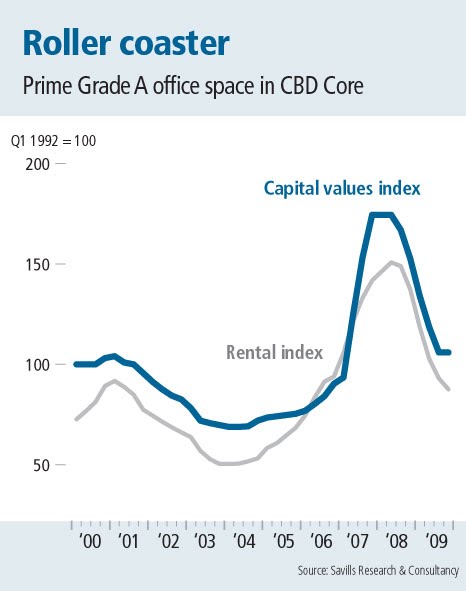
Subscribe to:
Posts (Atom)

 Posts
Posts


